

4.5 Mutes
175
The first composer to specify brass instrument mutes in a score appears to
have been Claudio Monteverdi (1567–1643). His opera Orfeo, first performed
in 1607, begins with a Toccata played by a group of instruments including a
trumpet ensemble. The original score, which is reproduced in Fig. 1.8b, includes
an instruction that if the trumpets are muted, the other accompanying instruments
must play a tone higher than the written notes. The implication is that the trumpet
mute in Monteverdi’s time was a transposing mute, raising the playing pitch of the
instrument by a whole tone.
It is to be expected that inserting an object into the bell of a brass instrument
will alter the resonant frequencies of the air column and therefore the playing
pitches of the instrument. The modern mutes described in the previous sections
are rendered non-transposing by the incorporation of a suitably chosen internal
cavity, an invention usually ascribed to the eighteenth-century horn player Anton
Joseph Hampel. The importance of this cavity can be readily verified by the simple
experiment of closing the open end of a straight mute with a cork. The pitches of
the natural notes from B 4 upwards are little affected by closing the internal cavity,
but the notes from F4 downwards are flattened by approximately a semitone.
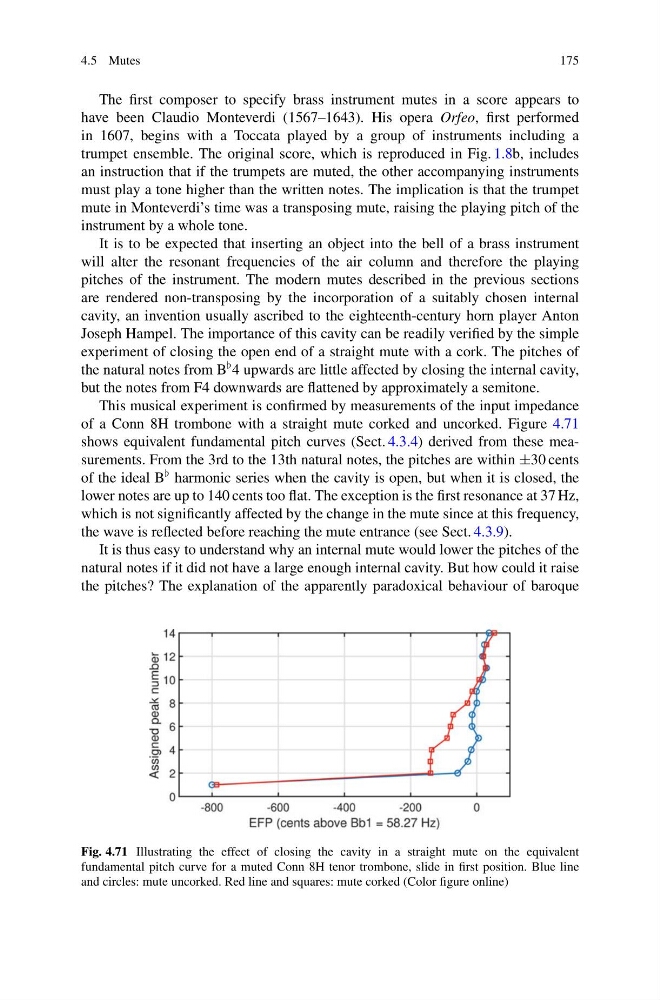
This musical experiment is confirmed by measurements of the input impedance
of a Conn 8H trombone with a straight mute corked and uncorked. Figure 4.71
shows equivalent fundamental pitch curves (Sect. 4.3.4) derived from these measurements. From the 3rd to the 13th natural notes, the pitches are within ±30 cents
of the ideal B harmonic series when the cavity is open, but when it is closed, the
lower notes are up to 140 cents too flat. The exception is the first resonance at 37 Hz,
which is not significantly affected by the change in the mute since at this frequency,
the wave is reflected before reaching the mute entrance (see Sect. 4.3.9).
It is thus easy to understand why an internal mute would lower the pitches of the
natural notes if it did not have a large enough internal cavity. But how could it raise
the pitches? The explanation of the apparently paradoxical behaviour of baroque
Fig. 4.71 Illustrating the effect of closing the cavity in a straight mute on the equivalent
fundamental pitch curve for a muted Conn 8H tenor trombone, slide in first position. Blue line
and circles: mute uncorked. Red line and squares: mute corked (Color figure online)
175
The first composer to specify brass instrument mutes in a score appears to
have been Claudio Monteverdi (1567–1643). His opera Orfeo, first performed
in 1607, begins with a Toccata played by a group of instruments including a
trumpet ensemble. The original score, which is reproduced in Fig. 1.8b, includes
an instruction that if the trumpets are muted, the other accompanying instruments
must play a tone higher than the written notes. The implication is that the trumpet
mute in Monteverdi’s time was a transposing mute, raising the playing pitch of the
instrument by a whole tone.
It is to be expected that inserting an object into the bell of a brass instrument
will alter the resonant frequencies of the air column and therefore the playing
pitches of the instrument. The modern mutes described in the previous sections
are rendered non-transposing by the incorporation of a suitably chosen internal
cavity, an invention usually ascribed to the eighteenth-century horn player Anton
Joseph Hampel. The importance of this cavity can be readily verified by the simple
experiment of closing the open end of a straight mute with a cork. The pitches of
the natural notes from B 4 upwards are little affected by closing the internal cavity,
but the notes from F4 downwards are flattened by approximately a semitone.
This musical experiment is confirmed by measurements of the input impedance
of a Conn 8H trombone with a straight mute corked and uncorked. Figure 4.71
shows equivalent fundamental pitch curves (Sect. 4.3.4) derived from these measurements. From the 3rd to the 13th natural notes, the pitches are within ±30 cents
of the ideal B harmonic series when the cavity is open, but when it is closed, the
lower notes are up to 140 cents too flat. The exception is the first resonance at 37 Hz,
which is not significantly affected by the change in the mute since at this frequency,
the wave is reflected before reaching the mute entrance (see Sect. 4.3.9).
It is thus easy to understand why an internal mute would lower the pitches of the
natural notes if it did not have a large enough internal cavity. But how could it raise
the pitches? The explanation of the apparently paradoxical behaviour of baroque
Fig. 4.71 Illustrating the effect of closing the cavity in a straight mute on the equivalent
fundamental pitch curve for a muted Conn 8H tenor trombone, slide in first position. Blue line
and circles: mute uncorked. Red line and squares: mute corked (Color figure online)