

174
4 After the Lips: Acoustic Resonances and Radiation
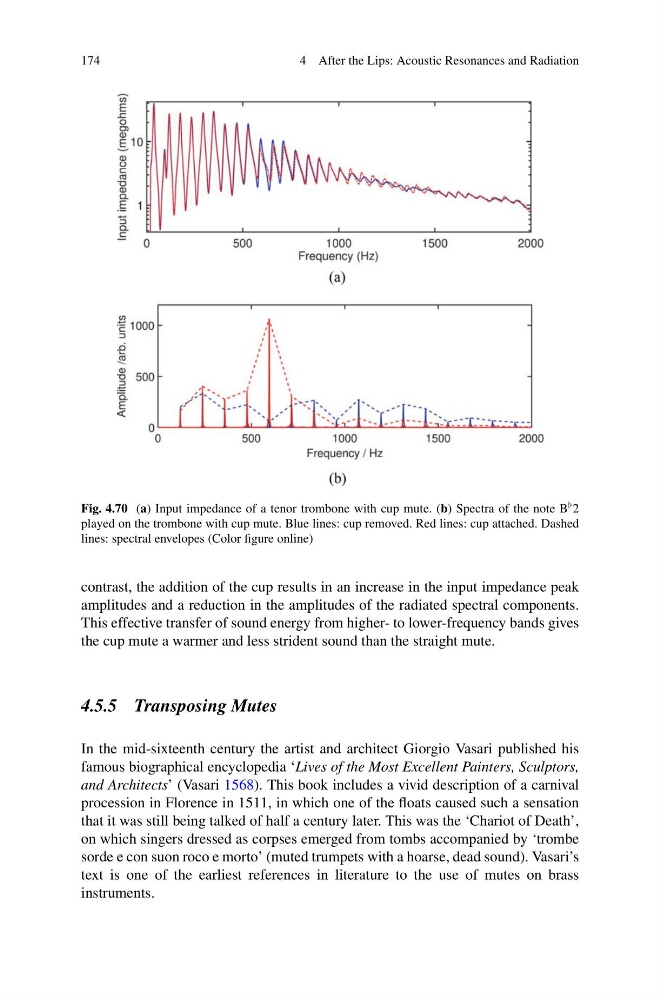
Fig. 4.70 (a) Input impedance of a tenor trombone with cup mute. (b) Spectra of the note B 2
played on the trombone with cup mute. Blue lines: cup removed. Red lines: cup attached. Dashed
lines: spectral envelopes (Color figure online)
contrast, the addition of the cup results in an increase in the input impedance peak
amplitudes and a reduction in the amplitudes of the radiated spectral components.
This effective transfer of sound energy from higher- to lower-frequency bands gives
the cup mute a warmer and less strident sound than the straight mute.
4.5.5 Transposing Mutes
In the mid-sixteenth century the artist and architect Giorgio Vasari published his
famous biographical encyclopedia ‘Lives of the Most Excellent Painters, Sculptors,
and Architects’ (Vasari 1568). This book includes a vivid description of a carnival
procession in Florence in 1511, in which one of the floats caused such a sensation
that it was still being talked of half a century later. This was the ‘Chariot of Death’,
on which singers dressed as corpses emerged from tombs accompanied by ‘trombe
sorde e con suon roco e morto’ (muted trumpets with a hoarse, dead sound). Vasari’s
text is one of the earliest references in literature to the use of mutes on brass
instruments.
4 After the Lips: Acoustic Resonances and Radiation
Fig. 4.70 (a) Input impedance of a tenor trombone with cup mute. (b) Spectra of the note B 2
played on the trombone with cup mute. Blue lines: cup removed. Red lines: cup attached. Dashed
lines: spectral envelopes (Color figure online)
contrast, the addition of the cup results in an increase in the input impedance peak
amplitudes and a reduction in the amplitudes of the radiated spectral components.
This effective transfer of sound energy from higher- to lower-frequency bands gives
the cup mute a warmer and less strident sound than the straight mute.
4.5.5 Transposing Mutes
In the mid-sixteenth century the artist and architect Giorgio Vasari published his
famous biographical encyclopedia ‘Lives of the Most Excellent Painters, Sculptors,
and Architects’ (Vasari 1568). This book includes a vivid description of a carnival
procession in Florence in 1511, in which one of the floats caused such a sensation
that it was still being talked of half a century later. This was the ‘Chariot of Death’,
on which singers dressed as corpses emerged from tombs accompanied by ‘trombe
sorde e con suon roco e morto’ (muted trumpets with a hoarse, dead sound). Vasari’s
text is one of the earliest references in literature to the use of mutes on brass
instruments.