

176
4 After the Lips: Acoustic Resonances and Radiation
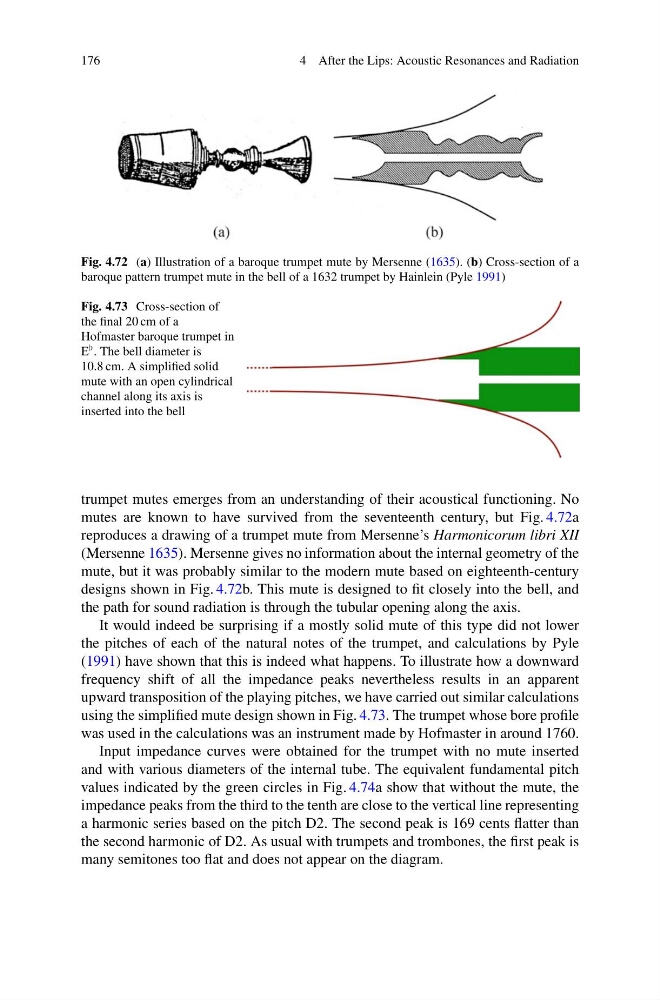
Fig. 4.72 (a) Illustration of a baroque trumpet mute by Mersenne (1635). (b) Cross-section of a
baroque pattern trumpet mute in the bell of a 1632 trumpet by Hainlein (Pyle 1991)
Fig. 4.73 Cross-section of
the final 20 cm of a
Hofmaster baroque trumpet in
E . The bell diameter is
10.8 cm. A simplified solid
mute with an open cylindrical
channel along its axis is
inserted into the bell
trumpet mutes emerges from an understanding of their acoustical functioning. No
mutes are known to have survived from the seventeenth century, but Fig. 4.72a
reproduces a drawing of a trumpet mute from Mersenne’s Harmonicorum libri XII
(Mersenne 1635). Mersenne gives no information about the internal geometry of the
mute, but it was probably similar to the modern mute based on eighteenth-century
designs shown in Fig. 4.72b. This mute is designed to fit closely into the bell, and
the path for sound radiation is through the tubular opening along the axis.
It would indeed be surprising if a mostly solid mute of this type did not lower
the pitches of each of the natural notes of the trumpet, and calculations by Pyle
(1991) have shown that this is indeed what happens. To illustrate how a downward
frequency shift of all the impedance peaks nevertheless results in an apparent
upward transposition of the playing pitches, we have carried out similar calculations
using the simplified mute design shown in Fig. 4.73. The trumpet whose bore profile
was used in the calculations was an instrument made by Hofmaster in around 1760.
Input impedance curves were obtained for the trumpet with no mute inserted
and with various diameters of the internal tube. The equivalent fundamental pitch
values indicated by the green circles in Fig. 4.74a show that without the mute, the
impedance peaks from the third to the tenth are close to the vertical line representing
a harmonic series based on the pitch D2. The second peak is 169 cents flatter than
the second harmonic of D2. As usual with trumpets and trombones, the first peak is
many semitones too flat and does not appear on the diagram.
4 After the Lips: Acoustic Resonances and Radiation
Fig. 4.72 (a) Illustration of a baroque trumpet mute by Mersenne (1635). (b) Cross-section of a
baroque pattern trumpet mute in the bell of a 1632 trumpet by Hainlein (Pyle 1991)
Fig. 4.73 Cross-section of
the final 20 cm of a
Hofmaster baroque trumpet in
E . The bell diameter is
10.8 cm. A simplified solid
mute with an open cylindrical
channel along its axis is
inserted into the bell
trumpet mutes emerges from an understanding of their acoustical functioning. No
mutes are known to have survived from the seventeenth century, but Fig. 4.72a
reproduces a drawing of a trumpet mute from Mersenne’s Harmonicorum libri XII
(Mersenne 1635). Mersenne gives no information about the internal geometry of the
mute, but it was probably similar to the modern mute based on eighteenth-century
designs shown in Fig. 4.72b. This mute is designed to fit closely into the bell, and
the path for sound radiation is through the tubular opening along the axis.
It would indeed be surprising if a mostly solid mute of this type did not lower
the pitches of each of the natural notes of the trumpet, and calculations by Pyle
(1991) have shown that this is indeed what happens. To illustrate how a downward
frequency shift of all the impedance peaks nevertheless results in an apparent
upward transposition of the playing pitches, we have carried out similar calculations
using the simplified mute design shown in Fig. 4.73. The trumpet whose bore profile
was used in the calculations was an instrument made by Hofmaster in around 1760.
Input impedance curves were obtained for the trumpet with no mute inserted
and with various diameters of the internal tube. The equivalent fundamental pitch
values indicated by the green circles in Fig. 4.74a show that without the mute, the
impedance peaks from the third to the tenth are close to the vertical line representing
a harmonic series based on the pitch D2. The second peak is 169 cents flatter than
the second harmonic of D2. As usual with trumpets and trombones, the first peak is
many semitones too flat and does not appear on the diagram.