

172
4 After the Lips: Acoustic Resonances and Radiation
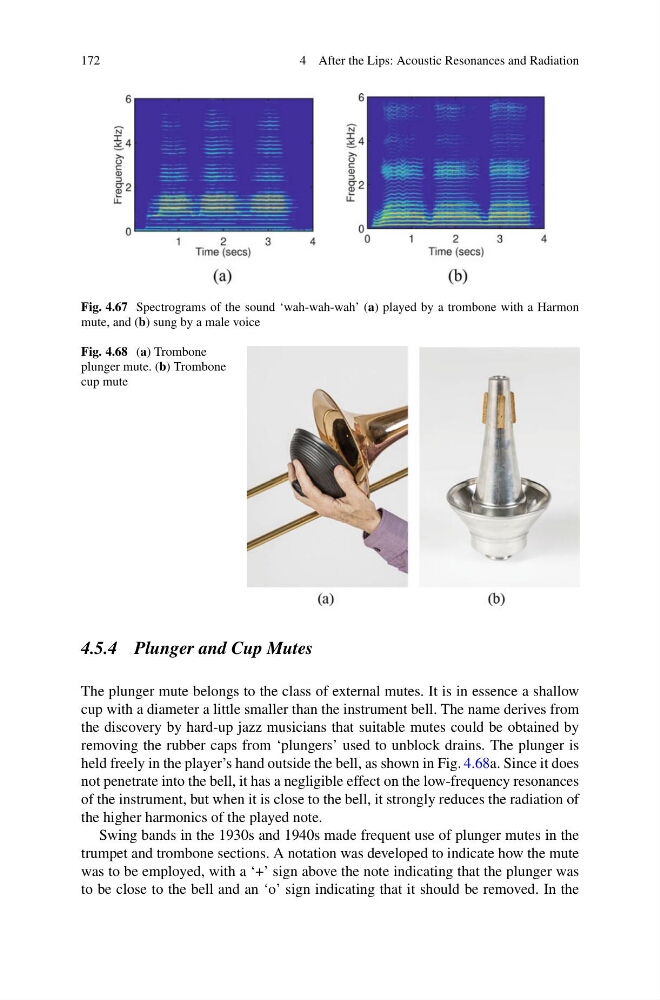
Fig. 4.67 Spectrograms of the sound ‘wah-wah-wah’ (a) played by a trombone with a Harmon
mute, and (b) sung by a male voice
Fig. 4.68 (a) Trombone
plunger mute. (b) Trombone
cup mute
4.5.4 Plunger and Cup Mutes
The plunger mute belongs to the class of external mutes. It is in essence a shallow
cup with a diameter a little smaller than the instrument bell. The name derives from
the discovery by hard-up jazz musicians that suitable mutes could be obtained by
removing the rubber caps from ‘plungers’ used to unblock drains. The plunger is
held freely in the player’s hand outside the bell, as shown in Fig. 4.68a. Since it does
not penetrate into the bell, it has a negligible effect on the low-frequency resonances
of the instrument, but when it is close to the bell, it strongly reduces the radiation of
the higher harmonics of the played note.
Swing bands in the 1930s and 1940s made frequent use of plunger mutes in the
trumpet and trombone sections. A notation was developed to indicate how the mute
was to be employed, with a ‘+’ sign above the note indicating that the plunger was
to be close to the bell and an ‘o’ sign indicating that it should be removed. In the
4 After the Lips: Acoustic Resonances and Radiation
Fig. 4.67 Spectrograms of the sound ‘wah-wah-wah’ (a) played by a trombone with a Harmon
mute, and (b) sung by a male voice
Fig. 4.68 (a) Trombone
plunger mute. (b) Trombone
cup mute
4.5.4 Plunger and Cup Mutes
The plunger mute belongs to the class of external mutes. It is in essence a shallow
cup with a diameter a little smaller than the instrument bell. The name derives from
the discovery by hard-up jazz musicians that suitable mutes could be obtained by
removing the rubber caps from ‘plungers’ used to unblock drains. The plunger is
held freely in the player’s hand outside the bell, as shown in Fig. 4.68a. Since it does
not penetrate into the bell, it has a negligible effect on the low-frequency resonances
of the instrument, but when it is close to the bell, it strongly reduces the radiation of
the higher harmonics of the played note.
Swing bands in the 1930s and 1940s made frequent use of plunger mutes in the
trumpet and trombone sections. A notation was developed to indicate how the mute
was to be employed, with a ‘+’ sign above the note indicating that the plunger was
to be close to the bell and an ‘o’ sign indicating that it should be removed. In the