

4.5 Mutes
171
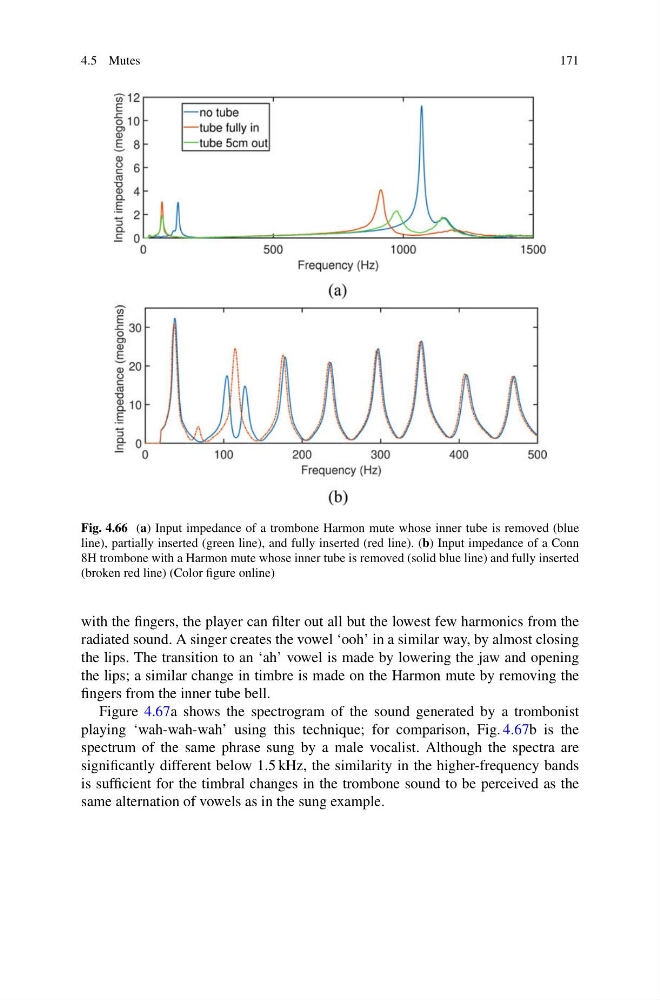
Fig. 4.66 (a) Input impedance of a trombone Harmon mute whose inner tube is removed (blue
line), partially inserted (green line), and fully inserted (red line). (b) Input impedance of a Conn
8H trombone with a Harmon mute whose inner tube is removed (solid blue line) and fully inserted
(broken red line) (Color figure online)
with the fingers, the player can filter out all but the lowest few harmonics from the
radiated sound. A singer creates the vowel ‘ooh’ in a similar way, by almost closing
the lips. The transition to an ‘ah’ vowel is made by lowering the jaw and opening
the lips; a similar change in timbre is made on the Harmon mute by removing the
fingers from the inner tube bell.
Figure 4.67a shows the spectrogram of the sound generated by a trombonist
playing ‘wah-wah-wah’ using this technique; for comparison, Fig. 4.67b is the
spectrum of the same phrase sung by a male vocalist. Although the spectra are
significantly different below 1.5 kHz, the similarity in the higher-frequency bands
is sufficient for the timbral changes in the trombone sound to be perceived as the
same alternation of vowels as in the sung example.
171
Fig. 4.66 (a) Input impedance of a trombone Harmon mute whose inner tube is removed (blue
line), partially inserted (green line), and fully inserted (red line). (b) Input impedance of a Conn
8H trombone with a Harmon mute whose inner tube is removed (solid blue line) and fully inserted
(broken red line) (Color figure online)
with the fingers, the player can filter out all but the lowest few harmonics from the
radiated sound. A singer creates the vowel ‘ooh’ in a similar way, by almost closing
the lips. The transition to an ‘ah’ vowel is made by lowering the jaw and opening
the lips; a similar change in timbre is made on the Harmon mute by removing the
fingers from the inner tube bell.
Figure 4.67a shows the spectrogram of the sound generated by a trombonist
playing ‘wah-wah-wah’ using this technique; for comparison, Fig. 4.67b is the
spectrum of the same phrase sung by a male vocalist. Although the spectra are
significantly different below 1.5 kHz, the similarity in the higher-frequency bands
is sufficient for the timbral changes in the trombone sound to be perceived as the
same alternation of vowels as in the sung example.