

170
4 After the Lips: Acoustic Resonances and Radiation
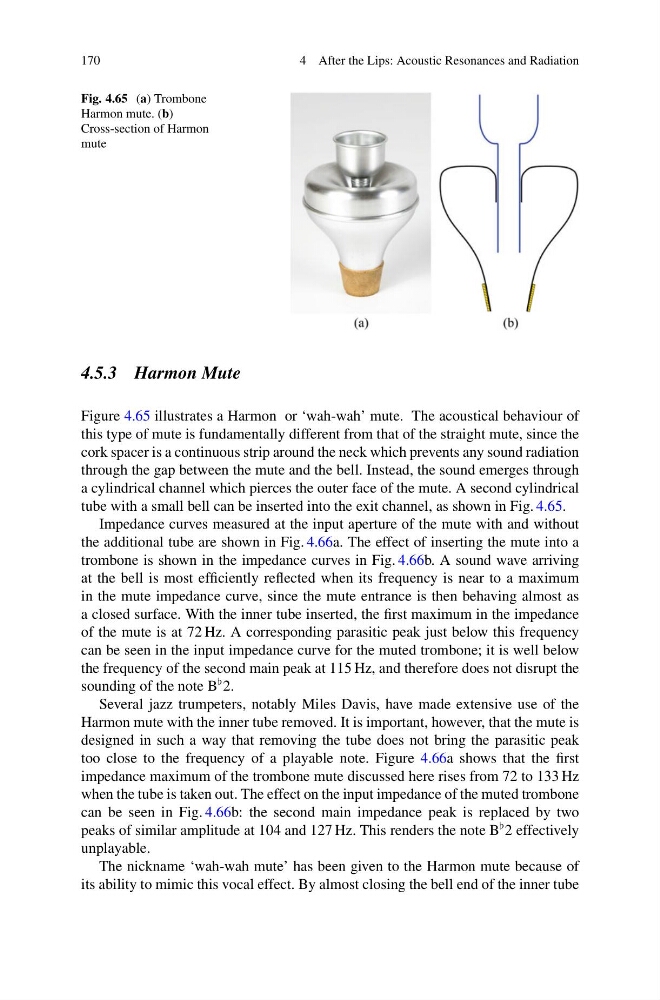
Fig. 4.65 (a) Trombone
Harmon mute. (b)
Cross-section of Harmon
mute
4.5.3 Harmon Mute
Figure 4.65 illustrates a Harmon or ‘wah-wah’ mute. The acoustical behaviour of
this type of mute is fundamentally different from that of the straight mute, since the
cork spacer is a continuous strip around the neck which prevents any sound radiation
through the gap between the mute and the bell. Instead, the sound emerges through
a cylindrical channel which pierces the outer face of the mute. A second cylindrical
tube with a small bell can be inserted into the exit channel, as shown in Fig. 4.65.
Impedance curves measured at the input aperture of the mute with and without
the additional tube are shown in Fig. 4.66a. The effect of inserting the mute into a
trombone is shown in the impedance curves in Fig. 4.66b. A sound wave arriving
at the bell is most efficiently reflected when its frequency is near to a maximum
in the mute impedance curve, since the mute entrance is then behaving almost as
a closed surface. With the inner tube inserted, the first maximum in the impedance
of the mute is at 72 Hz. A corresponding parasitic peak just below this frequency
can be seen in the input impedance curve for the muted trombone; it is well below
the frequency of the second main peak at 115 Hz, and therefore does not disrupt the
sounding of the note B 2.
Several jazz trumpeters, notably Miles Davis, have made extensive use of the
Harmon mute with the inner tube removed. It is important, however, that the mute is
designed in such a way that removing the tube does not bring the parasitic peak
too close to the frequency of a playable note. Figure 4.66a shows that the first
impedance maximum of the trombone mute discussed here rises from 72 to 133 Hz
when the tube is taken out. The effect on the input impedance of the muted trombone
can be seen in Fig. 4.66b: the second main impedance peak is replaced by two
peaks of similar amplitude at 104 and 127 Hz. This renders the note B 2 effectively
unplayable.
The nickname ‘wah-wah mute’ has been given to the Harmon mute because of
its ability to mimic this vocal effect. By almost closing the bell end of the inner tube
4 After the Lips: Acoustic Resonances and Radiation
Fig. 4.65 (a) Trombone
Harmon mute. (b)
Cross-section of Harmon
mute
4.5.3 Harmon Mute
Figure 4.65 illustrates a Harmon or ‘wah-wah’ mute. The acoustical behaviour of
this type of mute is fundamentally different from that of the straight mute, since the
cork spacer is a continuous strip around the neck which prevents any sound radiation
through the gap between the mute and the bell. Instead, the sound emerges through
a cylindrical channel which pierces the outer face of the mute. A second cylindrical
tube with a small bell can be inserted into the exit channel, as shown in Fig. 4.65.
Impedance curves measured at the input aperture of the mute with and without
the additional tube are shown in Fig. 4.66a. The effect of inserting the mute into a
trombone is shown in the impedance curves in Fig. 4.66b. A sound wave arriving
at the bell is most efficiently reflected when its frequency is near to a maximum
in the mute impedance curve, since the mute entrance is then behaving almost as
a closed surface. With the inner tube inserted, the first maximum in the impedance
of the mute is at 72 Hz. A corresponding parasitic peak just below this frequency
can be seen in the input impedance curve for the muted trombone; it is well below
the frequency of the second main peak at 115 Hz, and therefore does not disrupt the
sounding of the note B 2.
Several jazz trumpeters, notably Miles Davis, have made extensive use of the
Harmon mute with the inner tube removed. It is important, however, that the mute is
designed in such a way that removing the tube does not bring the parasitic peak
too close to the frequency of a playable note. Figure 4.66a shows that the first
impedance maximum of the trombone mute discussed here rises from 72 to 133 Hz
when the tube is taken out. The effect on the input impedance of the muted trombone
can be seen in Fig. 4.66b: the second main impedance peak is replaced by two
peaks of similar amplitude at 104 and 127 Hz. This renders the note B 2 effectively
unplayable.
The nickname ‘wah-wah mute’ has been given to the Harmon mute because of
its ability to mimic this vocal effect. By almost closing the bell end of the inner tube