

162
4 After the Lips: Acoustic Resonances and Radiation
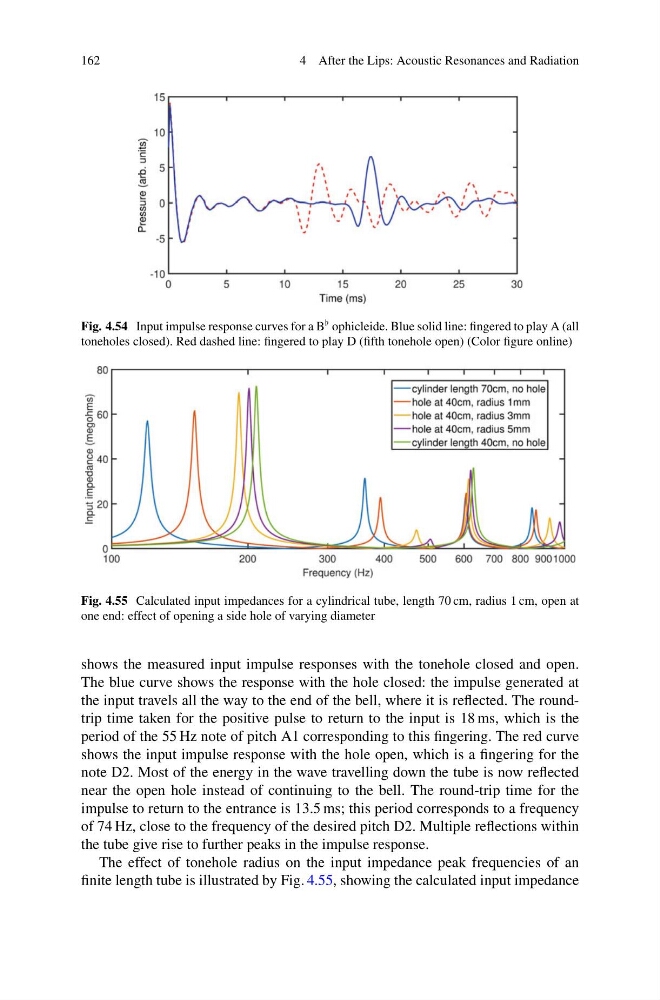
Fig. 4.54 Input impulse response curves for a B ophicleide. Blue solid line: fingered to play A (all
toneholes closed). Red dashed line: fingered to play D (fifth tonehole open) (Color figure online)
Fig. 4.55 Calculated input impedances for a cylindrical tube, length 70 cm, radius 1 cm, open at
one end: effect of opening a side hole of varying diameter
shows the measured input impulse responses with the tonehole closed and open.
The blue curve shows the response with the hole closed: the impulse generated at
the input travels all the way to the end of the bell, where it is reflected. The roundtrip time taken for the positive pulse to return to the input is 18 ms, which is the
period of the 55 Hz note of pitch A1 corresponding to this fingering. The red curve
shows the input impulse response with the hole open, which is a fingering for the
note D2. Most of the energy in the wave travelling down the tube is now reflected
near the open hole instead of continuing to the bell. The round-trip time for the
impulse to return to the entrance is 13.5 ms; this period corresponds to a frequency
of 74 Hz, close to the frequency of the desired pitch D2. Multiple reflections within
the tube give rise to further peaks in the impulse response.
The effect of tonehole radius on the input impedance peak frequencies of an
finite length tube is illustrated by Fig. 4.55, showing the calculated input impedance
4 After the Lips: Acoustic Resonances and Radiation
Fig. 4.54 Input impulse response curves for a B ophicleide. Blue solid line: fingered to play A (all
toneholes closed). Red dashed line: fingered to play D (fifth tonehole open) (Color figure online)
Fig. 4.55 Calculated input impedances for a cylindrical tube, length 70 cm, radius 1 cm, open at
one end: effect of opening a side hole of varying diameter
shows the measured input impulse responses with the tonehole closed and open.
The blue curve shows the response with the hole closed: the impulse generated at
the input travels all the way to the end of the bell, where it is reflected. The roundtrip time taken for the positive pulse to return to the input is 18 ms, which is the
period of the 55 Hz note of pitch A1 corresponding to this fingering. The red curve
shows the input impulse response with the hole open, which is a fingering for the
note D2. Most of the energy in the wave travelling down the tube is now reflected
near the open hole instead of continuing to the bell. The round-trip time for the
impulse to return to the entrance is 13.5 ms; this period corresponds to a frequency
of 74 Hz, close to the frequency of the desired pitch D2. Multiple reflections within
the tube give rise to further peaks in the impulse response.
The effect of tonehole radius on the input impedance peak frequencies of an
finite length tube is illustrated by Fig. 4.55, showing the calculated input impedance