

4.4 Toneholes
161
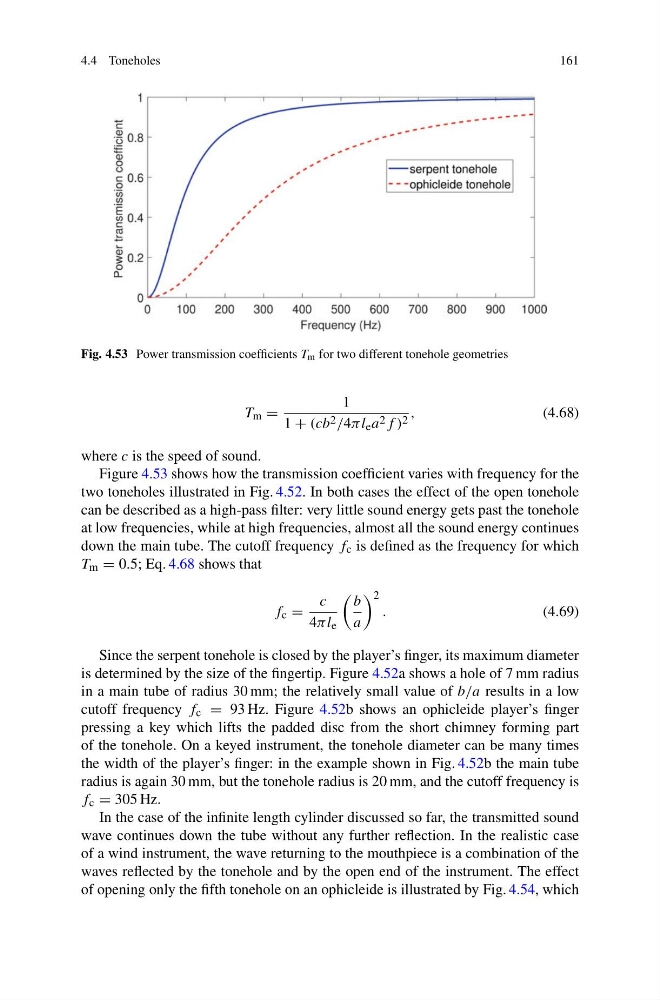
Fig. 4.53 Power transmission coefficients T m for two different tonehole geometries
T m =
1
1 + (cb 2 /4πl e a 2 f ) 2 ,
(4.68)
where c is the speed of sound.
Figure 4.53 shows how the transmission coefficient varies with frequency for the
two toneholes illustrated in Fig. 4.52. In both cases the effect of the open tonehole
can be described as a high-pass filter: very little sound energy gets past the tonehole
at low frequencies, while at high frequencies, almost all the sound energy continues
down the main tube. The cutoff frequency f c is defined as the frequency for which
T m = 0.5; Eq. 4.68 shows that
f c =
c
4πl e
b
a
2
.
(4.69)
Since the serpent tonehole is closed by the player’s finger, its maximum diameter
is determined by the size of the fingertip. Figure 4.52a shows a hole of 7 mm radius
in a main tube of radius 30 mm; the relatively small value of b/a results in a low
cutoff frequency f c = 93 Hz. Figure 4.52b shows an ophicleide player’s finger
pressing a key which lifts the padded disc from the short chimney forming part
of the tonehole. On a keyed instrument, the tonehole diameter can be many times
the width of the player’s finger: in the example shown in Fig. 4.52b the main tube
radius is again 30 mm, but the tonehole radius is 20 mm, and the cutoff frequency is
f c = 305 Hz.
In the case of the infinite length cylinder discussed so far, the transmitted sound
wave continues down the tube without any further reflection. In the realistic case
of a wind instrument, the wave returning to the mouthpiece is a combination of the
waves reflected by the tonehole and by the open end of the instrument. The effect
of opening only the fifth tonehole on an ophicleide is illustrated by Fig. 4.54, which
161
Fig. 4.53 Power transmission coefficients T m for two different tonehole geometries
T m =
1
1 + (cb 2 /4πl e a 2 f ) 2 ,
(4.68)
where c is the speed of sound.
Figure 4.53 shows how the transmission coefficient varies with frequency for the
two toneholes illustrated in Fig. 4.52. In both cases the effect of the open tonehole
can be described as a high-pass filter: very little sound energy gets past the tonehole
at low frequencies, while at high frequencies, almost all the sound energy continues
down the main tube. The cutoff frequency f c is defined as the frequency for which
T m = 0.5; Eq. 4.68 shows that
f c =
c
4πl e
b
a
2
.
(4.69)
Since the serpent tonehole is closed by the player’s finger, its maximum diameter
is determined by the size of the fingertip. Figure 4.52a shows a hole of 7 mm radius
in a main tube of radius 30 mm; the relatively small value of b/a results in a low
cutoff frequency f c = 93 Hz. Figure 4.52b shows an ophicleide player’s finger
pressing a key which lifts the padded disc from the short chimney forming part
of the tonehole. On a keyed instrument, the tonehole diameter can be many times
the width of the player’s finger: in the example shown in Fig. 4.52b the main tube
radius is again 30 mm, but the tonehole radius is 20 mm, and the cutoff frequency is
f c = 305 Hz.
In the case of the infinite length cylinder discussed so far, the transmitted sound
wave continues down the tube without any further reflection. In the realistic case
of a wind instrument, the wave returning to the mouthpiece is a combination of the
waves reflected by the tonehole and by the open end of the instrument. The effect
of opening only the fifth tonehole on an ophicleide is illustrated by Fig. 4.54, which