

4.4 Toneholes
163
for a simple cylinder of length 70 cm and radius 1 cm, open at the output end and
having a single tonehole centred at a point 40 cm from the input end. The blue curve
shows the impedance in the absence of a hole. As expected for a tube of this length,
the first resonance has a frequency close to 120 Hz, while the second peak has a
frequency near 360 Hz, three times that of the first. Opening a tonehole with radius
0.5 cm, half that of the main bore, moves the first resonance up to 201 Hz: this is
quite close to 208 Hz, the frequency of the first resonance of a cylinder of 40 cm
shown by the green curve. The other curves show the input impedance for holes of
smaller diameter at the same position. Opening a hole of radius 0.1 cm raises the
first resonance peak to only 152 Hz. The higher-frequency resonance peaks display
a much less regular behaviour; above the cutoff frequency, the sound wave continues
to propagate past the hole, and resonances of the complete tube and the lower section
are mixed with those of the upper section.
Most brass instruments with toneholes have bores which are closer to cones than
cylinders. To illustrate the effect of opening a side hole in an approximately conical
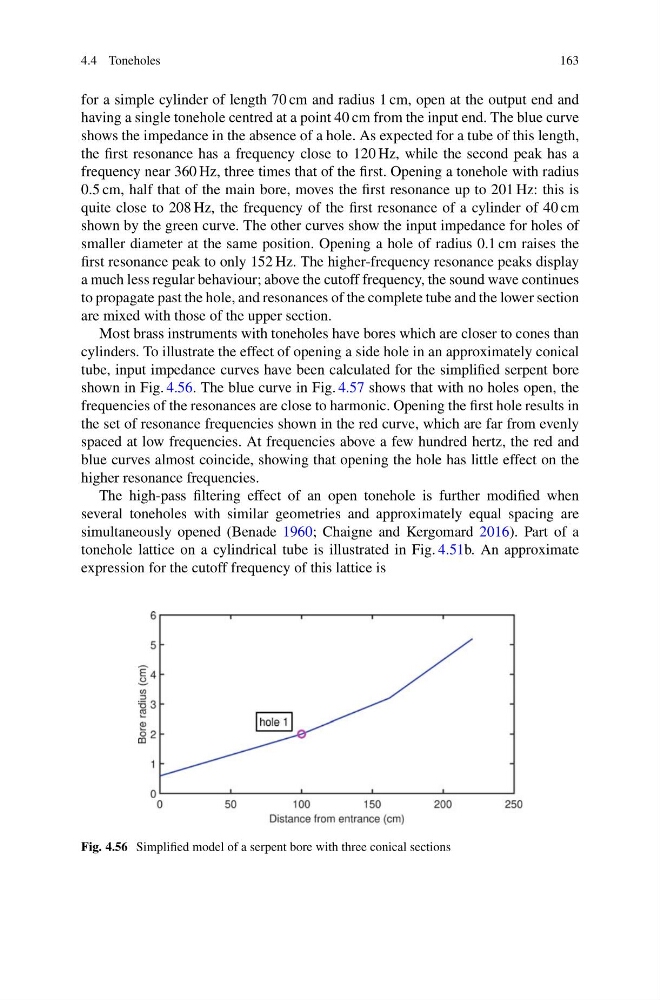
tube, input impedance curves have been calculated for the simplified serpent bore
shown in Fig. 4.56. The blue curve in Fig. 4.57 shows that with no holes open, the
frequencies of the resonances are close to harmonic. Opening the first hole results in
the set of resonance frequencies shown in the red curve, which are far from evenly
spaced at low frequencies. At frequencies above a few hundred hertz, the red and
blue curves almost coincide, showing that opening the hole has little effect on the
higher resonance frequencies.
The high-pass filtering effect of an open tonehole is further modified when
several toneholes with similar geometries and approximately equal spacing are
simultaneously opened (Benade 1960; Chaigne and Kergomard 2016). Part of a
tonehole lattice on a cylindrical tube is illustrated in Fig. 4.51b. An approximate
expression for the cutoff frequency of this lattice is
Fig. 4.56 Simplified model of a serpent bore with three conical sections
163
for a simple cylinder of length 70 cm and radius 1 cm, open at the output end and
having a single tonehole centred at a point 40 cm from the input end. The blue curve
shows the impedance in the absence of a hole. As expected for a tube of this length,
the first resonance has a frequency close to 120 Hz, while the second peak has a
frequency near 360 Hz, three times that of the first. Opening a tonehole with radius
0.5 cm, half that of the main bore, moves the first resonance up to 201 Hz: this is
quite close to 208 Hz, the frequency of the first resonance of a cylinder of 40 cm
shown by the green curve. The other curves show the input impedance for holes of
smaller diameter at the same position. Opening a hole of radius 0.1 cm raises the
first resonance peak to only 152 Hz. The higher-frequency resonance peaks display
a much less regular behaviour; above the cutoff frequency, the sound wave continues
to propagate past the hole, and resonances of the complete tube and the lower section
are mixed with those of the upper section.
Most brass instruments with toneholes have bores which are closer to cones than
cylinders. To illustrate the effect of opening a side hole in an approximately conical
tube, input impedance curves have been calculated for the simplified serpent bore
shown in Fig. 4.56. The blue curve in Fig. 4.57 shows that with no holes open, the
frequencies of the resonances are close to harmonic. Opening the first hole results in
the set of resonance frequencies shown in the red curve, which are far from evenly
spaced at low frequencies. At frequencies above a few hundred hertz, the red and
blue curves almost coincide, showing that opening the hole has little effect on the
higher resonance frequencies.
The high-pass filtering effect of an open tonehole is further modified when
several toneholes with similar geometries and approximately equal spacing are
simultaneously opened (Benade 1960; Chaigne and Kergomard 2016). Part of a
tonehole lattice on a cylindrical tube is illustrated in Fig. 4.51b. An approximate
expression for the cutoff frequency of this lattice is
Fig. 4.56 Simplified model of a serpent bore with three conical sections