

4.3 Bore Profiles of Brass Instruments
155
sound the notes corresponding to the first few modes of the bell section by buzzing
the lips against the tube entrance. The first mode has a pitch around D 3, but
the higher modes are obviously too sharp to be true harmonics of this pitch. The
trombone mouthpiece can be inserted in the bell section entrance if the stem is
wrapped with paper or tape, and the notes sounded with the mouthpiece are audibly
closer to true harmonics.
4.3.9 A Practical Example: The Complete Trombone
How well does the foregoing theoretical discussion describe the behaviour of a real
brass instrument? As a practical example, we take the Conn 8H trombone whose
separate components have been discussed earlier. An experimentally measured input
impedance curve for this instrument, with the slide in first position (fully retracted),
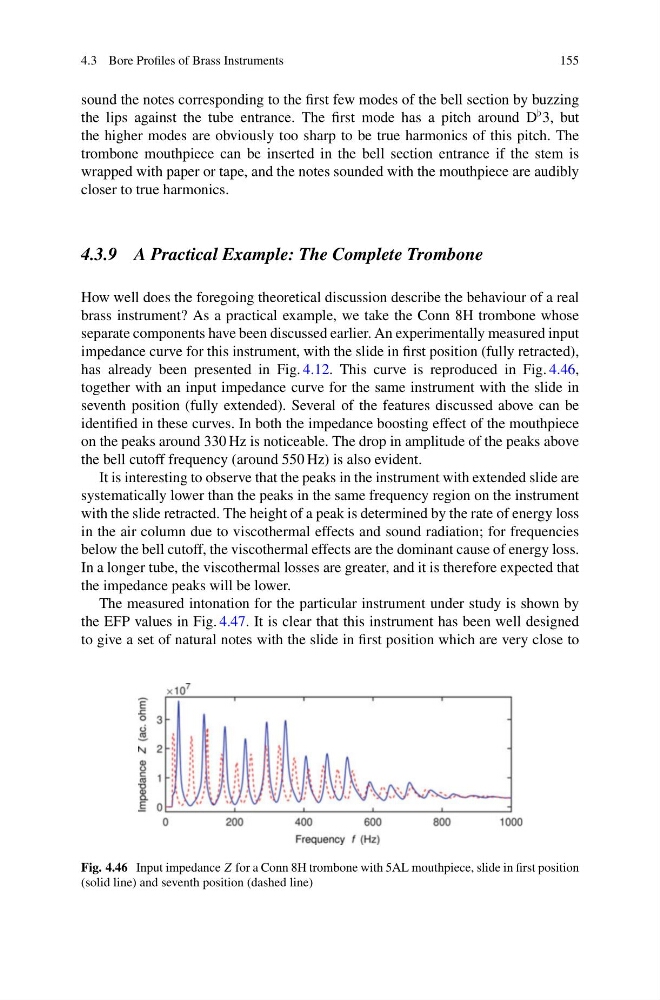
has already been presented in Fig. 4.12. This curve is reproduced in Fig. 4.46,
together with an input impedance curve for the same instrument with the slide in
seventh position (fully extended). Several of the features discussed above can be
identified in these curves. In both the impedance boosting effect of the mouthpiece
on the peaks around 330 Hz is noticeable. The drop in amplitude of the peaks above
the bell cutoff frequency (around 550 Hz) is also evident.
It is interesting to observe that the peaks in the instrument with extended slide are
systematically lower than the peaks in the same frequency region on the instrument
with the slide retracted. The height of a peak is determined by the rate of energy loss
in the air column due to viscothermal effects and sound radiation; for frequencies
below the bell cutoff, the viscothermal effects are the dominant cause of energy loss.
In a longer tube, the viscothermal losses are greater, and it is therefore expected that
the impedance peaks will be lower.
The measured intonation for the particular instrument under study is shown by
the EFP values in Fig. 4.47. It is clear that this instrument has been well designed
to give a set of natural notes with the slide in first position which are very close to
Fig. 4.46 Input impedance Z for a Conn 8H trombone with 5AL mouthpiece, slide in first position
(solid line) and seventh position (dashed line)
155
sound the notes corresponding to the first few modes of the bell section by buzzing
the lips against the tube entrance. The first mode has a pitch around D 3, but
the higher modes are obviously too sharp to be true harmonics of this pitch. The
trombone mouthpiece can be inserted in the bell section entrance if the stem is
wrapped with paper or tape, and the notes sounded with the mouthpiece are audibly
closer to true harmonics.
4.3.9 A Practical Example: The Complete Trombone
How well does the foregoing theoretical discussion describe the behaviour of a real
brass instrument? As a practical example, we take the Conn 8H trombone whose
separate components have been discussed earlier. An experimentally measured input
impedance curve for this instrument, with the slide in first position (fully retracted),
has already been presented in Fig. 4.12. This curve is reproduced in Fig. 4.46,
together with an input impedance curve for the same instrument with the slide in
seventh position (fully extended). Several of the features discussed above can be
identified in these curves. In both the impedance boosting effect of the mouthpiece
on the peaks around 330 Hz is noticeable. The drop in amplitude of the peaks above
the bell cutoff frequency (around 550 Hz) is also evident.
It is interesting to observe that the peaks in the instrument with extended slide are
systematically lower than the peaks in the same frequency region on the instrument
with the slide retracted. The height of a peak is determined by the rate of energy loss
in the air column due to viscothermal effects and sound radiation; for frequencies
below the bell cutoff, the viscothermal effects are the dominant cause of energy loss.
In a longer tube, the viscothermal losses are greater, and it is therefore expected that
the impedance peaks will be lower.
The measured intonation for the particular instrument under study is shown by
the EFP values in Fig. 4.47. It is clear that this instrument has been well designed
to give a set of natural notes with the slide in first position which are very close to
Fig. 4.46 Input impedance Z for a Conn 8H trombone with 5AL mouthpiece, slide in first position
(solid line) and seventh position (dashed line)