

156
4 After the Lips: Acoustic Resonances and Radiation
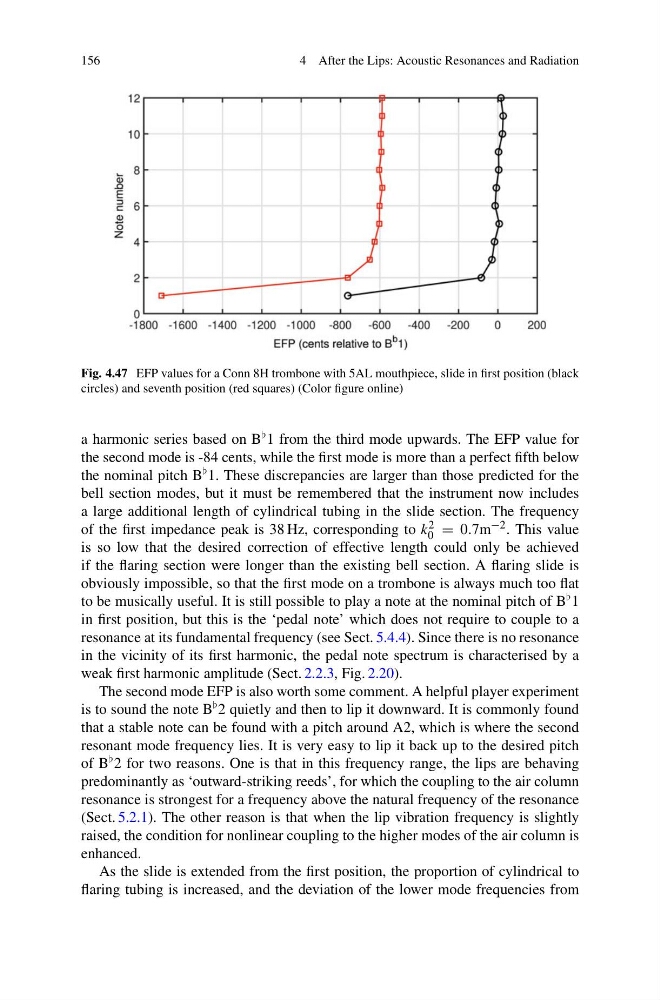
Fig. 4.47 EFP values for a Conn 8H trombone with 5AL mouthpiece, slide in first position (black
circles) and seventh position (red squares) (Color figure online)
a harmonic series based on B 1 from the third mode upwards. The EFP value for
the second mode is -84 cents, while the first mode is more than a perfect fifth below
the nominal pitch B 1. These discrepancies are larger than those predicted for the
bell section modes, but it must be remembered that the instrument now includes
a large additional length of cylindrical tubing in the slide section. The frequency
of the first impedance peak is 38 Hz, corresponding to k 2
0 = 0.7m −2 . This value
is so low that the desired correction of effective length could only be achieved
if the flaring section were longer than the existing bell section. A flaring slide is
obviously impossible, so that the first mode on a trombone is always much too flat
to be musically useful. It is still possible to play a note at the nominal pitch of B 1
in first position, but this is the ‘pedal note’ which does not require to couple to a
resonance at its fundamental frequency (see Sect. 5.4.4). Since there is no resonance
in the vicinity of its first harmonic, the pedal note spectrum is characterised by a
weak first harmonic amplitude (Sect. 2.2.3, Fig. 2.20).
The second mode EFP is also worth some comment. A helpful player experiment
is to sound the note B 2 quietly and then to lip it downward. It is commonly found
that a stable note can be found with a pitch around A2, which is where the second
resonant mode frequency lies. It is very easy to lip it back up to the desired pitch
of B 2 for two reasons. One is that in this frequency range, the lips are behaving
predominantly as ‘outward-striking reeds’, for which the coupling to the air column
resonance is strongest for a frequency above the natural frequency of the resonance
(Sect. 5.2.1). The other reason is that when the lip vibration frequency is slightly
raised, the condition for nonlinear coupling to the higher modes of the air column is
enhanced.
As the slide is extended from the first position, the proportion of cylindrical to
flaring tubing is increased, and the deviation of the lower mode frequencies from
4 After the Lips: Acoustic Resonances and Radiation
Fig. 4.47 EFP values for a Conn 8H trombone with 5AL mouthpiece, slide in first position (black
circles) and seventh position (red squares) (Color figure online)
a harmonic series based on B 1 from the third mode upwards. The EFP value for
the second mode is -84 cents, while the first mode is more than a perfect fifth below
the nominal pitch B 1. These discrepancies are larger than those predicted for the
bell section modes, but it must be remembered that the instrument now includes
a large additional length of cylindrical tubing in the slide section. The frequency
of the first impedance peak is 38 Hz, corresponding to k 2
0 = 0.7m −2 . This value
is so low that the desired correction of effective length could only be achieved
if the flaring section were longer than the existing bell section. A flaring slide is
obviously impossible, so that the first mode on a trombone is always much too flat
to be musically useful. It is still possible to play a note at the nominal pitch of B 1
in first position, but this is the ‘pedal note’ which does not require to couple to a
resonance at its fundamental frequency (see Sect. 5.4.4). Since there is no resonance
in the vicinity of its first harmonic, the pedal note spectrum is characterised by a
weak first harmonic amplitude (Sect. 2.2.3, Fig. 2.20).
The second mode EFP is also worth some comment. A helpful player experiment
is to sound the note B 2 quietly and then to lip it downward. It is commonly found
that a stable note can be found with a pitch around A2, which is where the second
resonant mode frequency lies. It is very easy to lip it back up to the desired pitch
of B 2 for two reasons. One is that in this frequency range, the lips are behaving
predominantly as ‘outward-striking reeds’, for which the coupling to the air column
resonance is strongest for a frequency above the natural frequency of the resonance
(Sect. 5.2.1). The other reason is that when the lip vibration frequency is slightly
raised, the condition for nonlinear coupling to the higher modes of the air column is
enhanced.
As the slide is extended from the first position, the proportion of cylindrical to
flaring tubing is increased, and the deviation of the lower mode frequencies from