

154
4 After the Lips: Acoustic Resonances and Radiation
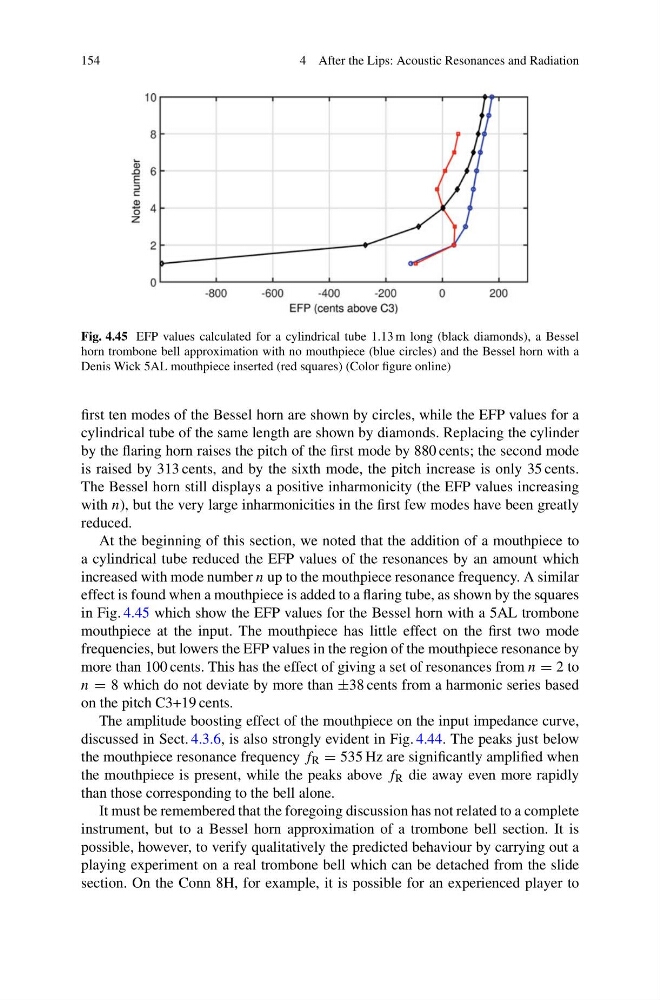
Fig. 4.45 EFP values calculated for a cylindrical tube 1.13 m long (black diamonds), a Bessel
horn trombone bell approximation with no mouthpiece (blue circles) and the Bessel horn with a
Denis Wick 5AL mouthpiece inserted (red squares) (Color figure online)
first ten modes of the Bessel horn are shown by circles, while the EFP values for a
cylindrical tube of the same length are shown by diamonds. Replacing the cylinder
by the flaring horn raises the pitch of the first mode by 880 cents; the second mode
is raised by 313 cents, and by the sixth mode, the pitch increase is only 35 cents.
The Bessel horn still displays a positive inharmonicity (the EFP values increasing
with n), but the very large inharmonicities in the first few modes have been greatly
reduced.
At the beginning of this section, we noted that the addition of a mouthpiece to
a cylindrical tube reduced the EFP values of the resonances by an amount which
increased with mode number n up to the mouthpiece resonance frequency. A similar
effect is found when a mouthpiece is added to a flaring tube, as shown by the squares
in Fig. 4.45 which show the EFP values for the Bessel horn with a 5AL trombone
mouthpiece at the input. The mouthpiece has little effect on the first two mode
frequencies, but lowers the EFP values in the region of the mouthpiece resonance by
more than 100 cents. This has the effect of giving a set of resonances from n = 2 to
n = 8 which do not deviate by more than ±38 cents from a harmonic series based
on the pitch C3+19 cents.
The amplitude boosting effect of the mouthpiece on the input impedance curve,
discussed in Sect. 4.3.6, is also strongly evident in Fig. 4.44. The peaks just below
the mouthpiece resonance frequency f R = 535 Hz are significantly amplified when
the mouthpiece is present, while the peaks above f R die away even more rapidly
than those corresponding to the bell alone.
It must be remembered that the foregoing discussion has not related to a complete
instrument, but to a Bessel horn approximation of a trombone bell section. It is
possible, however, to verify qualitatively the predicted behaviour by carrying out a
playing experiment on a real trombone bell which can be detached from the slide
section. On the Conn 8H, for example, it is possible for an experienced player to
4 After the Lips: Acoustic Resonances and Radiation
Fig. 4.45 EFP values calculated for a cylindrical tube 1.13 m long (black diamonds), a Bessel
horn trombone bell approximation with no mouthpiece (blue circles) and the Bessel horn with a
Denis Wick 5AL mouthpiece inserted (red squares) (Color figure online)
first ten modes of the Bessel horn are shown by circles, while the EFP values for a
cylindrical tube of the same length are shown by diamonds. Replacing the cylinder
by the flaring horn raises the pitch of the first mode by 880 cents; the second mode
is raised by 313 cents, and by the sixth mode, the pitch increase is only 35 cents.
The Bessel horn still displays a positive inharmonicity (the EFP values increasing
with n), but the very large inharmonicities in the first few modes have been greatly
reduced.
At the beginning of this section, we noted that the addition of a mouthpiece to
a cylindrical tube reduced the EFP values of the resonances by an amount which
increased with mode number n up to the mouthpiece resonance frequency. A similar
effect is found when a mouthpiece is added to a flaring tube, as shown by the squares
in Fig. 4.45 which show the EFP values for the Bessel horn with a 5AL trombone
mouthpiece at the input. The mouthpiece has little effect on the first two mode
frequencies, but lowers the EFP values in the region of the mouthpiece resonance by
more than 100 cents. This has the effect of giving a set of resonances from n = 2 to
n = 8 which do not deviate by more than ±38 cents from a harmonic series based
on the pitch C3+19 cents.
The amplitude boosting effect of the mouthpiece on the input impedance curve,
discussed in Sect. 4.3.6, is also strongly evident in Fig. 4.44. The peaks just below
the mouthpiece resonance frequency f R = 535 Hz are significantly amplified when
the mouthpiece is present, while the peaks above f R die away even more rapidly
than those corresponding to the bell alone.
It must be remembered that the foregoing discussion has not related to a complete
instrument, but to a Bessel horn approximation of a trombone bell section. It is
possible, however, to verify qualitatively the predicted behaviour by carrying out a
playing experiment on a real trombone bell which can be detached from the slide
section. On the Conn 8H, for example, it is possible for an experienced player to