

142
4 After the Lips: Acoustic Resonances and Radiation
The solution of Eq. 4.50 is a sinusoidal displacement with frequency f R =
ω/2π . The corresponding pressure change is also sinusoidal, as we found with the
experiment in blowing across a bottle in Sect. 4.1.1. From Eq. 4.51 the resonance
frequency is
f R =
c
2π
S
V L
1/2
.
(4.53)
4.3.6 Mouthpiece Effects on Intonation and Timbre
There are clearly serious limitations in applying this simplified model to a realistic
brass instrument mouthpiece: since the throat is not a short cylinder but a relatively
long tapering backbore, it is not obvious what value of L would be appropriate to
insert into the formula for f R . Equation 4.53 is nevertheless very useful in showing
how the mouthpiece resonance frequency depends on the throat diameter and cup
volume. f R will be increased if the throat cross-sectional area S is increased, other
variables remaining unchanged. Increasing only the volume V of the cup will reduce
f R .
The pitch of the Helmholtz resonance for a particular mouthpiece can be assessed
experimentally by slapping the palm of the hand against the mouthpiece rim to
close it. We already discussed this technique for sending an acoustic pulse down
a complete instrument (Sect. 4.1.4). In the case of an isolated mouthpiece, it is fairly
easy to hear the pitch of the rapidly decaying resonance in the sound radiated from
the neck of the mouthpiece. The corresponding frequency is sometimes called the
‘popping frequency’ of the mouthpiece (Benade 1976).
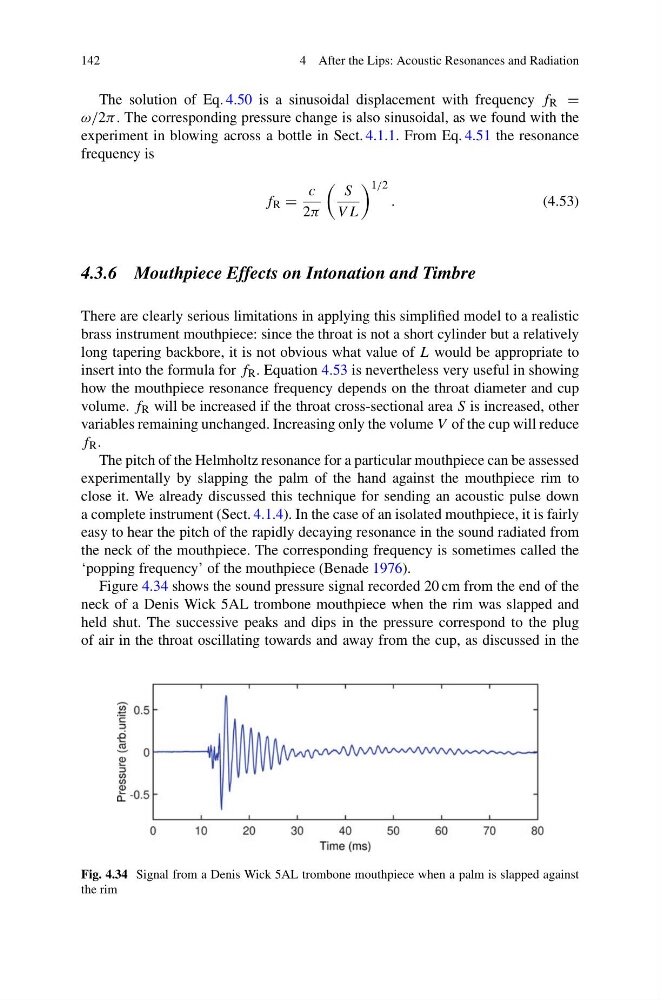
Figure 4.34 shows the sound pressure signal recorded 20 cm from the end of the
neck of a Denis Wick 5AL trombone mouthpiece when the rim was slapped and
held shut. The successive peaks and dips in the pressure correspond to the plug
of air in the throat oscillating towards and away from the cup, as discussed in the
Fig. 4.34 Signal from a Denis Wick 5AL trombone mouthpiece when a palm is slapped against
the rim
4 After the Lips: Acoustic Resonances and Radiation
The solution of Eq. 4.50 is a sinusoidal displacement with frequency f R =
ω/2π . The corresponding pressure change is also sinusoidal, as we found with the
experiment in blowing across a bottle in Sect. 4.1.1. From Eq. 4.51 the resonance
frequency is
f R =
c
2π
S
V L
1/2
.
(4.53)
4.3.6 Mouthpiece Effects on Intonation and Timbre
There are clearly serious limitations in applying this simplified model to a realistic
brass instrument mouthpiece: since the throat is not a short cylinder but a relatively
long tapering backbore, it is not obvious what value of L would be appropriate to
insert into the formula for f R . Equation 4.53 is nevertheless very useful in showing
how the mouthpiece resonance frequency depends on the throat diameter and cup
volume. f R will be increased if the throat cross-sectional area S is increased, other
variables remaining unchanged. Increasing only the volume V of the cup will reduce
f R .
The pitch of the Helmholtz resonance for a particular mouthpiece can be assessed
experimentally by slapping the palm of the hand against the mouthpiece rim to
close it. We already discussed this technique for sending an acoustic pulse down
a complete instrument (Sect. 4.1.4). In the case of an isolated mouthpiece, it is fairly
easy to hear the pitch of the rapidly decaying resonance in the sound radiated from
the neck of the mouthpiece. The corresponding frequency is sometimes called the
‘popping frequency’ of the mouthpiece (Benade 1976).
Figure 4.34 shows the sound pressure signal recorded 20 cm from the end of the
neck of a Denis Wick 5AL trombone mouthpiece when the rim was slapped and
held shut. The successive peaks and dips in the pressure correspond to the plug
of air in the throat oscillating towards and away from the cup, as discussed in the
Fig. 4.34 Signal from a Denis Wick 5AL trombone mouthpiece when a palm is slapped against
the rim