

4.3 Bore Profiles of Brass Instruments
141
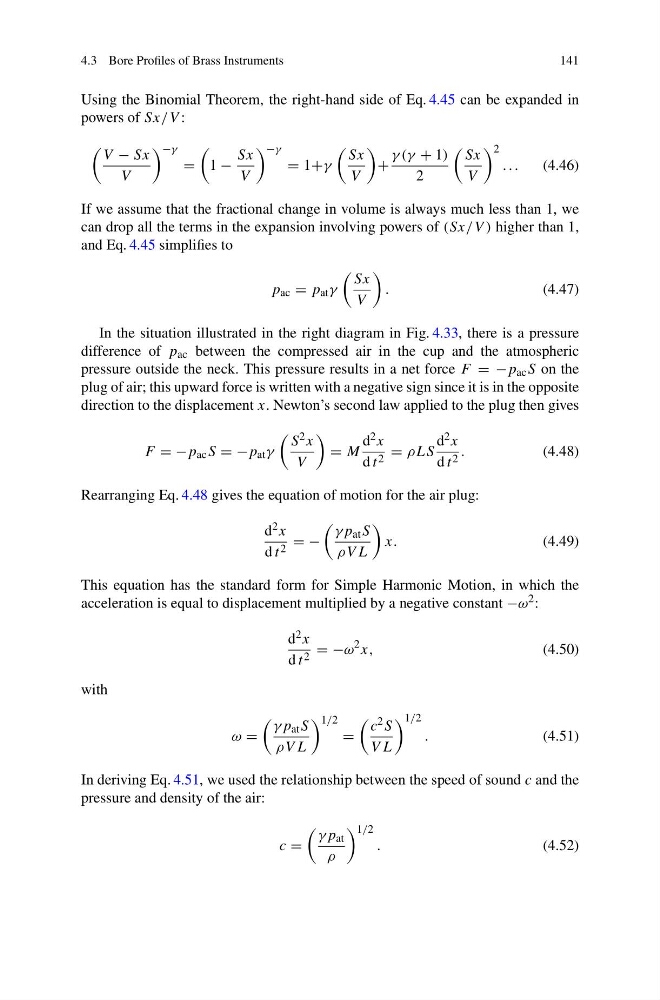
Using the Binomial Theorem, the right-hand side of Eq. 4.45 can be expanded in
powers of Sx/V :
V − Sx
V
−γ
=
1 −
Sx
V
−γ
= 1+γ
Sx
V
+
γ (γ + 1)
2
Sx
V
2
. . .
(4.46)
If we assume that the fractional change in volume is always much less than 1, we
can drop all the terms in the expansion involving powers of (Sx/V ) higher than 1,
and Eq. 4.45 simplifies to
p ac = p at γ
Sx
V
.
(4.47)
In the situation illustrated in the right diagram in Fig. 4.33, there is a pressure
difference of p ac between the compressed air in the cup and the atmospheric
pressure outside the neck. This pressure results in a net force F = −p ac S on the
plug of air; this upward force is written with a negative sign since it is in the opposite
direction to the displacement x. Newton’s second law applied to the plug then gives
F = −p ac S = −p at γ
S 2 x
V
= M
d 2 x
d t 2 = ρLS
d 2 x
d t 2 .
(4.48)
Rearranging Eq. 4.48 gives the equation of motion for the air plug:
d 2 x
d t 2 = −
γp at S
ρV L
x.
(4.49)
This equation has the standard form for Simple Harmonic Motion, in which the
acceleration is equal to displacement multiplied by a negative constant −ω 2 :
d 2 x
d t 2 = −ω
2 x,
(4.50)
with
ω =
γp at S
ρV L
1/2
=
c 2 S
V L
1/2
.
(4.51)
In deriving Eq. 4.51, we used the relationship between the speed of sound c and the
pressure and density of the air:
c =
γp at
ρ
1/2
.
(4.52)
141
Using the Binomial Theorem, the right-hand side of Eq. 4.45 can be expanded in
powers of Sx/V :
V − Sx
V
−γ
=
1 −
Sx
V
−γ
= 1+γ
Sx
V
+
γ (γ + 1)
2
Sx
V
2
. . .
(4.46)
If we assume that the fractional change in volume is always much less than 1, we
can drop all the terms in the expansion involving powers of (Sx/V ) higher than 1,
and Eq. 4.45 simplifies to
p ac = p at γ
Sx
V
.
(4.47)
In the situation illustrated in the right diagram in Fig. 4.33, there is a pressure
difference of p ac between the compressed air in the cup and the atmospheric
pressure outside the neck. This pressure results in a net force F = −p ac S on the
plug of air; this upward force is written with a negative sign since it is in the opposite
direction to the displacement x. Newton’s second law applied to the plug then gives
F = −p ac S = −p at γ
S 2 x
V
= M
d 2 x
d t 2 = ρLS
d 2 x
d t 2 .
(4.48)
Rearranging Eq. 4.48 gives the equation of motion for the air plug:
d 2 x
d t 2 = −
γp at S
ρV L
x.
(4.49)
This equation has the standard form for Simple Harmonic Motion, in which the
acceleration is equal to displacement multiplied by a negative constant −ω 2 :
d 2 x
d t 2 = −ω
2 x,
(4.50)
with
ω =
γp at S
ρV L
1/2
=
c 2 S
V L
1/2
.
(4.51)
In deriving Eq. 4.51, we used the relationship between the speed of sound c and the
pressure and density of the air:
c =
γp at
ρ
1/2
.
(4.52)