

140
4 After the Lips: Acoustic Resonances and Radiation
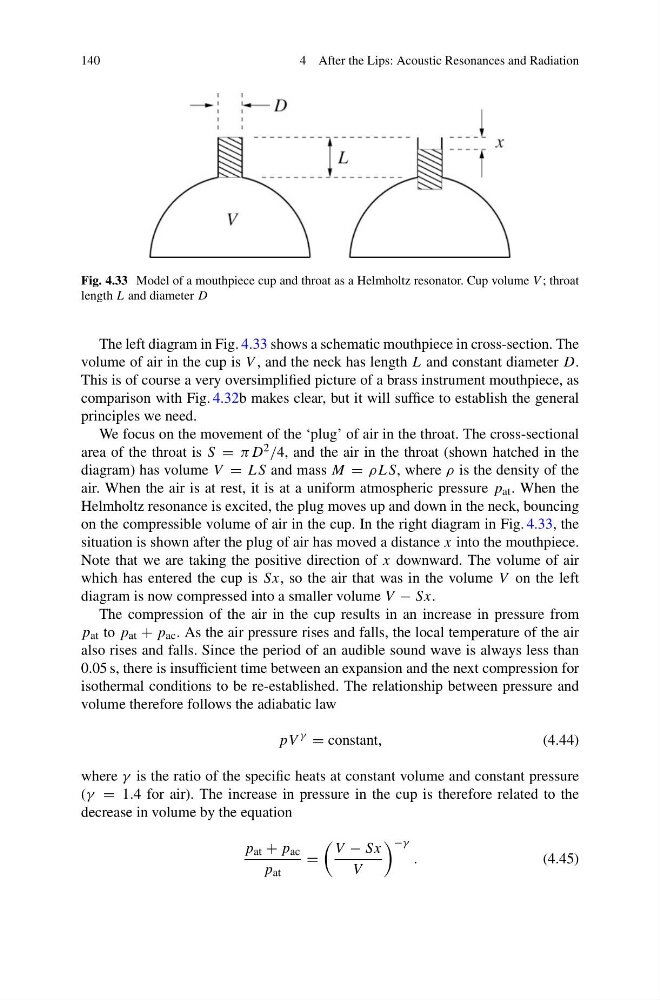
Fig. 4.33 Model of a mouthpiece cup and throat as a Helmholtz resonator. Cup volume V ; throat
length L and diameter D
The left diagram in Fig. 4.33 shows a schematic mouthpiece in cross-section. The
volume of air in the cup is V , and the neck has length L and constant diameter D.
This is of course a very oversimplified picture of a brass instrument mouthpiece, as
comparison with Fig. 4.32b makes clear, but it will suffice to establish the general
principles we need.
We focus on the movement of the ‘plug’ of air in the throat. The cross-sectional
area of the throat is S = πD 2 /4, and the air in the throat (shown hatched in the
diagram) has volume V = LS and mass M = ρLS, where ρ is the density of the
air. When the air is at rest, it is at a uniform atmospheric pressure p at . When the
Helmholtz resonance is excited, the plug moves up and down in the neck, bouncing
on the compressible volume of air in the cup. In the right diagram in Fig. 4.33, the
situation is shown after the plug of air has moved a distance x into the mouthpiece.
Note that we are taking the positive direction of x downward. The volume of air
which has entered the cup is Sx, so the air that was in the volume V on the left
diagram is now compressed into a smaller volume V − Sx.
The compression of the air in the cup results in an increase in pressure from
p at to p at + p ac . As the air pressure rises and falls, the local temperature of the air
also rises and falls. Since the period of an audible sound wave is always less than
0.05 s, there is insufficient time between an expansion and the next compression for
isothermal conditions to be re-established. The relationship between pressure and
volume therefore follows the adiabatic law
pV
γ
= constant,
(4.44)
where γ is the ratio of the specific heats at constant volume and constant pressure
(γ = 1.4 for air). The increase in pressure in the cup is therefore related to the
decrease in volume by the equation
p at + p ac
p at
=
V − Sx
V
−γ
.
(4.45)
4 After the Lips: Acoustic Resonances and Radiation
Fig. 4.33 Model of a mouthpiece cup and throat as a Helmholtz resonator. Cup volume V ; throat
length L and diameter D
The left diagram in Fig. 4.33 shows a schematic mouthpiece in cross-section. The
volume of air in the cup is V , and the neck has length L and constant diameter D.
This is of course a very oversimplified picture of a brass instrument mouthpiece, as
comparison with Fig. 4.32b makes clear, but it will suffice to establish the general
principles we need.
We focus on the movement of the ‘plug’ of air in the throat. The cross-sectional
area of the throat is S = πD 2 /4, and the air in the throat (shown hatched in the
diagram) has volume V = LS and mass M = ρLS, where ρ is the density of the
air. When the air is at rest, it is at a uniform atmospheric pressure p at . When the
Helmholtz resonance is excited, the plug moves up and down in the neck, bouncing
on the compressible volume of air in the cup. In the right diagram in Fig. 4.33, the
situation is shown after the plug of air has moved a distance x into the mouthpiece.
Note that we are taking the positive direction of x downward. The volume of air
which has entered the cup is Sx, so the air that was in the volume V on the left
diagram is now compressed into a smaller volume V − Sx.
The compression of the air in the cup results in an increase in pressure from
p at to p at + p ac . As the air pressure rises and falls, the local temperature of the air
also rises and falls. Since the period of an audible sound wave is always less than
0.05 s, there is insufficient time between an expansion and the next compression for
isothermal conditions to be re-established. The relationship between pressure and
volume therefore follows the adiabatic law
pV
γ
= constant,
(4.44)
where γ is the ratio of the specific heats at constant volume and constant pressure
(γ = 1.4 for air). The increase in pressure in the cup is therefore related to the
decrease in volume by the equation
p at + p ac
p at
=
V − Sx
V
−γ
.
(4.45)