

4.3 Bore Profiles of Brass Instruments
139
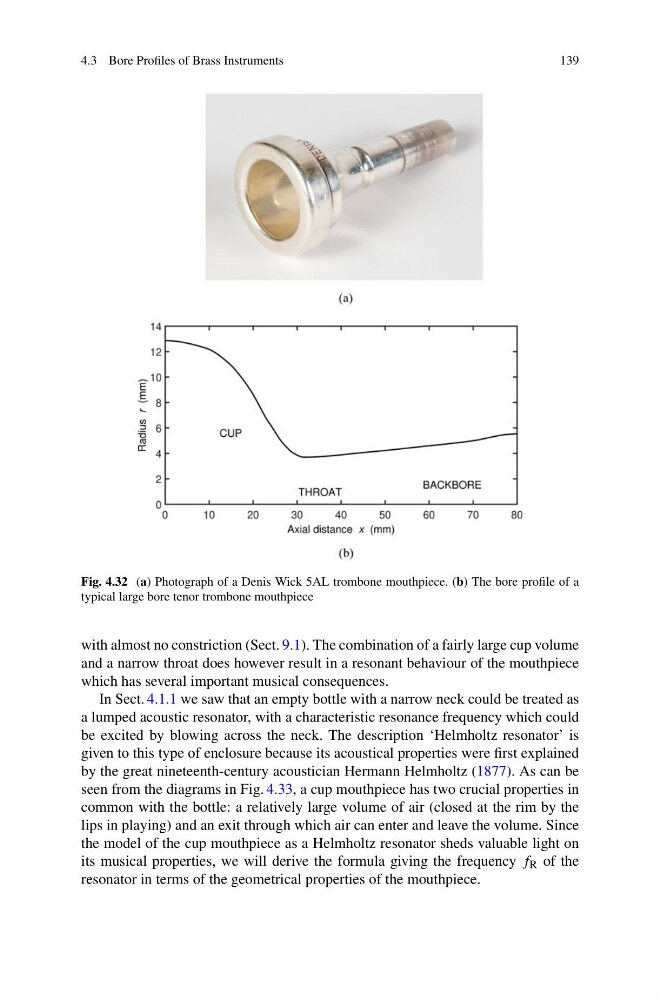
Fig. 4.32 (a) Photograph of a Denis Wick 5AL trombone mouthpiece. (b) The bore profile of a
typical large bore tenor trombone mouthpiece
with almost no constriction (Sect. 9.1). The combination of a fairly large cup volume
and a narrow throat does however result in a resonant behaviour of the mouthpiece
which has several important musical consequences.
In Sect. 4.1.1 we saw that an empty bottle with a narrow neck could be treated as
a lumped acoustic resonator, with a characteristic resonance frequency which could
be excited by blowing across the neck. The description ‘Helmholtz resonator’ is
given to this type of enclosure because its acoustical properties were first explained
by the great nineteenth-century acoustician Hermann Helmholtz (1877). As can be
seen from the diagrams in Fig. 4.33, a cup mouthpiece has two crucial properties in
common with the bottle: a relatively large volume of air (closed at the rim by the
lips in playing) and an exit through which air can enter and leave the volume. Since
the model of the cup mouthpiece as a Helmholtz resonator sheds valuable light on
its musical properties, we will derive the formula giving the frequency f R of the
resonator in terms of the geometrical properties of the mouthpiece.
139
Fig. 4.32 (a) Photograph of a Denis Wick 5AL trombone mouthpiece. (b) The bore profile of a
typical large bore tenor trombone mouthpiece
with almost no constriction (Sect. 9.1). The combination of a fairly large cup volume
and a narrow throat does however result in a resonant behaviour of the mouthpiece
which has several important musical consequences.
In Sect. 4.1.1 we saw that an empty bottle with a narrow neck could be treated as
a lumped acoustic resonator, with a characteristic resonance frequency which could
be excited by blowing across the neck. The description ‘Helmholtz resonator’ is
given to this type of enclosure because its acoustical properties were first explained
by the great nineteenth-century acoustician Hermann Helmholtz (1877). As can be
seen from the diagrams in Fig. 4.33, a cup mouthpiece has two crucial properties in
common with the bottle: a relatively large volume of air (closed at the rim by the
lips in playing) and an exit through which air can enter and leave the volume. Since
the model of the cup mouthpiece as a Helmholtz resonator sheds valuable light on
its musical properties, we will derive the formula giving the frequency f R of the
resonator in terms of the geometrical properties of the mouthpiece.