

138
4 After the Lips: Acoustic Resonances and Radiation
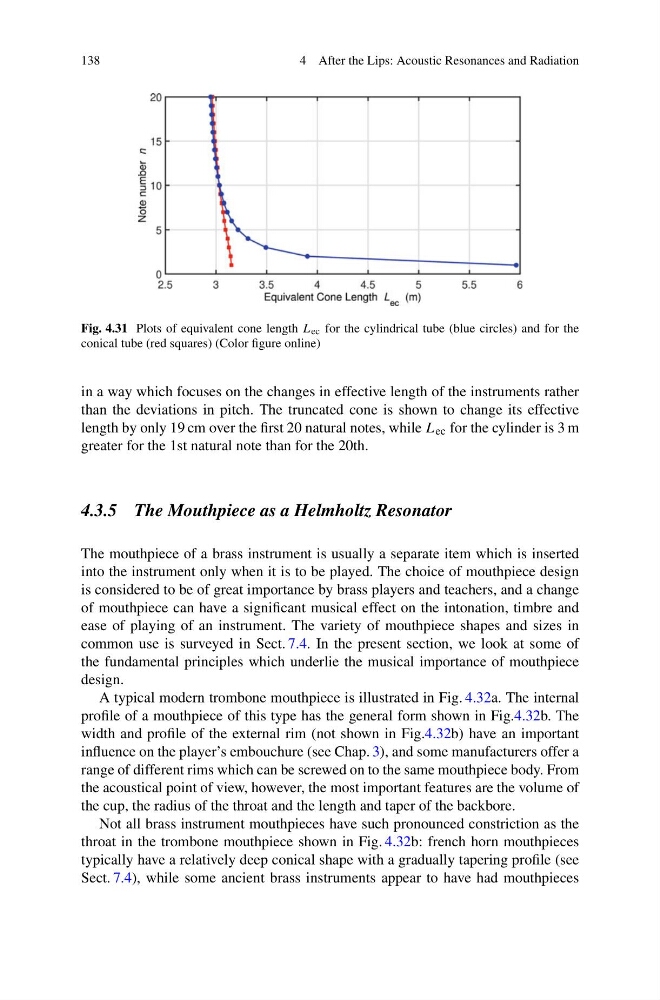
Fig. 4.31 Plots of equivalent cone length L ec for the cylindrical tube (blue circles) and for the
conical tube (red squares) (Color figure online)
in a way which focuses on the changes in effective length of the instruments rather
than the deviations in pitch. The truncated cone is shown to change its effective
length by only 19 cm over the first 20 natural notes, while L ec for the cylinder is 3 m
greater for the 1st natural note than for the 20th.
4.3.5 The Mouthpiece as a Helmholtz Resonator
The mouthpiece of a brass instrument is usually a separate item which is inserted
into the instrument only when it is to be played. The choice of mouthpiece design
is considered to be of great importance by brass players and teachers, and a change
of mouthpiece can have a significant musical effect on the intonation, timbre and
ease of playing of an instrument. The variety of mouthpiece shapes and sizes in
common use is surveyed in Sect. 7.4. In the present section, we look at some of
the fundamental principles which underlie the musical importance of mouthpiece
design.
A typical modern trombone mouthpiece is illustrated in Fig. 4.32a. The internal
profile of a mouthpiece of this type has the general form shown in Fig.4.32b. The
width and profile of the external rim (not shown in Fig.4.32b) have an important
influence on the player’s embouchure (see Chap. 3), and some manufacturers offer a
range of different rims which can be screwed on to the same mouthpiece body. From
the acoustical point of view, however, the most important features are the volume of
the cup, the radius of the throat and the length and taper of the backbore.
Not all brass instrument mouthpieces have such pronounced constriction as the
throat in the trombone mouthpiece shown in Fig. 4.32b: french horn mouthpieces
typically have a relatively deep conical shape with a gradually tapering profile (see
Sect. 7.4), while some ancient brass instruments appear to have had mouthpieces
4 After the Lips: Acoustic Resonances and Radiation
Fig. 4.31 Plots of equivalent cone length L ec for the cylindrical tube (blue circles) and for the
conical tube (red squares) (Color figure online)
in a way which focuses on the changes in effective length of the instruments rather
than the deviations in pitch. The truncated cone is shown to change its effective
length by only 19 cm over the first 20 natural notes, while L ec for the cylinder is 3 m
greater for the 1st natural note than for the 20th.
4.3.5 The Mouthpiece as a Helmholtz Resonator
The mouthpiece of a brass instrument is usually a separate item which is inserted
into the instrument only when it is to be played. The choice of mouthpiece design
is considered to be of great importance by brass players and teachers, and a change
of mouthpiece can have a significant musical effect on the intonation, timbre and
ease of playing of an instrument. The variety of mouthpiece shapes and sizes in
common use is surveyed in Sect. 7.4. In the present section, we look at some of
the fundamental principles which underlie the musical importance of mouthpiece
design.
A typical modern trombone mouthpiece is illustrated in Fig. 4.32a. The internal
profile of a mouthpiece of this type has the general form shown in Fig.4.32b. The
width and profile of the external rim (not shown in Fig.4.32b) have an important
influence on the player’s embouchure (see Chap. 3), and some manufacturers offer a
range of different rims which can be screwed on to the same mouthpiece body. From
the acoustical point of view, however, the most important features are the volume of
the cup, the radius of the throat and the length and taper of the backbore.
Not all brass instrument mouthpieces have such pronounced constriction as the
throat in the trombone mouthpiece shown in Fig. 4.32b: french horn mouthpieces
typically have a relatively deep conical shape with a gradually tapering profile (see
Sect. 7.4), while some ancient brass instruments appear to have had mouthpieces