

114
4 After the Lips: Acoustic Resonances and Radiation
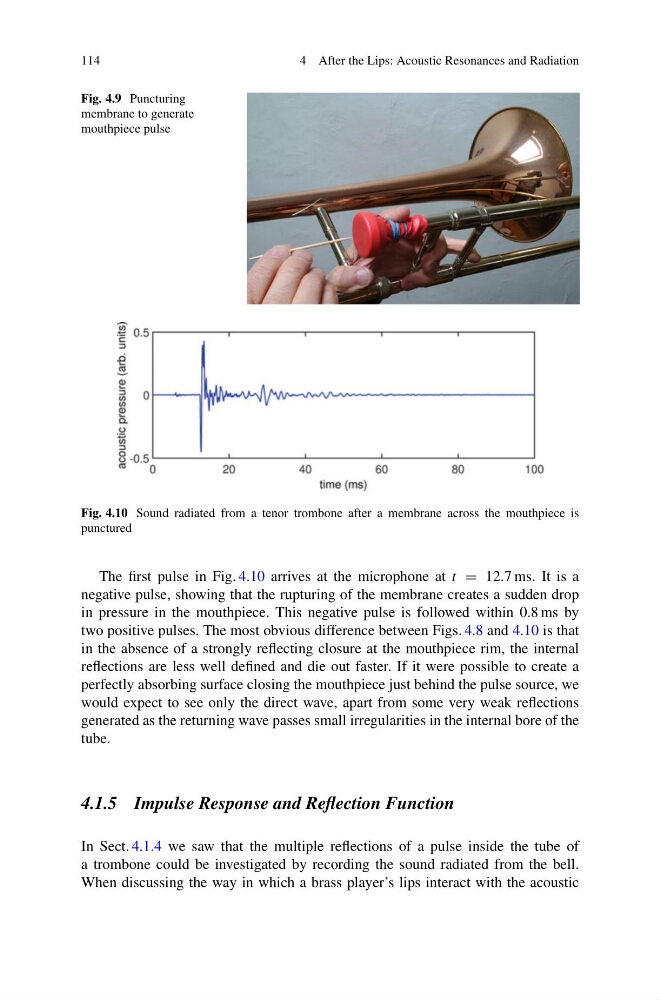
Fig. 4.9 Puncturing
membrane to generate
mouthpiece pulse
Fig. 4.10 Sound radiated from a tenor trombone after a membrane across the mouthpiece is
punctured
The first pulse in Fig. 4.10 arrives at the microphone at t = 12.7 ms. It is a
negative pulse, showing that the rupturing of the membrane creates a sudden drop
in pressure in the mouthpiece. This negative pulse is followed within 0.8 ms by
two positive pulses. The most obvious difference between Figs. 4.8 and 4.10 is that
in the absence of a strongly reflecting closure at the mouthpiece rim, the internal
reflections are less well defined and die out faster. If it were possible to create a
perfectly absorbing surface closing the mouthpiece just behind the pulse source, we
would expect to see only the direct wave, apart from some very weak reflections
generated as the returning wave passes small irregularities in the internal bore of the
tube.
4.1.5 Impulse Response and Reflection Function
In Sect. 4.1.4 we saw that the multiple reflections of a pulse inside the tube of
a trombone could be investigated by recording the sound radiated from the bell.
When discussing the way in which a brass player’s lips interact with the acoustic
4 After the Lips: Acoustic Resonances and Radiation
Fig. 4.9 Puncturing
membrane to generate
mouthpiece pulse
Fig. 4.10 Sound radiated from a tenor trombone after a membrane across the mouthpiece is
punctured
The first pulse in Fig. 4.10 arrives at the microphone at t = 12.7 ms. It is a
negative pulse, showing that the rupturing of the membrane creates a sudden drop
in pressure in the mouthpiece. This negative pulse is followed within 0.8 ms by
two positive pulses. The most obvious difference between Figs. 4.8 and 4.10 is that
in the absence of a strongly reflecting closure at the mouthpiece rim, the internal
reflections are less well defined and die out faster. If it were possible to create a
perfectly absorbing surface closing the mouthpiece just behind the pulse source, we
would expect to see only the direct wave, apart from some very weak reflections
generated as the returning wave passes small irregularities in the internal bore of the
tube.
4.1.5 Impulse Response and Reflection Function
In Sect. 4.1.4 we saw that the multiple reflections of a pulse inside the tube of
a trombone could be investigated by recording the sound radiated from the bell.
When discussing the way in which a brass player’s lips interact with the acoustic