

4.1 Internal Sounds in Brass Instruments
115
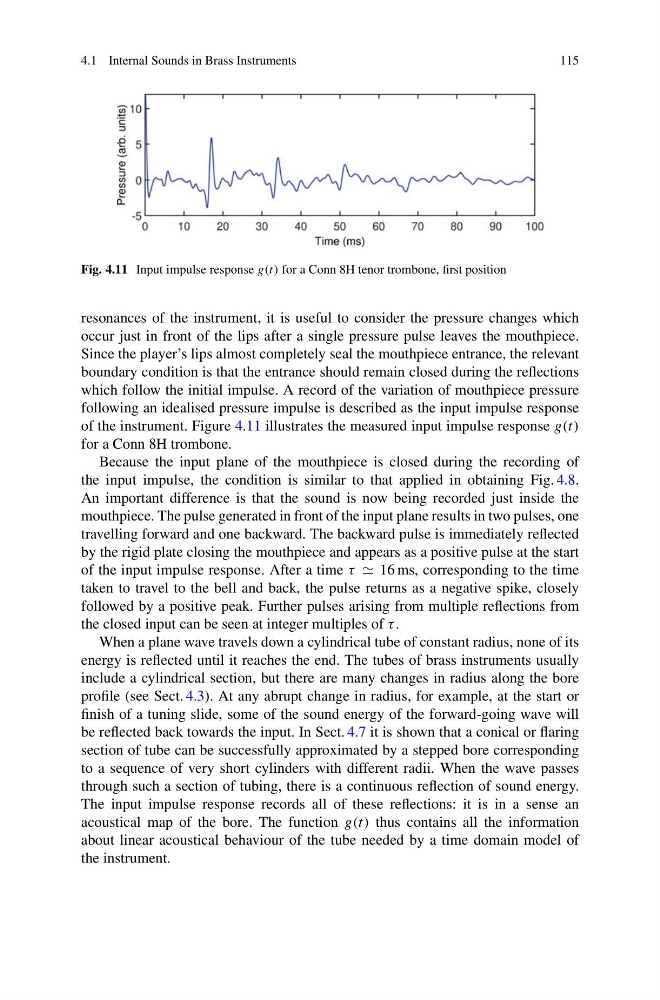
Fig. 4.11 Input impulse response g(t) for a Conn 8H tenor trombone, first position
resonances of the instrument, it is useful to consider the pressure changes which
occur just in front of the lips after a single pressure pulse leaves the mouthpiece.
Since the player’s lips almost completely seal the mouthpiece entrance, the relevant
boundary condition is that the entrance should remain closed during the reflections
which follow the initial impulse. A record of the variation of mouthpiece pressure
following an idealised pressure impulse is described as the input impulse response
of the instrument. Figure 4.11 illustrates the measured input impulse response g(t)
for a Conn 8H trombone.
Because the input plane of the mouthpiece is closed during the recording of
the input impulse, the condition is similar to that applied in obtaining Fig. 4.8.
An important difference is that the sound is now being recorded just inside the
mouthpiece. The pulse generated in front of the input plane results in two pulses, one
travelling forward and one backward. The backward pulse is immediately reflected
by the rigid plate closing the mouthpiece and appears as a positive pulse at the start
of the input impulse response. After a time τ 16 ms, corresponding to the time
taken to travel to the bell and back, the pulse returns as a negative spike, closely
followed by a positive peak. Further pulses arising from multiple reflections from
the closed input can be seen at integer multiples of τ .
When a plane wave travels down a cylindrical tube of constant radius, none of its
energy is reflected until it reaches the end. The tubes of brass instruments usually
include a cylindrical section, but there are many changes in radius along the bore
profile (see Sect. 4.3). At any abrupt change in radius, for example, at the start or
finish of a tuning slide, some of the sound energy of the forward-going wave will
be reflected back towards the input. In Sect. 4.7 it is shown that a conical or flaring
section of tube can be successfully approximated by a stepped bore corresponding
to a sequence of very short cylinders with different radii. When the wave passes
through such a section of tubing, there is a continuous reflection of sound energy.
The input impulse response records all of these reflections: it is in a sense an
acoustical map of the bore. The function g(t) thus contains all the information
about linear acoustical behaviour of the tube needed by a time domain model of
the instrument.
115
Fig. 4.11 Input impulse response g(t) for a Conn 8H tenor trombone, first position
resonances of the instrument, it is useful to consider the pressure changes which
occur just in front of the lips after a single pressure pulse leaves the mouthpiece.
Since the player’s lips almost completely seal the mouthpiece entrance, the relevant
boundary condition is that the entrance should remain closed during the reflections
which follow the initial impulse. A record of the variation of mouthpiece pressure
following an idealised pressure impulse is described as the input impulse response
of the instrument. Figure 4.11 illustrates the measured input impulse response g(t)
for a Conn 8H trombone.
Because the input plane of the mouthpiece is closed during the recording of
the input impulse, the condition is similar to that applied in obtaining Fig. 4.8.
An important difference is that the sound is now being recorded just inside the
mouthpiece. The pulse generated in front of the input plane results in two pulses, one
travelling forward and one backward. The backward pulse is immediately reflected
by the rigid plate closing the mouthpiece and appears as a positive pulse at the start
of the input impulse response. After a time τ 16 ms, corresponding to the time
taken to travel to the bell and back, the pulse returns as a negative spike, closely
followed by a positive peak. Further pulses arising from multiple reflections from
the closed input can be seen at integer multiples of τ .
When a plane wave travels down a cylindrical tube of constant radius, none of its
energy is reflected until it reaches the end. The tubes of brass instruments usually
include a cylindrical section, but there are many changes in radius along the bore
profile (see Sect. 4.3). At any abrupt change in radius, for example, at the start or
finish of a tuning slide, some of the sound energy of the forward-going wave will
be reflected back towards the input. In Sect. 4.7 it is shown that a conical or flaring
section of tube can be successfully approximated by a stepped bore corresponding
to a sequence of very short cylinders with different radii. When the wave passes
through such a section of tubing, there is a continuous reflection of sound energy.
The input impulse response records all of these reflections: it is in a sense an
acoustical map of the bore. The function g(t) thus contains all the information
about linear acoustical behaviour of the tube needed by a time domain model of
the instrument.