

4.1 Internal Sounds in Brass Instruments
113
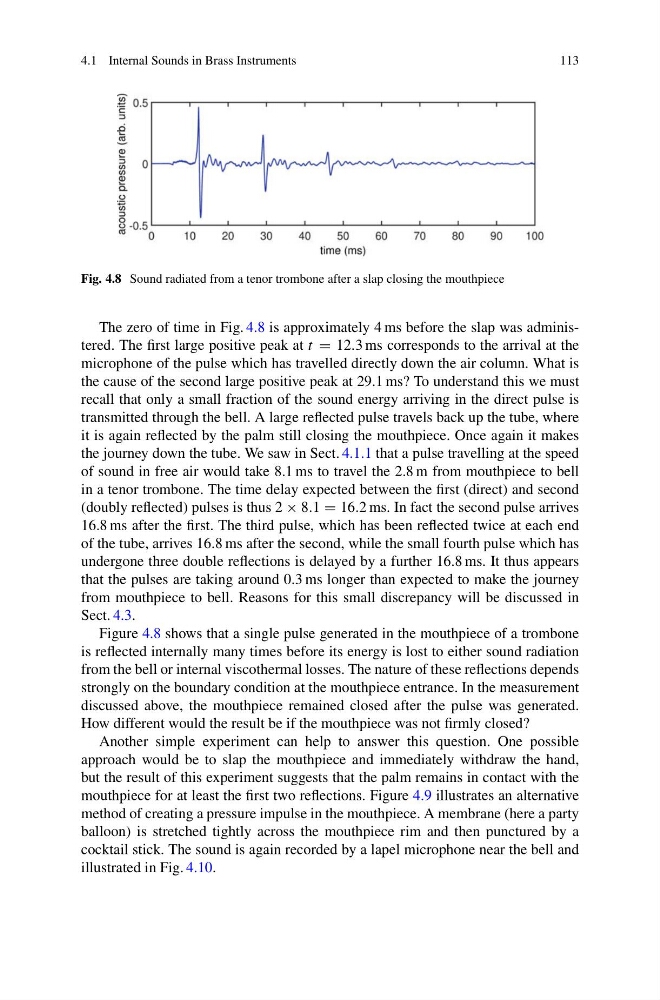
Fig. 4.8 Sound radiated from a tenor trombone after a slap closing the mouthpiece
The zero of time in Fig. 4.8 is approximately 4 ms before the slap was administered. The first large positive peak at t = 12.3 ms corresponds to the arrival at the
microphone of the pulse which has travelled directly down the air column. What is
the cause of the second large positive peak at 29.1 ms? To understand this we must
recall that only a small fraction of the sound energy arriving in the direct pulse is
transmitted through the bell. A large reflected pulse travels back up the tube, where
it is again reflected by the palm still closing the mouthpiece. Once again it makes
the journey down the tube. We saw in Sect. 4.1.1 that a pulse travelling at the speed
of sound in free air would take 8.1 ms to travel the 2.8 m from mouthpiece to bell
in a tenor trombone. The time delay expected between the first (direct) and second
(doubly reflected) pulses is thus 2 × 8.1 = 16.2 ms. In fact the second pulse arrives
16.8 ms after the first. The third pulse, which has been reflected twice at each end
of the tube, arrives 16.8 ms after the second, while the small fourth pulse which has
undergone three double reflections is delayed by a further 16.8 ms. It thus appears
that the pulses are taking around 0.3 ms longer than expected to make the journey
from mouthpiece to bell. Reasons for this small discrepancy will be discussed in
Sect. 4.3.
Figure 4.8 shows that a single pulse generated in the mouthpiece of a trombone
is reflected internally many times before its energy is lost to either sound radiation
from the bell or internal viscothermal losses. The nature of these reflections depends
strongly on the boundary condition at the mouthpiece entrance. In the measurement
discussed above, the mouthpiece remained closed after the pulse was generated.
How different would the result be if the mouthpiece was not firmly closed?
Another simple experiment can help to answer this question. One possible
approach would be to slap the mouthpiece and immediately withdraw the hand,
but the result of this experiment suggests that the palm remains in contact with the
mouthpiece for at least the first two reflections. Figure 4.9 illustrates an alternative
method of creating a pressure impulse in the mouthpiece. A membrane (here a party
balloon) is stretched tightly across the mouthpiece rim and then punctured by a
cocktail stick. The sound is again recorded by a lapel microphone near the bell and
illustrated in Fig. 4.10.
113
Fig. 4.8 Sound radiated from a tenor trombone after a slap closing the mouthpiece
The zero of time in Fig. 4.8 is approximately 4 ms before the slap was administered. The first large positive peak at t = 12.3 ms corresponds to the arrival at the
microphone of the pulse which has travelled directly down the air column. What is
the cause of the second large positive peak at 29.1 ms? To understand this we must
recall that only a small fraction of the sound energy arriving in the direct pulse is
transmitted through the bell. A large reflected pulse travels back up the tube, where
it is again reflected by the palm still closing the mouthpiece. Once again it makes
the journey down the tube. We saw in Sect. 4.1.1 that a pulse travelling at the speed
of sound in free air would take 8.1 ms to travel the 2.8 m from mouthpiece to bell
in a tenor trombone. The time delay expected between the first (direct) and second
(doubly reflected) pulses is thus 2 × 8.1 = 16.2 ms. In fact the second pulse arrives
16.8 ms after the first. The third pulse, which has been reflected twice at each end
of the tube, arrives 16.8 ms after the second, while the small fourth pulse which has
undergone three double reflections is delayed by a further 16.8 ms. It thus appears
that the pulses are taking around 0.3 ms longer than expected to make the journey
from mouthpiece to bell. Reasons for this small discrepancy will be discussed in
Sect. 4.3.
Figure 4.8 shows that a single pulse generated in the mouthpiece of a trombone
is reflected internally many times before its energy is lost to either sound radiation
from the bell or internal viscothermal losses. The nature of these reflections depends
strongly on the boundary condition at the mouthpiece entrance. In the measurement
discussed above, the mouthpiece remained closed after the pulse was generated.
How different would the result be if the mouthpiece was not firmly closed?
Another simple experiment can help to answer this question. One possible
approach would be to slap the mouthpiece and immediately withdraw the hand,
but the result of this experiment suggests that the palm remains in contact with the
mouthpiece for at least the first two reflections. Figure 4.9 illustrates an alternative
method of creating a pressure impulse in the mouthpiece. A membrane (here a party
balloon) is stretched tightly across the mouthpiece rim and then punctured by a
cocktail stick. The sound is again recorded by a lapel microphone near the bell and
illustrated in Fig. 4.10.