

4.1 Internal Sounds in Brass Instruments
103
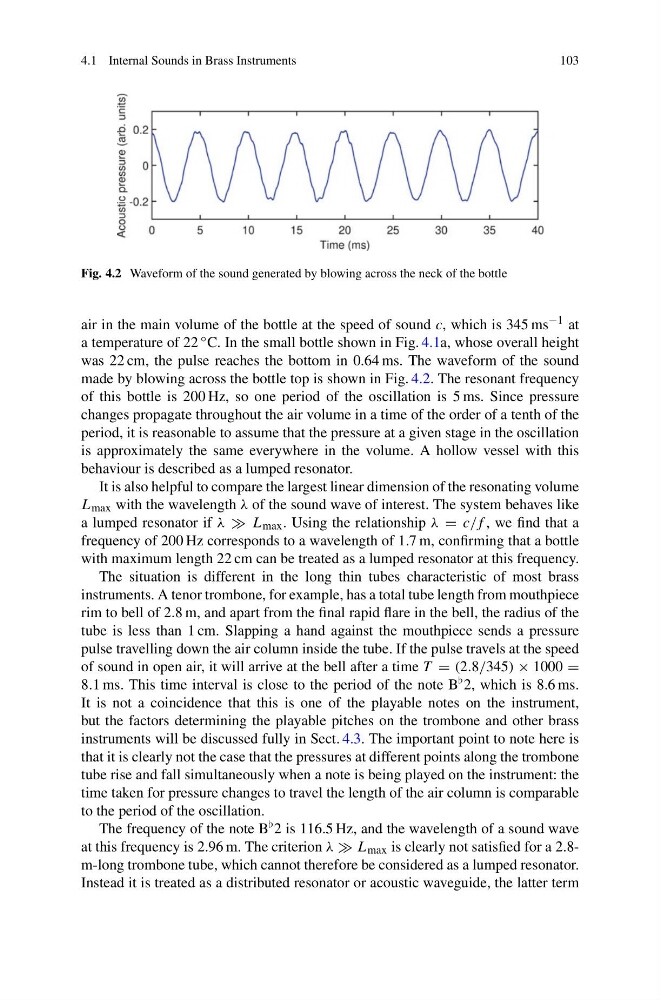
Fig. 4.2 Waveform of the sound generated by blowing across the neck of the bottle
air in the main volume of the bottle at the speed of sound c, which is 345 ms −1 at
a temperature of 22 ◦ C. In the small bottle shown in Fig. 4.1a, whose overall height
was 22 cm, the pulse reaches the bottom in 0.64 ms. The waveform of the sound
made by blowing across the bottle top is shown in Fig. 4.2. The resonant frequency
of this bottle is 200 Hz, so one period of the oscillation is 5 ms. Since pressure
changes propagate throughout the air volume in a time of the order of a tenth of the
period, it is reasonable to assume that the pressure at a given stage in the oscillation
is approximately the same everywhere in the volume. A hollow vessel with this
behaviour is described as a lumped resonator.
It is also helpful to compare the largest linear dimension of the resonating volume
L max with the wavelength λ of the sound wave of interest. The system behaves like
a lumped resonator if λ L max . Using the relationship λ = c/f , we find that a
frequency of 200 Hz corresponds to a wavelength of 1.7 m, confirming that a bottle
with maximum length 22 cm can be treated as a lumped resonator at this frequency.
The situation is different in the long thin tubes characteristic of most brass
instruments. A tenor trombone, for example, has a total tube length from mouthpiece
rim to bell of 2.8 m, and apart from the final rapid flare in the bell, the radius of the
tube is less than 1 cm. Slapping a hand against the mouthpiece sends a pressure
pulse travelling down the air column inside the tube. If the pulse travels at the speed
of sound in open air, it will arrive at the bell after a time T = (2.8/345) × 1000 =
8.1 ms. This time interval is close to the period of the note B 2, which is 8.6 ms.
It is not a coincidence that this is one of the playable notes on the instrument,
but the factors determining the playable pitches on the trombone and other brass
instruments will be discussed fully in Sect. 4.3. The important point to note here is
that it is clearly not the case that the pressures at different points along the trombone
tube rise and fall simultaneously when a note is being played on the instrument: the
time taken for pressure changes to travel the length of the air column is comparable
to the period of the oscillation.
The frequency of the note B 2 is 116.5 Hz, and the wavelength of a sound wave
at this frequency is 2.96 m. The criterion λ L max is clearly not satisfied for a 2.8m-long trombone tube, which cannot therefore be considered as a lumped resonator.
Instead it is treated as a distributed resonator or acoustic waveguide, the latter term
103
Fig. 4.2 Waveform of the sound generated by blowing across the neck of the bottle
air in the main volume of the bottle at the speed of sound c, which is 345 ms −1 at
a temperature of 22 ◦ C. In the small bottle shown in Fig. 4.1a, whose overall height
was 22 cm, the pulse reaches the bottom in 0.64 ms. The waveform of the sound
made by blowing across the bottle top is shown in Fig. 4.2. The resonant frequency
of this bottle is 200 Hz, so one period of the oscillation is 5 ms. Since pressure
changes propagate throughout the air volume in a time of the order of a tenth of the
period, it is reasonable to assume that the pressure at a given stage in the oscillation
is approximately the same everywhere in the volume. A hollow vessel with this
behaviour is described as a lumped resonator.
It is also helpful to compare the largest linear dimension of the resonating volume
L max with the wavelength λ of the sound wave of interest. The system behaves like
a lumped resonator if λ L max . Using the relationship λ = c/f , we find that a
frequency of 200 Hz corresponds to a wavelength of 1.7 m, confirming that a bottle
with maximum length 22 cm can be treated as a lumped resonator at this frequency.
The situation is different in the long thin tubes characteristic of most brass
instruments. A tenor trombone, for example, has a total tube length from mouthpiece
rim to bell of 2.8 m, and apart from the final rapid flare in the bell, the radius of the
tube is less than 1 cm. Slapping a hand against the mouthpiece sends a pressure
pulse travelling down the air column inside the tube. If the pulse travels at the speed
of sound in open air, it will arrive at the bell after a time T = (2.8/345) × 1000 =
8.1 ms. This time interval is close to the period of the note B 2, which is 8.6 ms.
It is not a coincidence that this is one of the playable notes on the instrument,
but the factors determining the playable pitches on the trombone and other brass
instruments will be discussed fully in Sect. 4.3. The important point to note here is
that it is clearly not the case that the pressures at different points along the trombone
tube rise and fall simultaneously when a note is being played on the instrument: the
time taken for pressure changes to travel the length of the air column is comparable
to the period of the oscillation.
The frequency of the note B 2 is 116.5 Hz, and the wavelength of a sound wave
at this frequency is 2.96 m. The criterion λ L max is clearly not satisfied for a 2.8m-long trombone tube, which cannot therefore be considered as a lumped resonator.
Instead it is treated as a distributed resonator or acoustic waveguide, the latter term