

102
4 After the Lips: Acoustic Resonances and Radiation
instrument family have resonators with many acoustic modes, each with its own
characteristic resonance frequency.
4.1.1 Lumped and Distributed Resonators
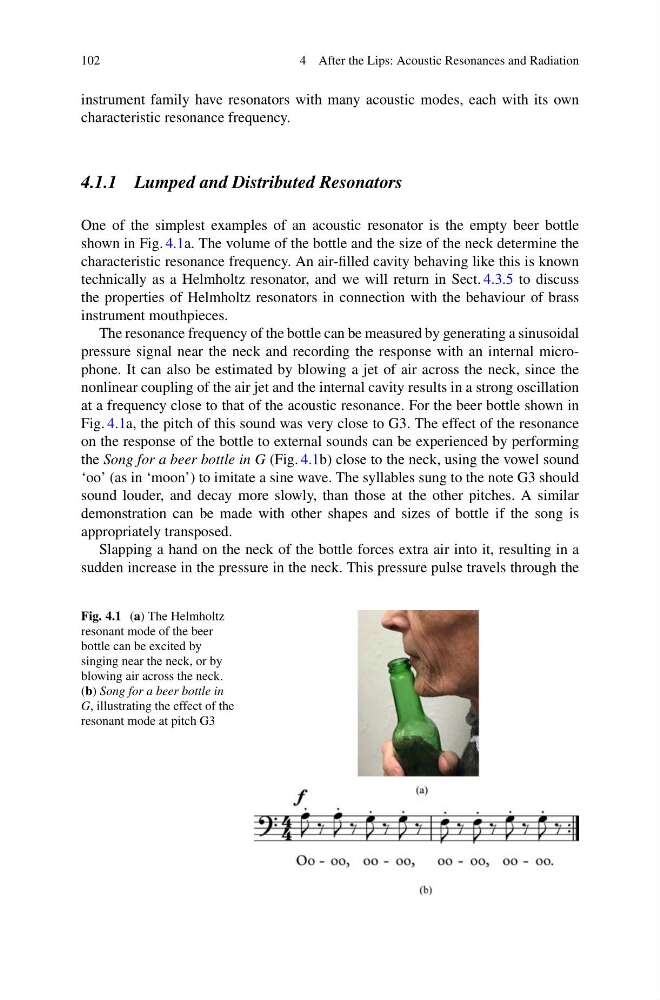
One of the simplest examples of an acoustic resonator is the empty beer bottle
shown in Fig. 4.1a. The volume of the bottle and the size of the neck determine the
characteristic resonance frequency. An air-filled cavity behaving like this is known
technically as a Helmholtz resonator, and we will return in Sect. 4.3.5 to discuss
the properties of Helmholtz resonators in connection with the behaviour of brass
instrument mouthpieces.
The resonance frequency of the bottle can be measured by generating a sinusoidal
pressure signal near the neck and recording the response with an internal microphone. It can also be estimated by blowing a jet of air across the neck, since the
nonlinear coupling of the air jet and the internal cavity results in a strong oscillation
at a frequency close to that of the acoustic resonance. For the beer bottle shown in
Fig. 4.1a, the pitch of this sound was very close to G3. The effect of the resonance
on the response of the bottle to external sounds can be experienced by performing
the Song for a beer bottle in G (Fig. 4.1b) close to the neck, using the vowel sound
‘oo’ (as in ‘moon’) to imitate a sine wave. The syllables sung to the note G3 should
sound louder, and decay more slowly, than those at the other pitches. A similar
demonstration can be made with other shapes and sizes of bottle if the song is
appropriately transposed.
Slapping a hand on the neck of the bottle forces extra air into it, resulting in a
sudden increase in the pressure in the neck. This pressure pulse travels through the
Fig. 4.1 (a) The Helmholtz
resonant mode of the beer
bottle can be excited by
singing near the neck, or by
blowing air across the neck.
(b) Song for a beer bottle in
G, illustrating the effect of the
resonant mode at pitch G3
4 After the Lips: Acoustic Resonances and Radiation
instrument family have resonators with many acoustic modes, each with its own
characteristic resonance frequency.
4.1.1 Lumped and Distributed Resonators
One of the simplest examples of an acoustic resonator is the empty beer bottle
shown in Fig. 4.1a. The volume of the bottle and the size of the neck determine the
characteristic resonance frequency. An air-filled cavity behaving like this is known
technically as a Helmholtz resonator, and we will return in Sect. 4.3.5 to discuss
the properties of Helmholtz resonators in connection with the behaviour of brass
instrument mouthpieces.
The resonance frequency of the bottle can be measured by generating a sinusoidal
pressure signal near the neck and recording the response with an internal microphone. It can also be estimated by blowing a jet of air across the neck, since the
nonlinear coupling of the air jet and the internal cavity results in a strong oscillation
at a frequency close to that of the acoustic resonance. For the beer bottle shown in
Fig. 4.1a, the pitch of this sound was very close to G3. The effect of the resonance
on the response of the bottle to external sounds can be experienced by performing
the Song for a beer bottle in G (Fig. 4.1b) close to the neck, using the vowel sound
‘oo’ (as in ‘moon’) to imitate a sine wave. The syllables sung to the note G3 should
sound louder, and decay more slowly, than those at the other pitches. A similar
demonstration can be made with other shapes and sizes of bottle if the song is
appropriately transposed.
Slapping a hand on the neck of the bottle forces extra air into it, resulting in a
sudden increase in the pressure in the neck. This pressure pulse travels through the
Fig. 4.1 (a) The Helmholtz
resonant mode of the beer
bottle can be excited by
singing near the neck, or by
blowing air across the neck.
(b) Song for a beer bottle in
G, illustrating the effect of the
resonant mode at pitch G3