

104
4 After the Lips: Acoustic Resonances and Radiation
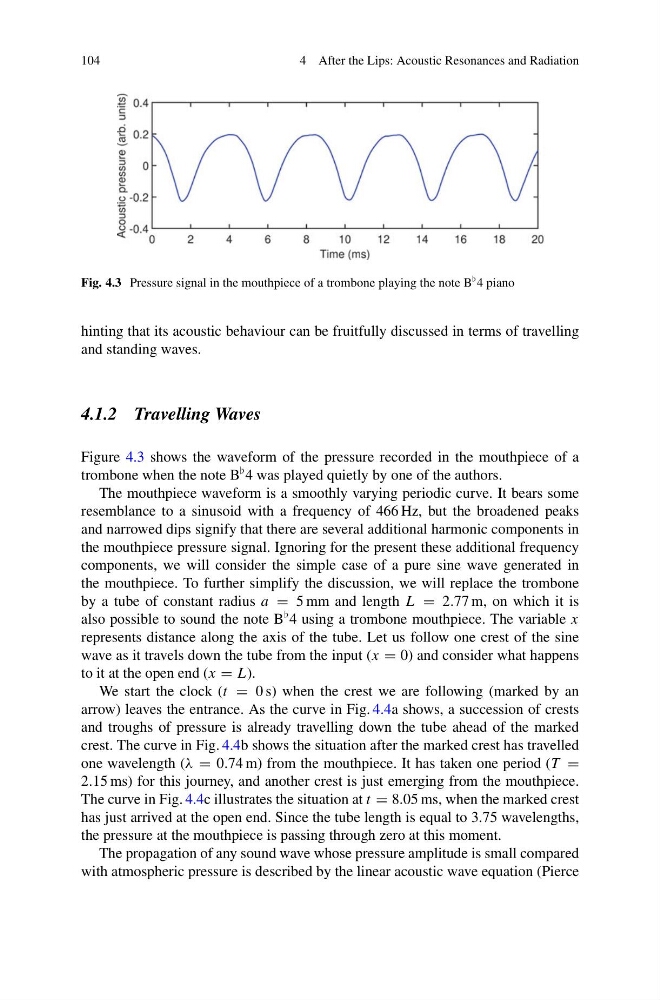
Fig. 4.3 Pressure signal in the mouthpiece of a trombone playing the note B 4 piano
hinting that its acoustic behaviour can be fruitfully discussed in terms of travelling
and standing waves.
4.1.2 Travelling Waves
Figure 4.3 shows the waveform of the pressure recorded in the mouthpiece of a
trombone when the note B 4 was played quietly by one of the authors.
The mouthpiece waveform is a smoothly varying periodic curve. It bears some
resemblance to a sinusoid with a frequency of 466 Hz, but the broadened peaks
and narrowed dips signify that there are several additional harmonic components in
the mouthpiece pressure signal. Ignoring for the present these additional frequency
components, we will consider the simple case of a pure sine wave generated in
the mouthpiece. To further simplify the discussion, we will replace the trombone
by a tube of constant radius a = 5 mm and length L = 2.77 m, on which it is
also possible to sound the note B 4 using a trombone mouthpiece. The variable x
represents distance along the axis of the tube. Let us follow one crest of the sine
wave as it travels down the tube from the input (x = 0) and consider what happens
to it at the open end (x = L).
We start the clock (t = 0 s) when the crest we are following (marked by an
arrow) leaves the entrance. As the curve in Fig. 4.4a shows, a succession of crests
and troughs of pressure is already travelling down the tube ahead of the marked
crest. The curve in Fig. 4.4b shows the situation after the marked crest has travelled
one wavelength (λ = 0.74 m) from the mouthpiece. It has taken one period (T =
2.15 ms) for this journey, and another crest is just emerging from the mouthpiece.
The curve in Fig. 4.4c illustrates the situation at t = 8.05 ms, when the marked crest
has just arrived at the open end. Since the tube length is equal to 3.75 wavelengths,
the pressure at the mouthpiece is passing through zero at this moment.
The propagation of any sound wave whose pressure amplitude is small compared
with atmospheric pressure is described by the linear acoustic wave equation (Pierce
4 After the Lips: Acoustic Resonances and Radiation
Fig. 4.3 Pressure signal in the mouthpiece of a trombone playing the note B 4 piano
hinting that its acoustic behaviour can be fruitfully discussed in terms of travelling
and standing waves.
4.1.2 Travelling Waves
Figure 4.3 shows the waveform of the pressure recorded in the mouthpiece of a
trombone when the note B 4 was played quietly by one of the authors.
The mouthpiece waveform is a smoothly varying periodic curve. It bears some
resemblance to a sinusoid with a frequency of 466 Hz, but the broadened peaks
and narrowed dips signify that there are several additional harmonic components in
the mouthpiece pressure signal. Ignoring for the present these additional frequency
components, we will consider the simple case of a pure sine wave generated in
the mouthpiece. To further simplify the discussion, we will replace the trombone
by a tube of constant radius a = 5 mm and length L = 2.77 m, on which it is
also possible to sound the note B 4 using a trombone mouthpiece. The variable x
represents distance along the axis of the tube. Let us follow one crest of the sine
wave as it travels down the tube from the input (x = 0) and consider what happens
to it at the open end (x = L).
We start the clock (t = 0 s) when the crest we are following (marked by an
arrow) leaves the entrance. As the curve in Fig. 4.4a shows, a succession of crests
and troughs of pressure is already travelling down the tube ahead of the marked
crest. The curve in Fig. 4.4b shows the situation after the marked crest has travelled
one wavelength (λ = 0.74 m) from the mouthpiece. It has taken one period (T =
2.15 ms) for this journey, and another crest is just emerging from the mouthpiece.
The curve in Fig. 4.4c illustrates the situation at t = 8.05 ms, when the marked crest
has just arrived at the open end. Since the tube length is equal to 3.75 wavelengths,
the pressure at the mouthpiece is passing through zero at this moment.
The propagation of any sound wave whose pressure amplitude is small compared
with atmospheric pressure is described by the linear acoustic wave equation (Pierce