

58
P. Bansal et al.
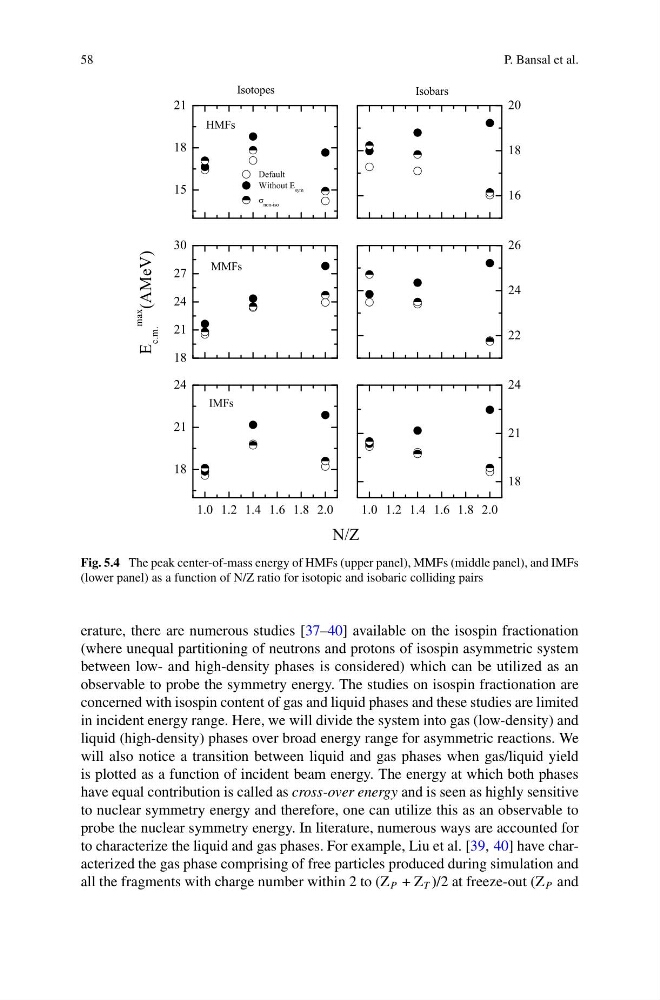
Fig. 5.4 The peak center-of-mass energy of HMFs (upper panel), MMFs (middle panel), and IMFs
(lower panel) as a function of N/Z ratio for isotopic and isobaric colliding pairs
erature, there are numerous studies [37–40] available on the isospin fractionation
(where unequal partitioning of neutrons and protons of isospin asymmetric system
between low- and high-density phases is considered) which can be utilized as an
observable to probe the symmetry energy. The studies on isospin fractionation are
concerned with isospin content of gas and liquid phases and these studies are limited
in incident energy range. Here, we will divide the system into gas (low-density) and
liquid (high-density) phases over broad energy range for asymmetric reactions. We
will also notice a transition between liquid and gas phases when gas/liquid yield
is plotted as a function of incident beam energy. The energy at which both phases
have equal contribution is called as cross-over energy and is seen as highly sensitive
to nuclear symmetry energy and therefore, one can utilize this as an observable to
probe the nuclear symmetry energy. In literature, numerous ways are accounted for
to characterize the liquid and gas phases. For example, Liu et al. [39, 40] have characterized the gas phase comprising of free particles produced during simulation and
all the fragments with charge number within 2 to (Z P + Z T )/2 at freeze-out (Z P and
P. Bansal et al.
Fig. 5.4 The peak center-of-mass energy of HMFs (upper panel), MMFs (middle panel), and IMFs
(lower panel) as a function of N/Z ratio for isotopic and isobaric colliding pairs
erature, there are numerous studies [37–40] available on the isospin fractionation
(where unequal partitioning of neutrons and protons of isospin asymmetric system
between low- and high-density phases is considered) which can be utilized as an
observable to probe the symmetry energy. The studies on isospin fractionation are
concerned with isospin content of gas and liquid phases and these studies are limited
in incident energy range. Here, we will divide the system into gas (low-density) and
liquid (high-density) phases over broad energy range for asymmetric reactions. We
will also notice a transition between liquid and gas phases when gas/liquid yield
is plotted as a function of incident beam energy. The energy at which both phases
have equal contribution is called as cross-over energy and is seen as highly sensitive
to nuclear symmetry energy and therefore, one can utilize this as an observable to
probe the nuclear symmetry energy. In literature, numerous ways are accounted for
to characterize the liquid and gas phases. For example, Liu et al. [39, 40] have characterized the gas phase comprising of free particles produced during simulation and
all the fragments with charge number within 2 to (Z P + Z T )/2 at freeze-out (Z P and