

5 Isospin Effects: Nuclear Fragmentation as a Probe
57
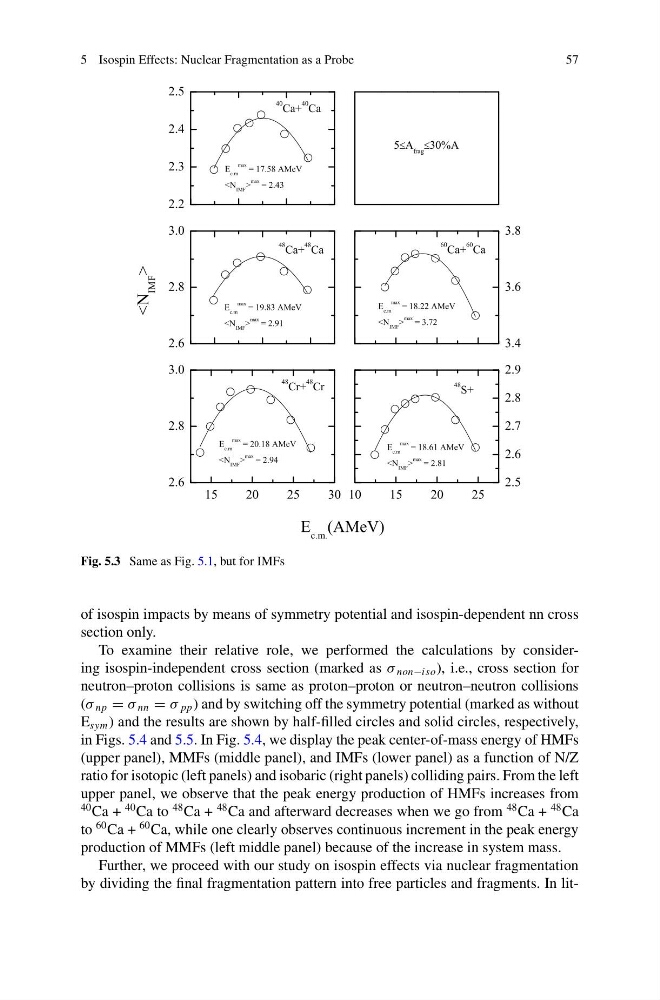
Fig. 5.3 Same as Fig. 5.1, but for IMFs
of isospin impacts by means of symmetry potential and isospin-dependent nn cross
section only.
To examine their relative role, we performed the calculations by considering isospin-independent cross section (marked as σ non−iso ), i.e., cross section for
neutron–proton collisions is same as proton–proton or neutron–neutron collisions
(σ np = σ nn = σ pp ) and by switching off the symmetry potential (marked as without
E sym ) and the results are shown by half-filled circles and solid circles, respectively,
in Figs. 5.4 and 5.5. In Fig. 5.4, we display the peak center-of-mass energy of HMFs
(upper panel), MMFs (middle panel), and IMFs (lower panel) as a function of N/Z
ratio for isotopic (left panels) and isobaric (right panels) colliding pairs. From the left
upper panel, we observe that the peak energy production of HMFs increases from
40 Ca +
40 Ca to
48 Ca +
48 Ca and afterward decreases when we go from
48 Ca +
48 Ca
to
60 Ca +
60 Ca, while one clearly observes continuous increment in the peak energy
production of MMFs (left middle panel) because of the increase in system mass.
Further, we proceed with our study on isospin effects via nuclear fragmentation
by dividing the final fragmentation pattern into free particles and fragments. In lit-
57
Fig. 5.3 Same as Fig. 5.1, but for IMFs
of isospin impacts by means of symmetry potential and isospin-dependent nn cross
section only.
To examine their relative role, we performed the calculations by considering isospin-independent cross section (marked as σ non−iso ), i.e., cross section for
neutron–proton collisions is same as proton–proton or neutron–neutron collisions
(σ np = σ nn = σ pp ) and by switching off the symmetry potential (marked as without
E sym ) and the results are shown by half-filled circles and solid circles, respectively,
in Figs. 5.4 and 5.5. In Fig. 5.4, we display the peak center-of-mass energy of HMFs
(upper panel), MMFs (middle panel), and IMFs (lower panel) as a function of N/Z
ratio for isotopic (left panels) and isobaric (right panels) colliding pairs. From the left
upper panel, we observe that the peak energy production of HMFs increases from
40 Ca +
40 Ca to
48 Ca +
48 Ca and afterward decreases when we go from
48 Ca +
48 Ca
to
60 Ca +
60 Ca, while one clearly observes continuous increment in the peak energy
production of MMFs (left middle panel) because of the increase in system mass.
Further, we proceed with our study on isospin effects via nuclear fragmentation
by dividing the final fragmentation pattern into free particles and fragments. In lit-