

56
P. Bansal et al.
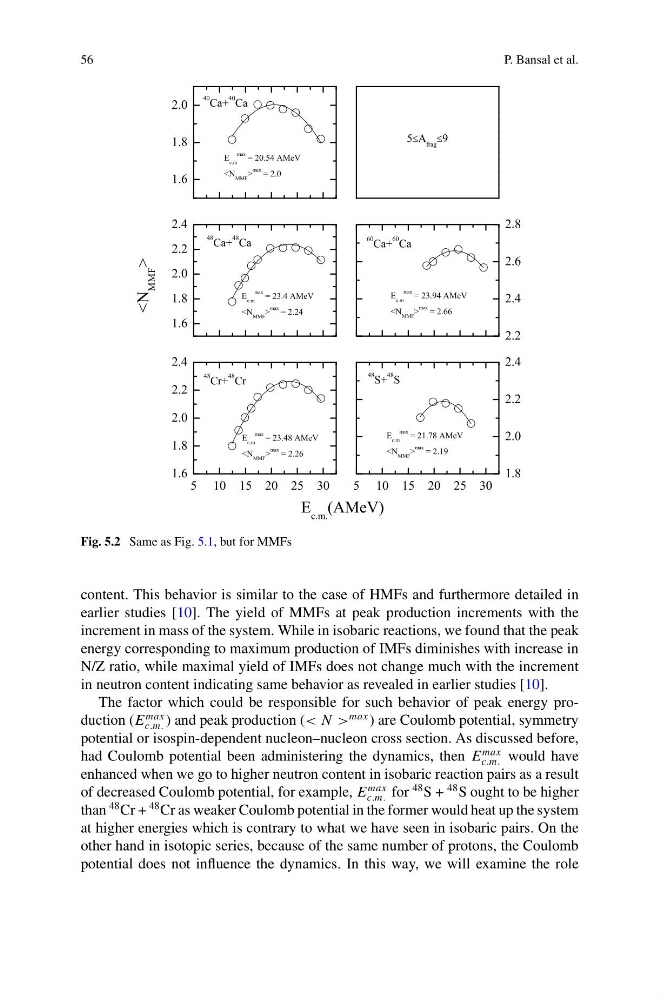
Fig. 5.2 Same as Fig. 5.1, but for MMFs
content. This behavior is similar to the case of HMFs and furthermore detailed in
earlier studies [10]. The yield of MMFs at peak production increments with the
increment in mass of the system. While in isobaric reactions, we found that the peak
energy corresponding to maximum production of IMFs diminishes with increase in
N/Z ratio, while maximal yield of IMFs does not change much with the increment
in neutron content indicating same behavior as revealed in earlier studies [10].
The factor which could be responsible for such behavior of peak energy production (E
max
c.m. ) and peak production (< N >
max ) are Coulomb potential, symmetry
potential or isospin-dependent nucleon–nucleon cross section. As discussed before,
had Coulomb potential been administering the dynamics, then E
max
c.m. would have
enhanced when we go to higher neutron content in isobaric reaction pairs as a result
of decreased Coulomb potential, for example, E
max
c.m. for
48 S +
48 S ought to be higher
than
48 Cr +
48 Cr as weaker Coulomb potential in the former would heat up the system
at higher energies which is contrary to what we have seen in isobaric pairs. On the
other hand in isotopic series, because of the same number of protons, the Coulomb
potential does not influence the dynamics. In this way, we will examine the role
P. Bansal et al.
Fig. 5.2 Same as Fig. 5.1, but for MMFs
content. This behavior is similar to the case of HMFs and furthermore detailed in
earlier studies [10]. The yield of MMFs at peak production increments with the
increment in mass of the system. While in isobaric reactions, we found that the peak
energy corresponding to maximum production of IMFs diminishes with increase in
N/Z ratio, while maximal yield of IMFs does not change much with the increment
in neutron content indicating same behavior as revealed in earlier studies [10].
The factor which could be responsible for such behavior of peak energy production (E
max
c.m. ) and peak production (< N >
max ) are Coulomb potential, symmetry
potential or isospin-dependent nucleon–nucleon cross section. As discussed before,
had Coulomb potential been administering the dynamics, then E
max
c.m. would have
enhanced when we go to higher neutron content in isobaric reaction pairs as a result
of decreased Coulomb potential, for example, E
max
c.m. for
48 S +
48 S ought to be higher
than
48 Cr +
48 Cr as weaker Coulomb potential in the former would heat up the system
at higher energies which is contrary to what we have seen in isobaric pairs. On the
other hand in isotopic series, because of the same number of protons, the Coulomb
potential does not influence the dynamics. In this way, we will examine the role