

5 Isospin Effects: Nuclear Fragmentation as a Probe
55
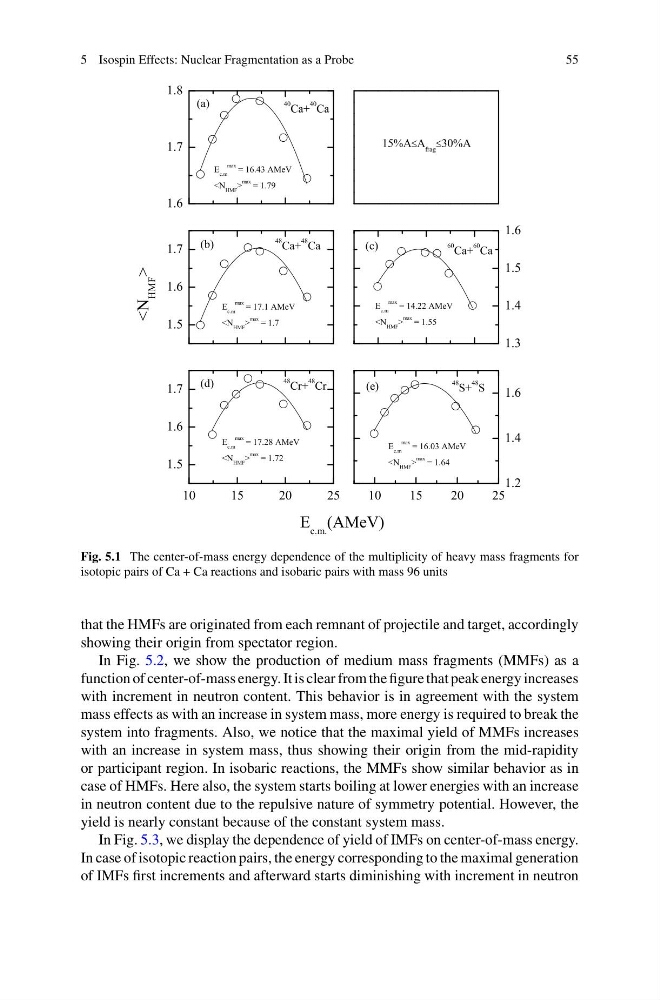
Fig. 5.1 The center-of-mass energy dependence of the multiplicity of heavy mass fragments for
isotopic pairs of Ca + Ca reactions and isobaric pairs with mass 96 units
that the HMFs are originated from each remnant of projectile and target, accordingly
showing their origin from spectator region.
In Fig. 5.2, we show the production of medium mass fragments (MMFs) as a
function of center-of-mass energy. It is clear from the figure that peak energy increases
with increment in neutron content. This behavior is in agreement with the system
mass effects as with an increase in system mass, more energy is required to break the
system into fragments. Also, we notice that the maximal yield of MMFs increases
with an increase in system mass, thus showing their origin from the mid-rapidity
or participant region. In isobaric reactions, the MMFs show similar behavior as in
case of HMFs. Here also, the system starts boiling at lower energies with an increase
in neutron content due to the repulsive nature of symmetry potential. However, the
yield is nearly constant because of the constant system mass.
In Fig. 5.3, we display the dependence of yield of IMFs on center-of-mass energy.
In case of isotopic reaction pairs, the energy corresponding to the maximal generation
of IMFs first increments and afterward starts diminishing with increment in neutron
55
Fig. 5.1 The center-of-mass energy dependence of the multiplicity of heavy mass fragments for
isotopic pairs of Ca + Ca reactions and isobaric pairs with mass 96 units
that the HMFs are originated from each remnant of projectile and target, accordingly
showing their origin from spectator region.
In Fig. 5.2, we show the production of medium mass fragments (MMFs) as a
function of center-of-mass energy. It is clear from the figure that peak energy increases
with increment in neutron content. This behavior is in agreement with the system
mass effects as with an increase in system mass, more energy is required to break the
system into fragments. Also, we notice that the maximal yield of MMFs increases
with an increase in system mass, thus showing their origin from the mid-rapidity
or participant region. In isobaric reactions, the MMFs show similar behavior as in
case of HMFs. Here also, the system starts boiling at lower energies with an increase
in neutron content due to the repulsive nature of symmetry potential. However, the
yield is nearly constant because of the constant system mass.
In Fig. 5.3, we display the dependence of yield of IMFs on center-of-mass energy.
In case of isotopic reaction pairs, the energy corresponding to the maximal generation
of IMFs first increments and afterward starts diminishing with increment in neutron