

5 Isospin Effects: Nuclear Fragmentation as a Probe
59
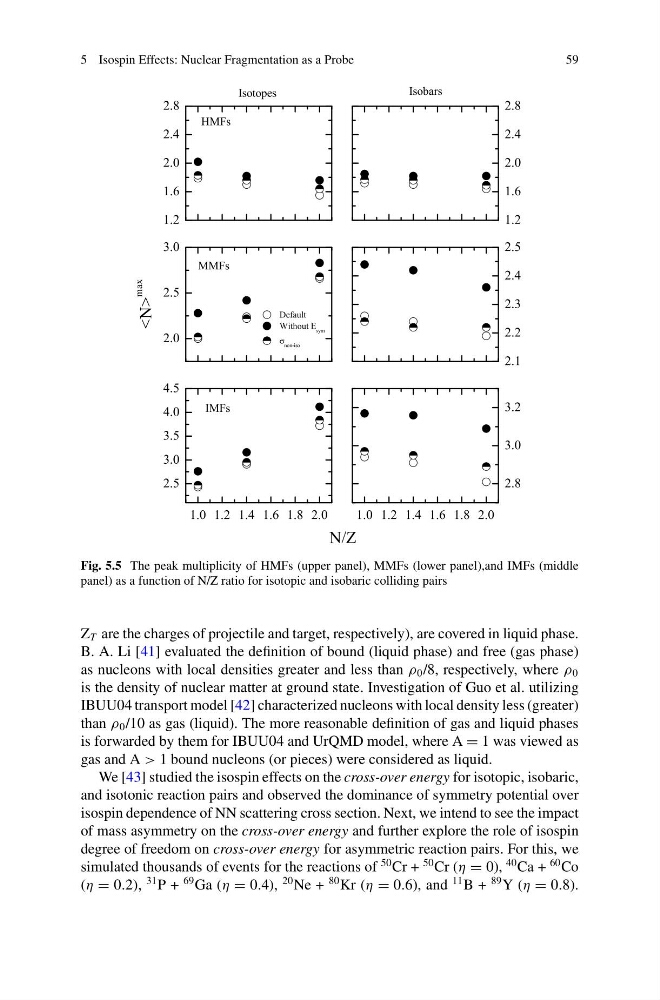
Fig. 5.5 The peak multiplicity of HMFs (upper panel), MMFs (lower panel),and IMFs (middle
panel) as a function of N/Z ratio for isotopic and isobaric colliding pairs
Z T are the charges of projectile and target, respectively), are covered in liquid phase.
B. A. Li [41] evaluated the definition of bound (liquid phase) and free (gas phase)
as nucleons with local densities greater and less than ρ 0 /8, respectively, where ρ 0
is the density of nuclear matter at ground state. Investigation of Guo et al. utilizing
IBUU04 transport model [42] characterized nucleons with local density less (greater)
than ρ 0 /10 as gas (liquid). The more reasonable definition of gas and liquid phases
is forwarded by them for IBUU04 and UrQMD model, where A = 1 was viewed as
gas and A > 1 bound nucleons (or pieces) were considered as liquid.
We [43] studied the isospin effects on the cross-over energy for isotopic, isobaric,
and isotonic reaction pairs and observed the dominance of symmetry potential over
isospin dependence of NN scattering cross section. Next, we intend to see the impact
of mass asymmetry on the cross-over energy and further explore the role of isospin
degree of freedom on cross-over energy for asymmetric reaction pairs. For this, we
simulated thousands of events for the reactions of
50 Cr +
50 Cr (η = 0),
40 Ca +
60 Co
(η = 0.2),
31 P +
69 Ga (η = 0.4),
20 Ne +
80 Kr (η = 0.6), and
11 B +
89 Y (η = 0.8).
59
Fig. 5.5 The peak multiplicity of HMFs (upper panel), MMFs (lower panel),and IMFs (middle
panel) as a function of N/Z ratio for isotopic and isobaric colliding pairs
Z T are the charges of projectile and target, respectively), are covered in liquid phase.
B. A. Li [41] evaluated the definition of bound (liquid phase) and free (gas phase)
as nucleons with local densities greater and less than ρ 0 /8, respectively, where ρ 0
is the density of nuclear matter at ground state. Investigation of Guo et al. utilizing
IBUU04 transport model [42] characterized nucleons with local density less (greater)
than ρ 0 /10 as gas (liquid). The more reasonable definition of gas and liquid phases
is forwarded by them for IBUU04 and UrQMD model, where A = 1 was viewed as
gas and A > 1 bound nucleons (or pieces) were considered as liquid.
We [43] studied the isospin effects on the cross-over energy for isotopic, isobaric,
and isotonic reaction pairs and observed the dominance of symmetry potential over
isospin dependence of NN scattering cross section. Next, we intend to see the impact
of mass asymmetry on the cross-over energy and further explore the role of isospin
degree of freedom on cross-over energy for asymmetric reaction pairs. For this, we
simulated thousands of events for the reactions of
50 Cr +
50 Cr (η = 0),
40 Ca +
60 Co
(η = 0.2),
31 P +
69 Ga (η = 0.4),
20 Ne +
80 Kr (η = 0.6), and
11 B +
89 Y (η = 0.8).