

38
S. Mallik et al.
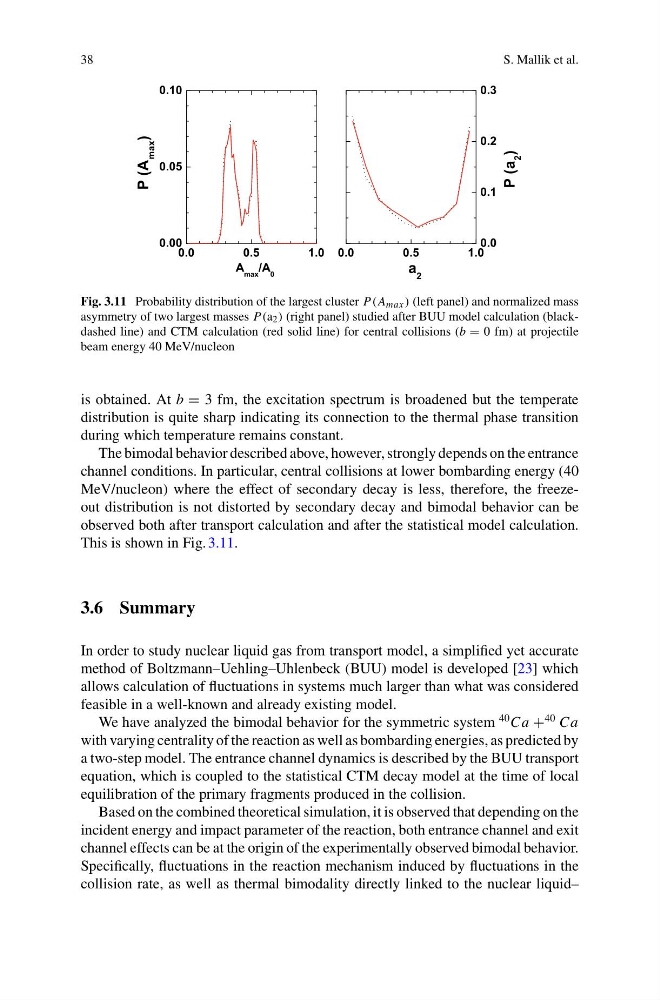
Fig. 3.11 Probability distribution of the largest cluster P(A max ) (left panel) and normalized mass
asymmetry of two largest masses P(a 2 ) (right panel) studied after BUU model calculation (blackdashed line) and CTM calculation (red solid line) for central collisions (b = 0 fm) at projectile
beam energy 40 MeV/nucleon
is obtained. At b = 3 fm, the excitation spectrum is broadened but the temperate
distribution is quite sharp indicating its connection to the thermal phase transition
during which temperature remains constant.
The bimodal behavior described above, however, strongly depends on the entrance
channel conditions. In particular, central collisions at lower bombarding energy (40
MeV/nucleon) where the effect of secondary decay is less, therefore, the freezeout distribution is not distorted by secondary decay and bimodal behavior can be
observed both after transport calculation and after the statistical model calculation.
This is shown in Fig. 3.11.
3.6 Summary
In order to study nuclear liquid gas from transport model, a simplified yet accurate
method of Boltzmann–Uehling–Uhlenbeck (BUU) model is developed [23] which
allows calculation of fluctuations in systems much larger than what was considered
feasible in a well-known and already existing model.
We have analyzed the bimodal behavior for the symmetric system
40 Ca +
40 Ca
with varying centrality of the reaction as well as bombarding energies, as predicted by
a two-step model. The entrance channel dynamics is described by the BUU transport
equation, which is coupled to the statistical CTM decay model at the time of local
equilibration of the primary fragments produced in the collision.
Based on the combined theoretical simulation, it is observed that depending on the
incident energy and impact parameter of the reaction, both entrance channel and exit
channel effects can be at the origin of the experimentally observed bimodal behavior.
Specifically, fluctuations in the reaction mechanism induced by fluctuations in the
collision rate, as well as thermal bimodality directly linked to the nuclear liquid–
S. Mallik et al.
Fig. 3.11 Probability distribution of the largest cluster P(A max ) (left panel) and normalized mass
asymmetry of two largest masses P(a 2 ) (right panel) studied after BUU model calculation (blackdashed line) and CTM calculation (red solid line) for central collisions (b = 0 fm) at projectile
beam energy 40 MeV/nucleon
is obtained. At b = 3 fm, the excitation spectrum is broadened but the temperate
distribution is quite sharp indicating its connection to the thermal phase transition
during which temperature remains constant.
The bimodal behavior described above, however, strongly depends on the entrance
channel conditions. In particular, central collisions at lower bombarding energy (40
MeV/nucleon) where the effect of secondary decay is less, therefore, the freezeout distribution is not distorted by secondary decay and bimodal behavior can be
observed both after transport calculation and after the statistical model calculation.
This is shown in Fig. 3.11.
3.6 Summary
In order to study nuclear liquid gas from transport model, a simplified yet accurate
method of Boltzmann–Uehling–Uhlenbeck (BUU) model is developed [23] which
allows calculation of fluctuations in systems much larger than what was considered
feasible in a well-known and already existing model.
We have analyzed the bimodal behavior for the symmetric system
40 Ca +
40 Ca
with varying centrality of the reaction as well as bombarding energies, as predicted by
a two-step model. The entrance channel dynamics is described by the BUU transport
equation, which is coupled to the statistical CTM decay model at the time of local
equilibration of the primary fragments produced in the collision.
Based on the combined theoretical simulation, it is observed that depending on the
incident energy and impact parameter of the reaction, both entrance channel and exit
channel effects can be at the origin of the experimentally observed bimodal behavior.
Specifically, fluctuations in the reaction mechanism induced by fluctuations in the
collision rate, as well as thermal bimodality directly linked to the nuclear liquid–