

3 Statistical and Dynamical Bimodality in Multifragmentation Reactions
37
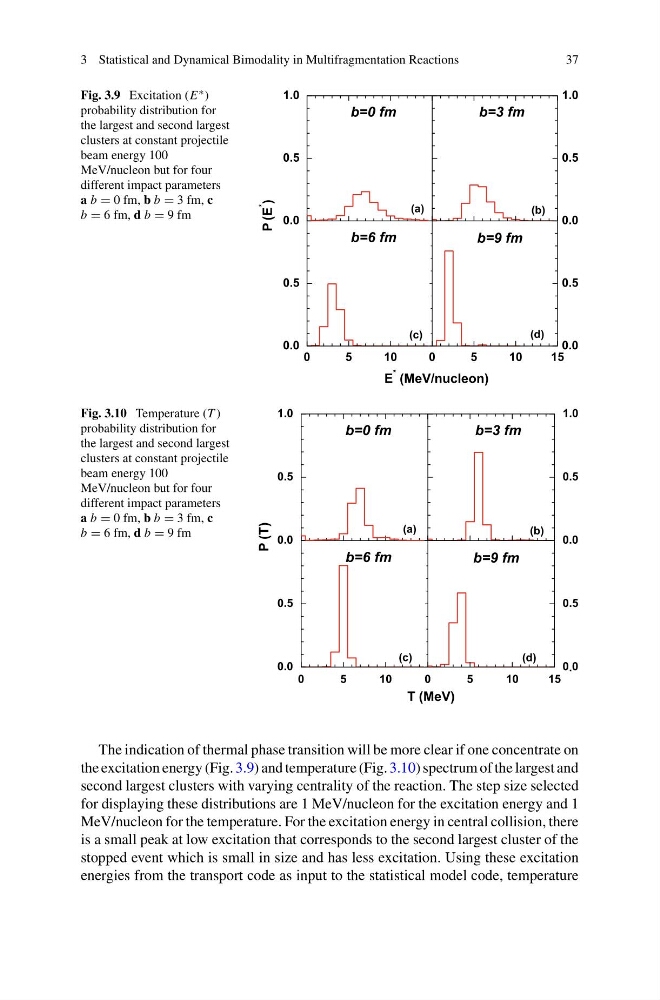
Fig. 3.9 Excitation (E ∗ )
probability distribution for
the largest and second largest
clusters at constant projectile
beam energy 100
MeV/nucleon but for four
different impact parameters
a b = 0 fm, b b = 3 fm, c
b = 6 fm, d b = 9 fm
Fig. 3.10 Temperature (T )
probability distribution for
the largest and second largest
clusters at constant projectile
beam energy 100
MeV/nucleon but for four
different impact parameters
a b = 0 fm, b b = 3 fm, c
b = 6 fm, d b = 9 fm
The indication of thermal phase transition will be more clear if one concentrate on
the excitation energy (Fig. 3.9) and temperature (Fig. 3.10) spectrum of the largest and
second largest clusters with varying centrality of the reaction. The step size selected
for displaying these distributions are 1 MeV/nucleon for the excitation energy and 1
MeV/nucleon for the temperature. For the excitation energy in central collision, there
is a small peak at low excitation that corresponds to the second largest cluster of the
stopped event which is small in size and has less excitation. Using these excitation
energies from the transport code as input to the statistical model code, temperature
37
Fig. 3.9 Excitation (E ∗ )
probability distribution for
the largest and second largest
clusters at constant projectile
beam energy 100
MeV/nucleon but for four
different impact parameters
a b = 0 fm, b b = 3 fm, c
b = 6 fm, d b = 9 fm
Fig. 3.10 Temperature (T )
probability distribution for
the largest and second largest
clusters at constant projectile
beam energy 100
MeV/nucleon but for four
different impact parameters
a b = 0 fm, b b = 3 fm, c
b = 6 fm, d b = 9 fm
The indication of thermal phase transition will be more clear if one concentrate on
the excitation energy (Fig. 3.9) and temperature (Fig. 3.10) spectrum of the largest and
second largest clusters with varying centrality of the reaction. The step size selected
for displaying these distributions are 1 MeV/nucleon for the excitation energy and 1
MeV/nucleon for the temperature. For the excitation energy in central collision, there
is a small peak at low excitation that corresponds to the second largest cluster of the
stopped event which is small in size and has less excitation. Using these excitation
energies from the transport code as input to the statistical model code, temperature