

266
A. Quddus and S. K. Patra
E cm = −
3
4
× 41A
−1/3
.
(18.3)
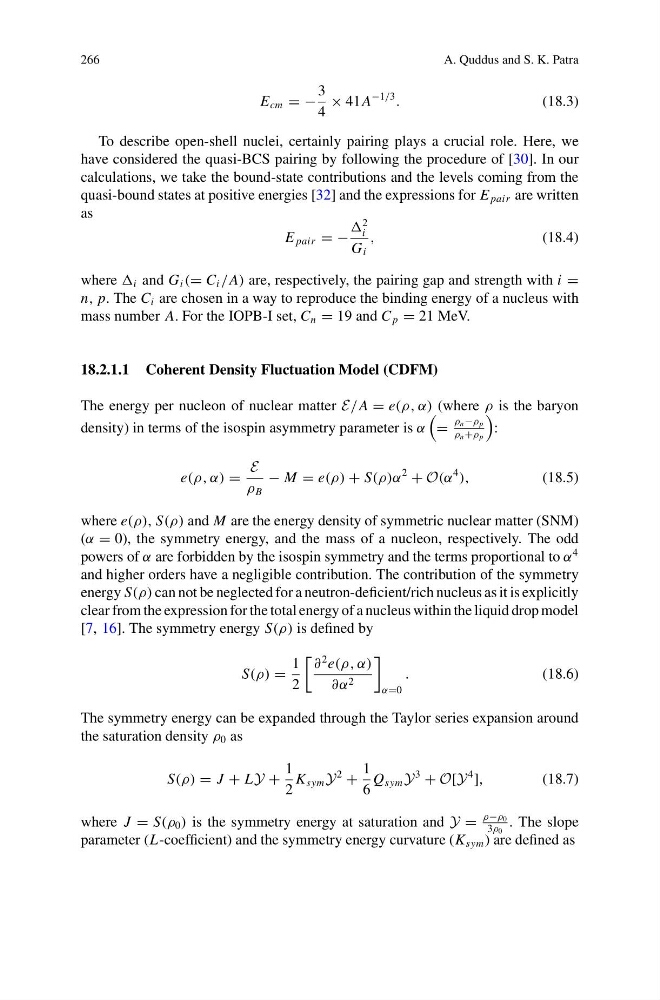
To describe open-shell nuclei, certainly pairing plays a crucial role. Here, we
have considered the quasi-BCS pairing by following the procedure of [30]. In our
calculations, we take the bound-state contributions and the levels coming from the
quasi-bound states at positive energies [32] and the expressions for E pair are written
as
E pair = −
2
i
G i
,
(18.4)
where i and G i (= C i /A) are, respectively, the pairing gap and strength with i =
n, p. The C i are chosen in a way to reproduce the binding energy of a nucleus with
mass number A. For the IOPB-I set, C n = 19 and C p = 21 MeV.
18.2.1.1 Coherent Density Fluctuation Model (CDFM)
The energy per nucleon of nuclear matter E/A = e(ρ, α) (where ρ is the baryon
density) in terms of the isospin asymmetry parameter is α
=
ρ n −ρ p
ρ n +ρ p
:
e(ρ, α) =
E
ρ B
− M = e(ρ) + S(ρ)α
2
+ O(α
4
),
(18.5)
where e(ρ), S(ρ) and M are the energy density of symmetric nuclear matter (SNM)
(α = 0), the symmetry energy, and the mass of a nucleon, respectively. The odd
powers of α are forbidden by the isospin symmetry and the terms proportional to α
4
and higher orders have a negligible contribution. The contribution of the symmetry
energy S(ρ) can not be neglected for a neutron-deficient/rich nucleus as it is explicitly
clear from the expression for the total energy of a nucleus within the liquid drop model
[7, 16]. The symmetry energy S(ρ) is defined by
S(ρ) =
1
2
∂
2 e(ρ, α)
∂α 2
α=0
.
(18.6)
The symmetry energy can be expanded through the Taylor series expansion around
the saturation density ρ 0 as
S(ρ) = J + LY +
1
2
K sym Y
2
+
1
6
Q sym Y
3
+ O[Y
4
],
(18.7)
where J = S(ρ 0 ) is the symmetry energy at saturation and Y =
ρ−ρ 0
3ρ 0
. The slope
parameter (L-coefficient) and the symmetry energy curvature (K sym ) are defined as
A. Quddus and S. K. Patra
E cm = −
3
4
× 41A
−1/3
.
(18.3)
To describe open-shell nuclei, certainly pairing plays a crucial role. Here, we
have considered the quasi-BCS pairing by following the procedure of [30]. In our
calculations, we take the bound-state contributions and the levels coming from the
quasi-bound states at positive energies [32] and the expressions for E pair are written
as
E pair = −
2
i
G i
,
(18.4)
where i and G i (= C i /A) are, respectively, the pairing gap and strength with i =
n, p. The C i are chosen in a way to reproduce the binding energy of a nucleus with
mass number A. For the IOPB-I set, C n = 19 and C p = 21 MeV.
18.2.1.1 Coherent Density Fluctuation Model (CDFM)
The energy per nucleon of nuclear matter E/A = e(ρ, α) (where ρ is the baryon
density) in terms of the isospin asymmetry parameter is α
=
ρ n −ρ p
ρ n +ρ p
:
e(ρ, α) =
E
ρ B
− M = e(ρ) + S(ρ)α
2
+ O(α
4
),
(18.5)
where e(ρ), S(ρ) and M are the energy density of symmetric nuclear matter (SNM)
(α = 0), the symmetry energy, and the mass of a nucleon, respectively. The odd
powers of α are forbidden by the isospin symmetry and the terms proportional to α
4
and higher orders have a negligible contribution. The contribution of the symmetry
energy S(ρ) can not be neglected for a neutron-deficient/rich nucleus as it is explicitly
clear from the expression for the total energy of a nucleus within the liquid drop model
[7, 16]. The symmetry energy S(ρ) is defined by
S(ρ) =
1
2
∂
2 e(ρ, α)
∂α 2
α=0
.
(18.6)
The symmetry energy can be expanded through the Taylor series expansion around
the saturation density ρ 0 as
S(ρ) = J + LY +
1
2
K sym Y
2
+
1
6
Q sym Y
3
+ O[Y
4
],
(18.7)
where J = S(ρ 0 ) is the symmetry energy at saturation and Y =
ρ−ρ 0
3ρ 0
. The slope
parameter (L-coefficient) and the symmetry energy curvature (K sym ) are defined as