

18 Effective Surface Properties of Light and Medium Mass Exotic-Nuclei
267
L = 3ρ
∂ S(ρ)
∂ρ
ρ=ρ 0
,
(18.8)
K sym = 9ρ
2 ∂
2 S(ρ)
∂ρ 2
ρ=ρ 0
,
(18.9)
respectively.
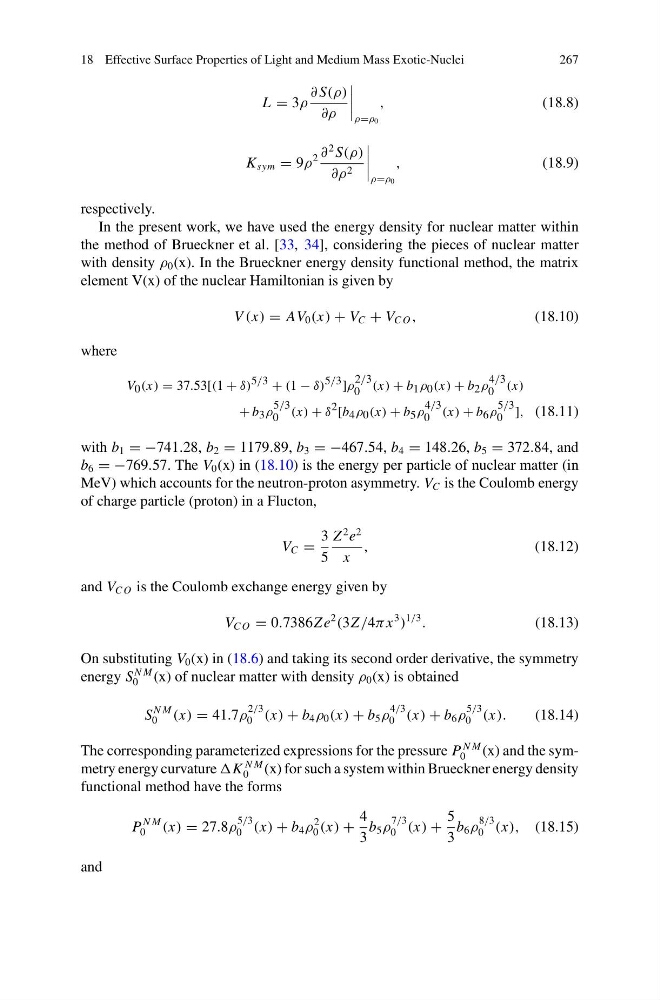
In the present work, we have used the energy density for nuclear matter within
the method of Brueckner et al. [33, 34], considering the pieces of nuclear matter
with density ρ 0 (x). In the Brueckner energy density functional method, the matrix
element V(x) of the nuclear Hamiltonian is given by
V (x) = AV 0 (x) + V C + V C O ,
(18.10)
where
V 0 (x) = 37.53[(1 + δ) 5/3 + (1 − δ) 5/3 ]ρ
2/3
0 (x) + b 1 ρ 0 (x) + b 2 ρ
4/3
0 (x)
+ b 3 ρ
5/3
0 (x) + δ 2 [b 4 ρ 0 (x) + b 5 ρ
4/3
0 (x) + b 6 ρ
5/3
0 ], (18.11)
with b 1 = −741.28, b 2 = 1179.89, b 3 = −467.54, b 4 = 148.26, b 5 = 372.84, and
b 6 = −769.57. The V 0 (x) in (18.10) is the energy per particle of nuclear matter (in
MeV) which accounts for the neutron-proton asymmetry. V C is the Coulomb energy
of charge particle (proton) in a Flucton,
V C =
3
5
Z
2 e
2
x
,
(18.12)
and V C O is the Coulomb exchange energy given by
V C O = 0.7386Ze
2
(3Z /4π x
3
)
1/3
.
(18.13)
On substituting V 0 (x) in (18.6) and taking its second order derivative, the symmetry
energy S
N M
0 (x) of nuclear matter with density ρ 0 (x) is obtained
S
N M
0 (x) = 41.7ρ
2/3
0 (x) + b 4 ρ 0 (x) + b 5 ρ
4/3
0 (x) + b 6 ρ
5/3
0 (x).
(18.14)
The corresponding parameterized expressions for the pressure P
N M
0
(x) and the symmetry energy curvature K
N M
0
(x) for such a system within Brueckner energy density
functional method have the forms
P
N M
0
(x) = 27.8ρ
5/3
0 (x) + b 4 ρ
2
0 (x) +
4
3
b 5 ρ
7/3
0 (x) +
5
3
b 6 ρ
8/3
0 (x), (18.15)
and
267
L = 3ρ
∂ S(ρ)
∂ρ
ρ=ρ 0
,
(18.8)
K sym = 9ρ
2 ∂
2 S(ρ)
∂ρ 2
ρ=ρ 0
,
(18.9)
respectively.
In the present work, we have used the energy density for nuclear matter within
the method of Brueckner et al. [33, 34], considering the pieces of nuclear matter
with density ρ 0 (x). In the Brueckner energy density functional method, the matrix
element V(x) of the nuclear Hamiltonian is given by
V (x) = AV 0 (x) + V C + V C O ,
(18.10)
where
V 0 (x) = 37.53[(1 + δ) 5/3 + (1 − δ) 5/3 ]ρ
2/3
0 (x) + b 1 ρ 0 (x) + b 2 ρ
4/3
0 (x)
+ b 3 ρ
5/3
0 (x) + δ 2 [b 4 ρ 0 (x) + b 5 ρ
4/3
0 (x) + b 6 ρ
5/3
0 ], (18.11)
with b 1 = −741.28, b 2 = 1179.89, b 3 = −467.54, b 4 = 148.26, b 5 = 372.84, and
b 6 = −769.57. The V 0 (x) in (18.10) is the energy per particle of nuclear matter (in
MeV) which accounts for the neutron-proton asymmetry. V C is the Coulomb energy
of charge particle (proton) in a Flucton,
V C =
3
5
Z
2 e
2
x
,
(18.12)
and V C O is the Coulomb exchange energy given by
V C O = 0.7386Ze
2
(3Z /4π x
3
)
1/3
.
(18.13)
On substituting V 0 (x) in (18.6) and taking its second order derivative, the symmetry
energy S
N M
0 (x) of nuclear matter with density ρ 0 (x) is obtained
S
N M
0 (x) = 41.7ρ
2/3
0 (x) + b 4 ρ 0 (x) + b 5 ρ
4/3
0 (x) + b 6 ρ
5/3
0 (x).
(18.14)
The corresponding parameterized expressions for the pressure P
N M
0
(x) and the symmetry energy curvature K
N M
0
(x) for such a system within Brueckner energy density
functional method have the forms
P
N M
0
(x) = 27.8ρ
5/3
0 (x) + b 4 ρ
2
0 (x) +
4
3
b 5 ρ
7/3
0 (x) +
5
3
b 6 ρ
8/3
0 (x), (18.15)
and