

18 Effective Surface Properties of Light and Medium Mass Exotic-Nuclei
265
18.2.1 Relativistic Mean Field Theory
Relativistic mean field (RMF) theory is one of the most successful microscopic
approaches to solve the many body problem of nuclear system, where the nucleons are
assumed to interact through the exchange of mesons. It predicts well the properties of
finite nuclei and infinite nuclear matter as well. The effective field theory motivated
relativistic mean field model (E-RMF) is just an extension of RMF in which, in
principle, all possible types of self and cross-couplings of mesons are considered.
To handle E-RMF numerically, the ratios of fields and the nucleon mass are used
in the truncation scheme as a constrain of naturalness. The detailed formalism of
E-RMF model and its various parameterizations can be found in [27–31]. Here for
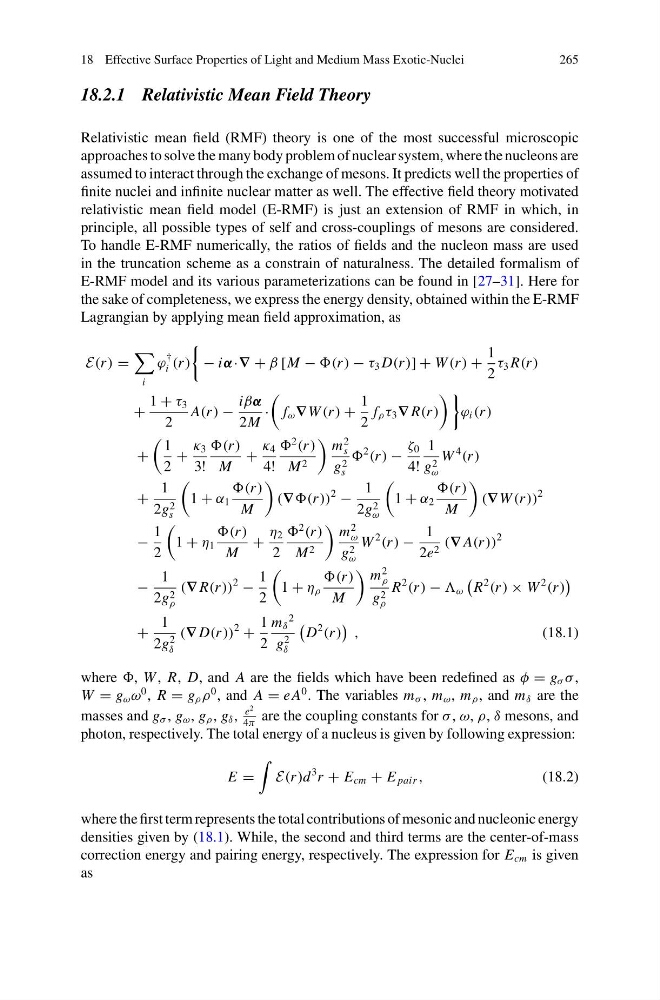
the sake of completeness, we express the energy density, obtained within the E-RMF
Lagrangian by applying mean field approximation, as
E(r ) =
i
ϕ
†
i (r )
− iα·∇ + β [M − (r ) − τ 3 D(r )] + W (r ) +
1
2
τ 3 R(r )
+
1 + τ 3
2
A(r ) −
iβα
2M
·
f ω ∇W (r ) +
1
2
f ρ τ 3 ∇ R(r )
ϕ i (r )
+
1
2
+
κ 3
3!
(r )
M
+
κ 4
4!
2
(r )
M 2
m
2
s
g 2
s
2
(r ) −
ζ 0
4!
1
g 2
ω
W
4
(r )
+
1
2g 2
s
1 + α 1
(r )
M
(∇(r ))
2
−
1
2g 2
ω
1 + α 2
(r )
M
(∇W (r ))
2
−
1
2
1 + η 1
(r )
M
+
η 2
2
2
(r )
M 2
m
2
ω
g 2
ω
W
2
(r ) −
1
2e 2 (∇ A(r ))
2
−
1
2g 2
ρ
(∇ R(r ))
2
−
1
2
1 + η ρ
(r )
M
m
2
ρ
g 2
ρ
R
2
(r ) − ω
R
2
(r ) × W
2
(r )
+
1
2g
2
δ
(∇ D(r ))
2
+
1
2
m δ
2
g
2
δ
D
2
(r )
,
(18.1)
where , W , R, D, and A are the fields which have been redefined as φ = g σ σ ,
W = g ω ω
0 , R = g ρ ρ
0 , and A = e A
0 . The variables m σ , m ω , m ρ , and m δ are the
masses and g σ , g ω , g ρ , g δ ,
e
2
4π
are the coupling constants for σ , ω, ρ, δ mesons, and
photon, respectively. The total energy of a nucleus is given by following expression:
E =
E(r )d
3 r + E cm + E pair ,
(18.2)
where the first term represents the total contributions of mesonic and nucleonic energy
densities given by (18.1). While, the second and third terms are the center-of-mass
correction energy and pairing energy, respectively. The expression for E cm is given
as
265
18.2.1 Relativistic Mean Field Theory
Relativistic mean field (RMF) theory is one of the most successful microscopic
approaches to solve the many body problem of nuclear system, where the nucleons are
assumed to interact through the exchange of mesons. It predicts well the properties of
finite nuclei and infinite nuclear matter as well. The effective field theory motivated
relativistic mean field model (E-RMF) is just an extension of RMF in which, in
principle, all possible types of self and cross-couplings of mesons are considered.
To handle E-RMF numerically, the ratios of fields and the nucleon mass are used
in the truncation scheme as a constrain of naturalness. The detailed formalism of
E-RMF model and its various parameterizations can be found in [27–31]. Here for
the sake of completeness, we express the energy density, obtained within the E-RMF
Lagrangian by applying mean field approximation, as
E(r ) =
i
ϕ
†
i (r )
− iα·∇ + β [M − (r ) − τ 3 D(r )] + W (r ) +
1
2
τ 3 R(r )
+
1 + τ 3
2
A(r ) −
iβα
2M
·
f ω ∇W (r ) +
1
2
f ρ τ 3 ∇ R(r )
ϕ i (r )
+
1
2
+
κ 3
3!
(r )
M
+
κ 4
4!
2
(r )
M 2
m
2
s
g 2
s
2
(r ) −
ζ 0
4!
1
g 2
ω
W
4
(r )
+
1
2g 2
s
1 + α 1
(r )
M
(∇(r ))
2
−
1
2g 2
ω
1 + α 2
(r )
M
(∇W (r ))
2
−
1
2
1 + η 1
(r )
M
+
η 2
2
2
(r )
M 2
m
2
ω
g 2
ω
W
2
(r ) −
1
2e 2 (∇ A(r ))
2
−
1
2g 2
ρ
(∇ R(r ))
2
−
1
2
1 + η ρ
(r )
M
m
2
ρ
g 2
ρ
R
2
(r ) − ω
R
2
(r ) × W
2
(r )
+
1
2g
2
δ
(∇ D(r ))
2
+
1
2
m δ
2
g
2
δ
D
2
(r )
,
(18.1)
where , W , R, D, and A are the fields which have been redefined as φ = g σ σ ,
W = g ω ω
0 , R = g ρ ρ
0 , and A = e A
0 . The variables m σ , m ω , m ρ , and m δ are the
masses and g σ , g ω , g ρ , g δ ,
e
2
4π
are the coupling constants for σ , ω, ρ, δ mesons, and
photon, respectively. The total energy of a nucleus is given by following expression:
E =
E(r )d
3 r + E cm + E pair ,
(18.2)
where the first term represents the total contributions of mesonic and nucleonic energy
densities given by (18.1). While, the second and third terms are the center-of-mass
correction energy and pairing energy, respectively. The expression for E cm is given
as