

17 Momentum and Density Dependence of the Nuclear Mean Field …
235
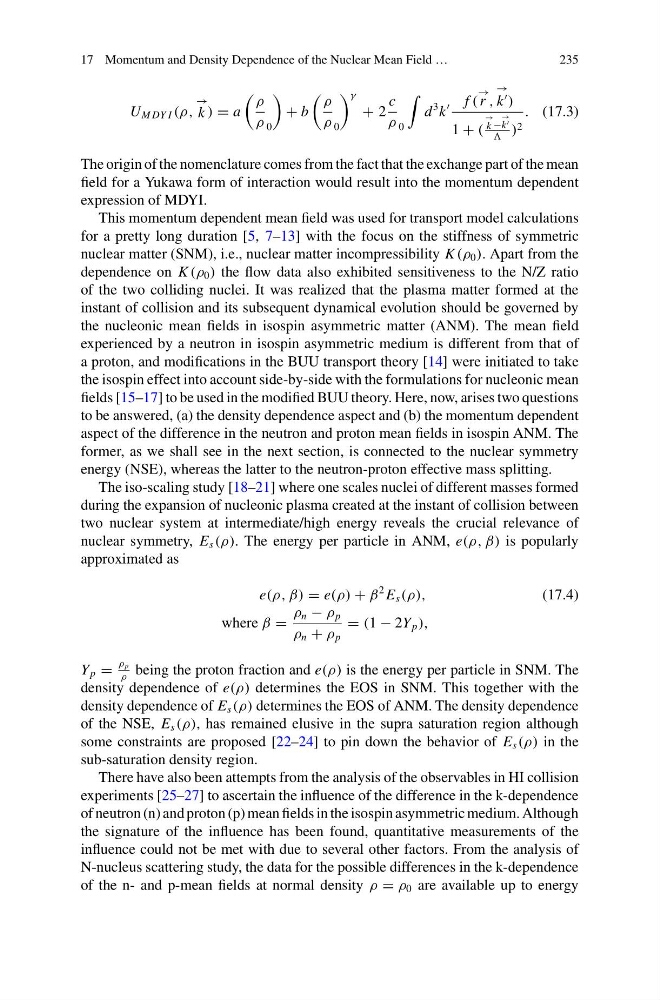
U M DY I (ρ,
→
k ) = a
ρ
ρ 0
+ b
ρ
ρ 0
γ
+ 2
c
ρ 0
d
3 k
f (
→
r ,
→
k
)
1 + (
→
k −
→
k
) 2
. (17.3)
The origin of the nomenclature comes from the fact that the exchange part of the mean
field for a Yukawa form of interaction would result into the momentum dependent
expression of MDYI.
This momentum dependent mean field was used for transport model calculations
for a pretty long duration [5, 7–13] with the focus on the stiffness of symmetric
nuclear matter (SNM), i.e., nuclear matter incompressibility K (ρ 0 ). Apart from the
dependence on K (ρ 0 ) the flow data also exhibited sensitiveness to the N/Z ratio
of the two colliding nuclei. It was realized that the plasma matter formed at the
instant of collision and its subsequent dynamical evolution should be governed by
the nucleonic mean fields in isospin asymmetric matter (ANM). The mean field
experienced by a neutron in isospin asymmetric medium is different from that of
a proton, and modifications in the BUU transport theory [14] were initiated to take
the isospin effect into account side-by-side with the formulations for nucleonic mean
fields [15–17] to be used in the modified BUU theory. Here, now, arises two questions
to be answered, (a) the density dependence aspect and (b) the momentum dependent
aspect of the difference in the neutron and proton mean fields in isospin ANM. The
former, as we shall see in the next section, is connected to the nuclear symmetry
energy (NSE), whereas the latter to the neutron-proton effective mass splitting.
The iso-scaling study [18–21] where one scales nuclei of different masses formed
during the expansion of nucleonic plasma created at the instant of collision between
two nuclear system at intermediate/high energy reveals the crucial relevance of
nuclear symmetry, E s (ρ). The energy per particle in ANM, e(ρ, β) is popularly
approximated as
e(ρ, β) = e(ρ) + β
2 E s (ρ),
(17.4)
where β =
ρ n − ρ p
ρ n + ρ p
= (1 − 2Y p ),
Y p =
ρ p
ρ
being the proton fraction and e(ρ) is the energy per particle in SNM. The
density dependence of e(ρ) determines the EOS in SNM. This together with the
density dependence of E s (ρ) determines the EOS of ANM. The density dependence
of the NSE, E s (ρ), has remained elusive in the supra saturation region although
some constraints are proposed [22–24] to pin down the behavior of E s (ρ) in the
sub-saturation density region.
There have also been attempts from the analysis of the observables in HI collision
experiments [25–27] to ascertain the influence of the difference in the k-dependence
of neutron (n) and proton (p) mean fields in the isospin asymmetric medium. Although
the signature of the influence has been found, quantitative measurements of the
influence could not be met with due to several other factors. From the analysis of
N-nucleus scattering study, the data for the possible differences in the k-dependence
of the n- and p-mean fields at normal density ρ = ρ 0 are available up to energy
235
U M DY I (ρ,
→
k ) = a
ρ
ρ 0
+ b
ρ
ρ 0
γ
+ 2
c
ρ 0
d
3 k
f (
→
r ,
→
k
)
1 + (
→
k −
→
k
) 2
. (17.3)
The origin of the nomenclature comes from the fact that the exchange part of the mean
field for a Yukawa form of interaction would result into the momentum dependent
expression of MDYI.
This momentum dependent mean field was used for transport model calculations
for a pretty long duration [5, 7–13] with the focus on the stiffness of symmetric
nuclear matter (SNM), i.e., nuclear matter incompressibility K (ρ 0 ). Apart from the
dependence on K (ρ 0 ) the flow data also exhibited sensitiveness to the N/Z ratio
of the two colliding nuclei. It was realized that the plasma matter formed at the
instant of collision and its subsequent dynamical evolution should be governed by
the nucleonic mean fields in isospin asymmetric matter (ANM). The mean field
experienced by a neutron in isospin asymmetric medium is different from that of
a proton, and modifications in the BUU transport theory [14] were initiated to take
the isospin effect into account side-by-side with the formulations for nucleonic mean
fields [15–17] to be used in the modified BUU theory. Here, now, arises two questions
to be answered, (a) the density dependence aspect and (b) the momentum dependent
aspect of the difference in the neutron and proton mean fields in isospin ANM. The
former, as we shall see in the next section, is connected to the nuclear symmetry
energy (NSE), whereas the latter to the neutron-proton effective mass splitting.
The iso-scaling study [18–21] where one scales nuclei of different masses formed
during the expansion of nucleonic plasma created at the instant of collision between
two nuclear system at intermediate/high energy reveals the crucial relevance of
nuclear symmetry, E s (ρ). The energy per particle in ANM, e(ρ, β) is popularly
approximated as
e(ρ, β) = e(ρ) + β
2 E s (ρ),
(17.4)
where β =
ρ n − ρ p
ρ n + ρ p
= (1 − 2Y p ),
Y p =
ρ p
ρ
being the proton fraction and e(ρ) is the energy per particle in SNM. The
density dependence of e(ρ) determines the EOS in SNM. This together with the
density dependence of E s (ρ) determines the EOS of ANM. The density dependence
of the NSE, E s (ρ), has remained elusive in the supra saturation region although
some constraints are proposed [22–24] to pin down the behavior of E s (ρ) in the
sub-saturation density region.
There have also been attempts from the analysis of the observables in HI collision
experiments [25–27] to ascertain the influence of the difference in the k-dependence
of neutron (n) and proton (p) mean fields in the isospin asymmetric medium. Although
the signature of the influence has been found, quantitative measurements of the
influence could not be met with due to several other factors. From the analysis of
N-nucleus scattering study, the data for the possible differences in the k-dependence
of the n- and p-mean fields at normal density ρ = ρ 0 are available up to energy