

234
T. R. Routray et al.
17.1 Introduction
In the heavy-ion (HI) collision at intermediate and high energy, the flow and particle
production are modeled by transport model equations using hydrodynamics. The
Boltzmann–Uehling–Uhlenbeck (BUU) equation is a popular transport equation [1]
developed that includes the stochastic collisions between individual nucleons, particle production, effects of the Pauli principle, and propagation between collisions
controlled by a mean field. Here, the mean field otherwise termed as the singleparticle potential is the key ingredient and in the early stage of development of the
subject the calculations were done using the simple version of the mean field,
U (ρ) = a
ρ
ρ 0
+ b
ρ
ρ 0
γ
.
(17.1)
The experimental data on pion production [2] and collective flow [3] could be reproduced with this form of the mean field in (17.1) for the value of γ that predicts a high
value of nuclear matter (NM) incompressibility, K (ρ 0 ) ∼ 380 MeV, is in disagreement with the microscopic calculations based on realistic interactions that reproduces
the nucleon–nucleon (NN) scattering data [4]. In the attempt to resolve this anomaly,
different groups [5, 6] have examined the impact of considering momentum dependence in the mean field. It was found that the momentum dependent mean field
could reproduce the flow data of HI collision for which the equation of state (EOS)
is relatively softer having K (ρ 0 ) ∼ 215 MeV, in contrast to the requirement of a very
stiff EOS in case of momentum independent mean field of type given in (17.1). This
finding demonstrated the crucial importance of momentum dependent aspect of the
nuclear mean field that was usually not given emphasis in earlier nuclear calculations.
The momentum k (we shall use the notations k P in the unit of ¯
h) dependent mean
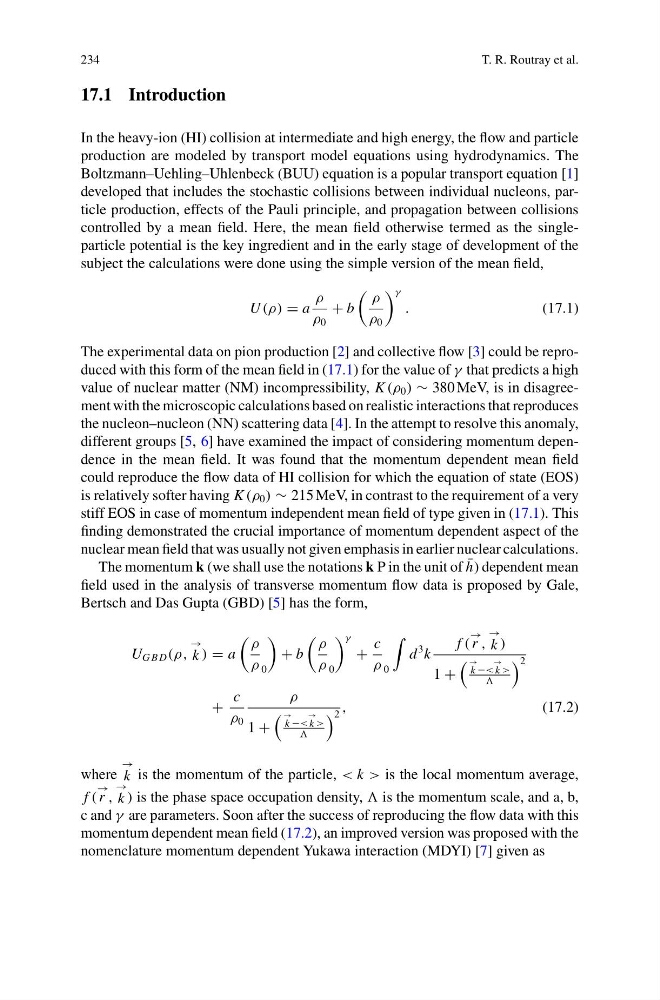
field used in the analysis of transverse momentum flow data is proposed by Gale,
Bertsch and Das Gupta (GBD) [5] has the form,
U G B D (ρ,
→
k ) = a
ρ
ρ 0
+ b
ρ
ρ 0
γ
+
c
ρ 0
d
3 k
f (
→
r ,
→
k )
1 +
→
k −<
→
k >
2
+
c
ρ 0
ρ
1 +
→
k −<
→
k >
2 ,
(17.2)
where
→
k is the momentum of the particle, < k > is the local momentum average,
f (
→
r ,
→
k ) is the phase space occupation density, is the momentum scale, and a, b,
c and γ are parameters. Soon after the success of reproducing the flow data with this
momentum dependent mean field (17.2), an improved version was proposed with the
nomenclature momentum dependent Yukawa interaction (MDYI) [7] given as
T. R. Routray et al.
17.1 Introduction
In the heavy-ion (HI) collision at intermediate and high energy, the flow and particle
production are modeled by transport model equations using hydrodynamics. The
Boltzmann–Uehling–Uhlenbeck (BUU) equation is a popular transport equation [1]
developed that includes the stochastic collisions between individual nucleons, particle production, effects of the Pauli principle, and propagation between collisions
controlled by a mean field. Here, the mean field otherwise termed as the singleparticle potential is the key ingredient and in the early stage of development of the
subject the calculations were done using the simple version of the mean field,
U (ρ) = a
ρ
ρ 0
+ b
ρ
ρ 0
γ
.
(17.1)
The experimental data on pion production [2] and collective flow [3] could be reproduced with this form of the mean field in (17.1) for the value of γ that predicts a high
value of nuclear matter (NM) incompressibility, K (ρ 0 ) ∼ 380 MeV, is in disagreement with the microscopic calculations based on realistic interactions that reproduces
the nucleon–nucleon (NN) scattering data [4]. In the attempt to resolve this anomaly,
different groups [5, 6] have examined the impact of considering momentum dependence in the mean field. It was found that the momentum dependent mean field
could reproduce the flow data of HI collision for which the equation of state (EOS)
is relatively softer having K (ρ 0 ) ∼ 215 MeV, in contrast to the requirement of a very
stiff EOS in case of momentum independent mean field of type given in (17.1). This
finding demonstrated the crucial importance of momentum dependent aspect of the
nuclear mean field that was usually not given emphasis in earlier nuclear calculations.
The momentum k (we shall use the notations k P in the unit of ¯
h) dependent mean
field used in the analysis of transverse momentum flow data is proposed by Gale,
Bertsch and Das Gupta (GBD) [5] has the form,
U G B D (ρ,
→
k ) = a
ρ
ρ 0
+ b
ρ
ρ 0
γ
+
c
ρ 0
d
3 k
f (
→
r ,
→
k )
1 +
→
k −<
→
k >
2
+
c
ρ 0
ρ
1 +
→
k −<
→
k >
2 ,
(17.2)
where
→
k is the momentum of the particle, < k > is the local momentum average,
f (
→
r ,
→
k ) is the phase space occupation density, is the momentum scale, and a, b,
c and γ are parameters. Soon after the success of reproducing the flow data with this
momentum dependent mean field (17.2), an improved version was proposed with the
nomenclature momentum dependent Yukawa interaction (MDYI) [7] given as