

236
T. R. Routray et al.
0
0.5
1
1.5
2
2.5
3
k [fm
-1 ]
0
10
20
30
40
50
u
τ
(k,
ρ
0
)[MeV]
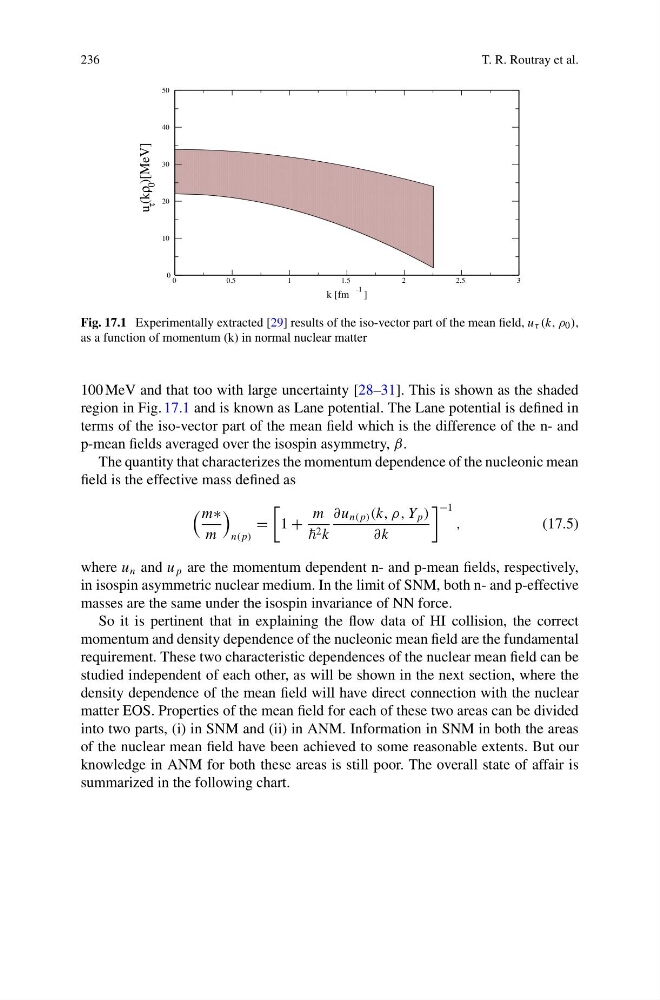
Fig. 17.1 Experimentally extracted [29] results of the iso-vector part of the mean field, u τ (k, ρ 0 ),
as a function of momentum (k) in normal nuclear matter
100 MeV and that too with large uncertainty [28–31]. This is shown as the shaded
region in Fig. 17.1 and is known as Lane potential. The Lane potential is defined in
terms of the iso-vector part of the mean field which is the difference of the n- and
p-mean fields averaged over the isospin asymmetry, β.
The quantity that characterizes the momentum dependence of the nucleonic mean
field is the effective mass defined as
m∗
m
n( p)
=
1 +
m
2 k
∂u n( p) (k, ρ, Y p )
∂k
−1
,
(17.5)
where u n and u p are the momentum dependent n- and p-mean fields, respectively,
in isospin asymmetric nuclear medium. In the limit of SNM, both n- and p-effective
masses are the same under the isospin invariance of NN force.
So it is pertinent that in explaining the flow data of HI collision, the correct
momentum and density dependence of the nucleonic mean field are the fundamental
requirement. These two characteristic dependences of the nuclear mean field can be
studied independent of each other, as will be shown in the next section, where the
density dependence of the mean field will have direct connection with the nuclear
matter EOS. Properties of the mean field for each of these two areas can be divided
into two parts, (i) in SNM and (ii) in ANM. Information in SNM in both the areas
of the nuclear mean field have been achieved to some reasonable extents. But our
knowledge in ANM for both these areas is still poor. The overall state of affair is
summarized in the following chart.
T. R. Routray et al.
0
0.5
1
1.5
2
2.5
3
k [fm
-1 ]
0
10
20
30
40
50
u
τ
(k,
ρ
0
)[MeV]
Fig. 17.1 Experimentally extracted [29] results of the iso-vector part of the mean field, u τ (k, ρ 0 ),
as a function of momentum (k) in normal nuclear matter
100 MeV and that too with large uncertainty [28–31]. This is shown as the shaded
region in Fig. 17.1 and is known as Lane potential. The Lane potential is defined in
terms of the iso-vector part of the mean field which is the difference of the n- and
p-mean fields averaged over the isospin asymmetry, β.
The quantity that characterizes the momentum dependence of the nucleonic mean
field is the effective mass defined as
m∗
m
n( p)
=
1 +
m
2 k
∂u n( p) (k, ρ, Y p )
∂k
−1
,
(17.5)
where u n and u p are the momentum dependent n- and p-mean fields, respectively,
in isospin asymmetric nuclear medium. In the limit of SNM, both n- and p-effective
masses are the same under the isospin invariance of NN force.
So it is pertinent that in explaining the flow data of HI collision, the correct
momentum and density dependence of the nucleonic mean field are the fundamental
requirement. These two characteristic dependences of the nuclear mean field can be
studied independent of each other, as will be shown in the next section, where the
density dependence of the mean field will have direct connection with the nuclear
matter EOS. Properties of the mean field for each of these two areas can be divided
into two parts, (i) in SNM and (ii) in ANM. Information in SNM in both the areas
of the nuclear mean field have been achieved to some reasonable extents. But our
knowledge in ANM for both these areas is still poor. The overall state of affair is
summarized in the following chart.