

16 Systematic Study of Po Compound Nuclei Using Evaporation Residue …
223
σ f us (E) =
l
σ l (E) =
π
k 2
o
l
(2l + 1)P l (E)
(16.9)
< l >=
l
lσ l (E)/
l
σ l (E)
(16.10)
where P l (E) is penetrability.
It works on the ingoing-wave boundary condition inside the Coulomb barrier to
account for fusion, along with the isocentrifugal approximation, which works well
for heavy ions. The nuclear potential in the entrance channel is defined by parameters
V 0 , r 0 , and a 0 ; where V 0 is the depth parameter of the Woods–Saxon potential, r 0 is
the radius parameter, and a 0 is the surface diffuseness parameter.
Depending upon the value of E(4
+ )/E (2
+ ), nuclei can be classified as vibrator
or rotor. If this ratio is 3.3, the nucleus is treated as rotor and vibrator if this value
is 2. In case of
18 O +
192 Os system, the projectile
18 O is treated as a vibrator and
target
192 Os is treated as a rotor. The deformation parameters along with the value
of E(4
+ )/E (2
+ ) are given in Table 16.1.
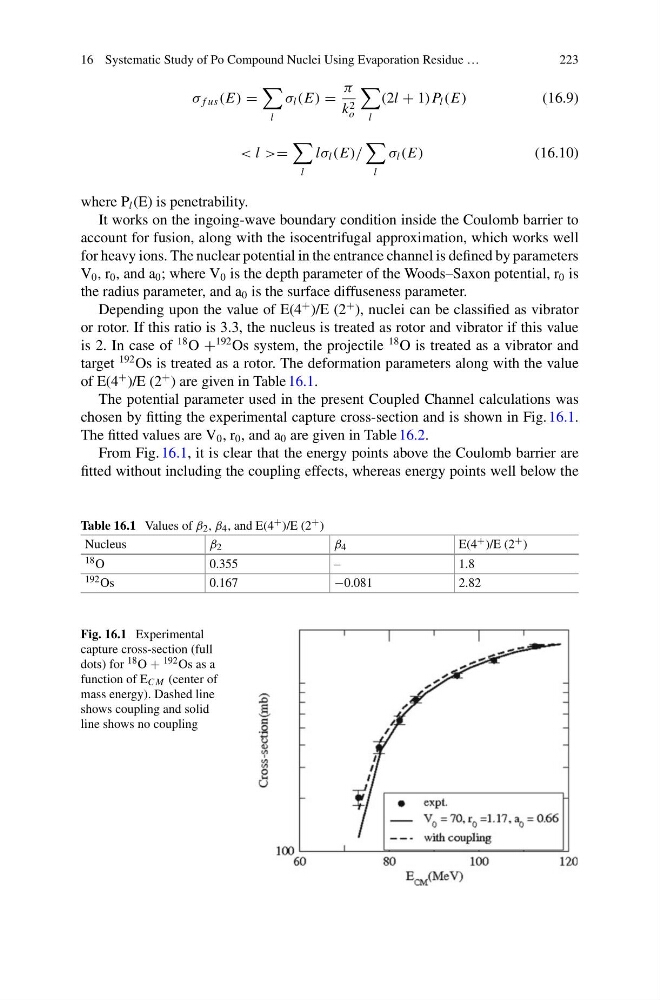
The potential parameter used in the present Coupled Channel calculations was
chosen by fitting the experimental capture cross-section and is shown in Fig. 16.1.
The fitted values are V 0 , r 0 , and a 0 are given in Table 16.2.
From Fig. 16.1, it is clear that the energy points above the Coulomb barrier are
fitted without including the coupling effects, whereas energy points well below the
Table 16.1 Values of β 2 , β 4 , and E(4 + )/E (2 + )
Nucleus
β 2
β 4
E(4 + )/E (2 + )
18 O
0.355
–
1.8
192 Os
0.167
−0.081
2.82
Fig. 16.1 Experimental
capture cross-section (full
dots) for 18 O + 192 Os as a
function of E C M (center of
mass energy). Dashed line
shows coupling and solid
line shows no coupling
223
σ f us (E) =
l
σ l (E) =
π
k 2
o
l
(2l + 1)P l (E)
(16.9)
< l >=
l
lσ l (E)/
l
σ l (E)
(16.10)
where P l (E) is penetrability.
It works on the ingoing-wave boundary condition inside the Coulomb barrier to
account for fusion, along with the isocentrifugal approximation, which works well
for heavy ions. The nuclear potential in the entrance channel is defined by parameters
V 0 , r 0 , and a 0 ; where V 0 is the depth parameter of the Woods–Saxon potential, r 0 is
the radius parameter, and a 0 is the surface diffuseness parameter.
Depending upon the value of E(4
+ )/E (2
+ ), nuclei can be classified as vibrator
or rotor. If this ratio is 3.3, the nucleus is treated as rotor and vibrator if this value
is 2. In case of
18 O +
192 Os system, the projectile
18 O is treated as a vibrator and
target
192 Os is treated as a rotor. The deformation parameters along with the value
of E(4
+ )/E (2
+ ) are given in Table 16.1.
The potential parameter used in the present Coupled Channel calculations was
chosen by fitting the experimental capture cross-section and is shown in Fig. 16.1.
The fitted values are V 0 , r 0 , and a 0 are given in Table 16.2.
From Fig. 16.1, it is clear that the energy points above the Coulomb barrier are
fitted without including the coupling effects, whereas energy points well below the
Table 16.1 Values of β 2 , β 4 , and E(4 + )/E (2 + )
Nucleus
β 2
β 4
E(4 + )/E (2 + )
18 O
0.355
–
1.8
192 Os
0.167
−0.081
2.82
Fig. 16.1 Experimental
capture cross-section (full
dots) for 18 O + 192 Os as a
function of E C M (center of
mass energy). Dashed line
shows coupling and solid
line shows no coupling