

224
R. Mahajan
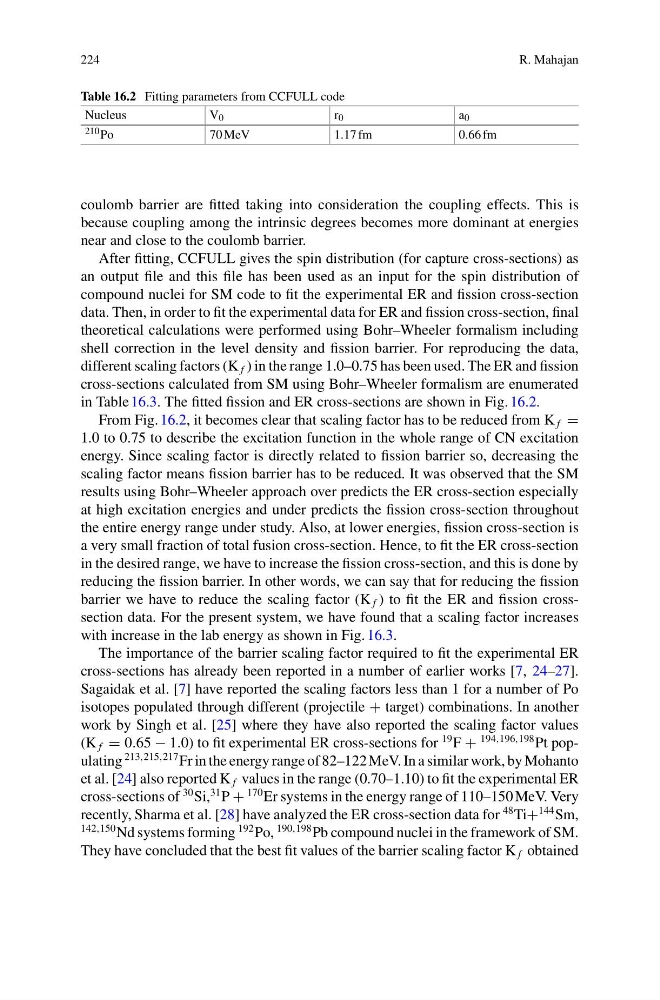
Table 16.2 Fitting parameters from CCFULL code
Nucleus
V 0
r 0
a 0
210 Po
70 MeV
1.17 fm
0.66 fm
coulomb barrier are fitted taking into consideration the coupling effects. This is
because coupling among the intrinsic degrees becomes more dominant at energies
near and close to the coulomb barrier.
After fitting, CCFULL gives the spin distribution (for capture cross-sections) as
an output file and this file has been used as an input for the spin distribution of
compound nuclei for SM code to fit the experimental ER and fission cross-section
data. Then, in order to fit the experimental data for ER and fission cross-section, final
theoretical calculations were performed using Bohr–Wheeler formalism including
shell correction in the level density and fission barrier. For reproducing the data,
different scaling factors (K f ) in the range 1.0–0.75 has been used. The ER and fission
cross-sections calculated from SM using Bohr–Wheeler formalism are enumerated
in Table 16.3. The fitted fission and ER cross-sections are shown in Fig. 16.2.
From Fig. 16.2, it becomes clear that scaling factor has to be reduced from K f =
1.0 to 0.75 to describe the excitation function in the whole range of CN excitation
energy. Since scaling factor is directly related to fission barrier so, decreasing the
scaling factor means fission barrier has to be reduced. It was observed that the SM
results using Bohr–Wheeler approach over predicts the ER cross-section especially
at high excitation energies and under predicts the fission cross-section throughout
the entire energy range under study. Also, at lower energies, fission cross-section is
a very small fraction of total fusion cross-section. Hence, to fit the ER cross-section
in the desired range, we have to increase the fission cross-section, and this is done by
reducing the fission barrier. In other words, we can say that for reducing the fission
barrier we have to reduce the scaling factor (K f ) to fit the ER and fission crosssection data. For the present system, we have found that a scaling factor increases
with increase in the lab energy as shown in Fig. 16.3.
The importance of the barrier scaling factor required to fit the experimental ER
cross-sections has already been reported in a number of earlier works [7, 24–27].
Sagaidak et al. [7] have reported the scaling factors less than 1 for a number of Po
isotopes populated through different (projectile + target) combinations. In another
work by Singh et al. [25] where they have also reported the scaling factor values
(K f = 0.65 − 1.0) to fit experimental ER cross-sections for
19 F +
194,196,198 Pt populating
213,215,217 Fr in the energy range of 82–122 MeV. In a similar work, by Mohanto
et al. [24] also reported K f values in the range (0.70–1.10) to fit the experimental ER
cross-sections of
30 Si,
31 P +
170 Er systems in the energy range of 110–150 MeV. Very
recently, Sharma et al. [28] have analyzed the ER cross-section data for
48 Ti+
144 Sm,
142,150 Nd systems forming
192 Po,
190,198 Pb compound nuclei in the framework of SM.
They have concluded that the best fit values of the barrier scaling factor K f obtained
R. Mahajan
Table 16.2 Fitting parameters from CCFULL code
Nucleus
V 0
r 0
a 0
210 Po
70 MeV
1.17 fm
0.66 fm
coulomb barrier are fitted taking into consideration the coupling effects. This is
because coupling among the intrinsic degrees becomes more dominant at energies
near and close to the coulomb barrier.
After fitting, CCFULL gives the spin distribution (for capture cross-sections) as
an output file and this file has been used as an input for the spin distribution of
compound nuclei for SM code to fit the experimental ER and fission cross-section
data. Then, in order to fit the experimental data for ER and fission cross-section, final
theoretical calculations were performed using Bohr–Wheeler formalism including
shell correction in the level density and fission barrier. For reproducing the data,
different scaling factors (K f ) in the range 1.0–0.75 has been used. The ER and fission
cross-sections calculated from SM using Bohr–Wheeler formalism are enumerated
in Table 16.3. The fitted fission and ER cross-sections are shown in Fig. 16.2.
From Fig. 16.2, it becomes clear that scaling factor has to be reduced from K f =
1.0 to 0.75 to describe the excitation function in the whole range of CN excitation
energy. Since scaling factor is directly related to fission barrier so, decreasing the
scaling factor means fission barrier has to be reduced. It was observed that the SM
results using Bohr–Wheeler approach over predicts the ER cross-section especially
at high excitation energies and under predicts the fission cross-section throughout
the entire energy range under study. Also, at lower energies, fission cross-section is
a very small fraction of total fusion cross-section. Hence, to fit the ER cross-section
in the desired range, we have to increase the fission cross-section, and this is done by
reducing the fission barrier. In other words, we can say that for reducing the fission
barrier we have to reduce the scaling factor (K f ) to fit the ER and fission crosssection data. For the present system, we have found that a scaling factor increases
with increase in the lab energy as shown in Fig. 16.3.
The importance of the barrier scaling factor required to fit the experimental ER
cross-sections has already been reported in a number of earlier works [7, 24–27].
Sagaidak et al. [7] have reported the scaling factors less than 1 for a number of Po
isotopes populated through different (projectile + target) combinations. In another
work by Singh et al. [25] where they have also reported the scaling factor values
(K f = 0.65 − 1.0) to fit experimental ER cross-sections for
19 F +
194,196,198 Pt populating
213,215,217 Fr in the energy range of 82–122 MeV. In a similar work, by Mohanto
et al. [24] also reported K f values in the range (0.70–1.10) to fit the experimental ER
cross-sections of
30 Si,
31 P +
170 Er systems in the energy range of 110–150 MeV. Very
recently, Sharma et al. [28] have analyzed the ER cross-section data for
48 Ti+
144 Sm,
142,150 Nd systems forming
192 Po,
190,198 Pb compound nuclei in the framework of SM.
They have concluded that the best fit values of the barrier scaling factor K f obtained