

222
R. Mahajan
follows from the work of Myers and Swiatecki [18]. A particular decay channel
is selected by performing Monte Carlo sampling between all the particles and γ
emission widths.
16.2.1 Spin Distribution from CCFULL
The spin distribution of CN is an important component of the SM and for the present
work and it is obtained from the coupled channel calculations code CCFULL [21].
Fusion of two separate nuclei to form a composite system, for low incident energy
(near or sub-barrier) and light system, is predominantly governed by quantum tunneling through the coulomb barrier. Extensive experimental and theoretical studies
have revealed that fusion reactions at energies near and below the coulomb barrier
are strongly influenced by the couplings to the relative motion of the colliding nuclei
to several nuclear intrinsic motions [13]. For heavy-ion fusion reactions, to a good
approximation, the angular momentum of the relative motion in each channel can be
replaced by the total angular momentum J [22, 23]. The program CCFULL solves the
coupled-channels equations to compute the fusion cross-sections and mean angular
momenta of CN, taking into account the couplings to all orders. The coupled channel
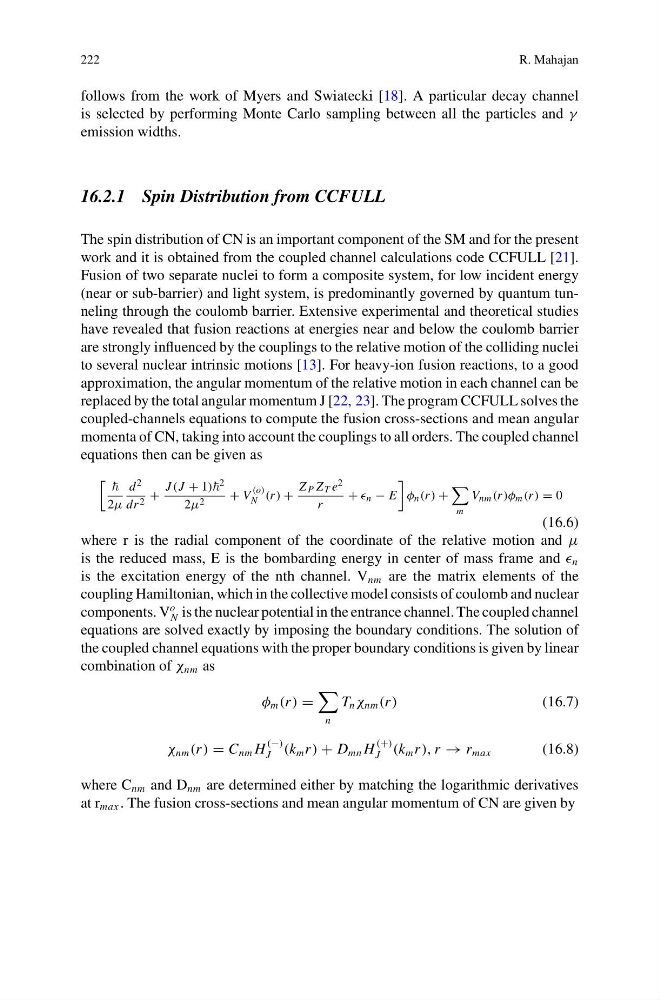
equations then can be given as
2μ
d 2
dr 2 +
J (J + 1) 2
2μ 2
+ V
(o)
N (r ) +
Z P Z T e 2
r
+ n − E
φ n (r ) +
m
V nm (r )φ m (r ) = 0
(16.6)
where r is the radial component of the coordinate of the relative motion and μ
is the reduced mass, E is the bombarding energy in center of mass frame and n
is the excitation energy of the nth channel. V nm are the matrix elements of the
coupling Hamiltonian, which in the collective model consists of coulomb and nuclear
components. V
o
N is the nuclear potential in the entrance channel. The coupled channel
equations are solved exactly by imposing the boundary conditions. The solution of
the coupled channel equations with the proper boundary conditions is given by linear
combination of χ nm as
φ m (r ) =
n
T n χ nm (r )
(16.7)
χ nm (r ) = C nm H
(−)
J (k m r ) + D mn H
(+)
J (k m r ), r → r max
(16.8)
where C nm and D nm are determined either by matching the logarithmic derivatives
at r max . The fusion cross-sections and mean angular momentum of CN are given by
R. Mahajan
follows from the work of Myers and Swiatecki [18]. A particular decay channel
is selected by performing Monte Carlo sampling between all the particles and γ
emission widths.
16.2.1 Spin Distribution from CCFULL
The spin distribution of CN is an important component of the SM and for the present
work and it is obtained from the coupled channel calculations code CCFULL [21].
Fusion of two separate nuclei to form a composite system, for low incident energy
(near or sub-barrier) and light system, is predominantly governed by quantum tunneling through the coulomb barrier. Extensive experimental and theoretical studies
have revealed that fusion reactions at energies near and below the coulomb barrier
are strongly influenced by the couplings to the relative motion of the colliding nuclei
to several nuclear intrinsic motions [13]. For heavy-ion fusion reactions, to a good
approximation, the angular momentum of the relative motion in each channel can be
replaced by the total angular momentum J [22, 23]. The program CCFULL solves the
coupled-channels equations to compute the fusion cross-sections and mean angular
momenta of CN, taking into account the couplings to all orders. The coupled channel
equations then can be given as
2μ
d 2
dr 2 +
J (J + 1) 2
2μ 2
+ V
(o)
N (r ) +
Z P Z T e 2
r
+ n − E
φ n (r ) +
m
V nm (r )φ m (r ) = 0
(16.6)
where r is the radial component of the coordinate of the relative motion and μ
is the reduced mass, E is the bombarding energy in center of mass frame and n
is the excitation energy of the nth channel. V nm are the matrix elements of the
coupling Hamiltonian, which in the collective model consists of coulomb and nuclear
components. V
o
N is the nuclear potential in the entrance channel. The coupled channel
equations are solved exactly by imposing the boundary conditions. The solution of
the coupled channel equations with the proper boundary conditions is given by linear
combination of χ nm as
φ m (r ) =
n
T n χ nm (r )
(16.7)
χ nm (r ) = C nm H
(−)
J (k m r ) + D mn H
(+)
J (k m r ), r → r max
(16.8)
where C nm and D nm are determined either by matching the logarithmic derivatives
at r max . The fusion cross-sections and mean angular momentum of CN are given by