

16 Systematic Study of Po Compound Nuclei Using Evaporation Residue …
221
fit the experimental data for ER and fission cross-sections. The experimental fusion
cross-section has been reproduced in good agreement by using coupled channel
calculations (CCFULL) [13]. Then, in order to fit the experimental data, different
scaling factors (K f ) for the finite-range liquid drop model fission barrier in the range
1.0–0.75 were used.
In the framework of SM, the possible decay channels of a CN are the emission
of neutrons, protons, α, and giant dipole resonance (GDR) γ -rays [14]. The main
assumption of the SM is that the system forms a fully equilibrated CN after capture
of projectile and contribution from non-compound nuclear processes such as QF
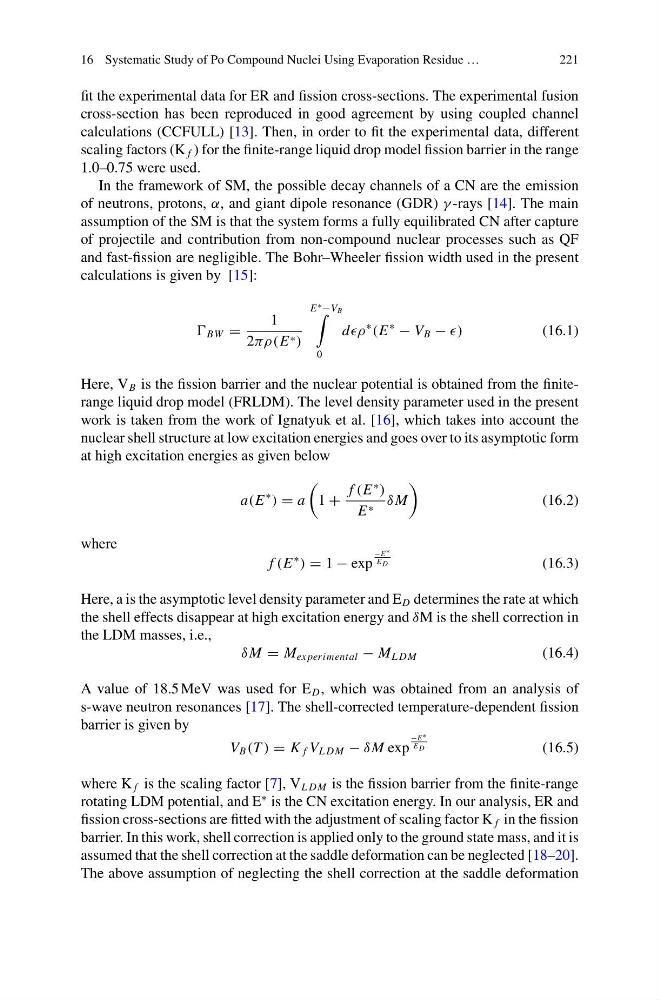
and fast-fission are negligible. The Bohr–Wheeler fission width used in the present
calculations is given by [15]:
BW =
1
2πρ(E ∗ )
E
∗ −V B
0
dρ
∗
(E
∗
− V B − )
(16.1)
Here, V B is the fission barrier and the nuclear potential is obtained from the finiterange liquid drop model (FRLDM). The level density parameter used in the present
work is taken from the work of Ignatyuk et al. [16], which takes into account the
nuclear shell structure at low excitation energies and goes over to its asymptotic form
at high excitation energies as given below
a(E
∗
) = a
1 +
f (E
∗
)
E ∗ δ M
(16.2)
where
f (E
∗
) = 1 − exp
−E ∗
E D
(16.3)
Here, a is the asymptotic level density parameter and E D determines the rate at which
the shell effects disappear at high excitation energy and δM is the shell correction in
the LDM masses, i.e.,
δ M = M ex perimental − M L DM
(16.4)
A value of 18.5 MeV was used for E D , which was obtained from an analysis of
s-wave neutron resonances [17]. The shell-corrected temperature-dependent fission
barrier is given by
V B (T ) = K f V L DM − δ M exp
−E ∗
E D
(16.5)
where K f is the scaling factor [7], V L DM is the fission barrier from the finite-range
rotating LDM potential, and E
∗ is the CN excitation energy. In our analysis, ER and
fission cross-sections are fitted with the adjustment of scaling factor K f in the fission
barrier. In this work, shell correction is applied only to the ground state mass, and it is
assumed that the shell correction at the saddle deformation can be neglected [18–20].
The above assumption of neglecting the shell correction at the saddle deformation
221
fit the experimental data for ER and fission cross-sections. The experimental fusion
cross-section has been reproduced in good agreement by using coupled channel
calculations (CCFULL) [13]. Then, in order to fit the experimental data, different
scaling factors (K f ) for the finite-range liquid drop model fission barrier in the range
1.0–0.75 were used.
In the framework of SM, the possible decay channels of a CN are the emission
of neutrons, protons, α, and giant dipole resonance (GDR) γ -rays [14]. The main
assumption of the SM is that the system forms a fully equilibrated CN after capture
of projectile and contribution from non-compound nuclear processes such as QF
and fast-fission are negligible. The Bohr–Wheeler fission width used in the present
calculations is given by [15]:
BW =
1
2πρ(E ∗ )
E
∗ −V B
0
dρ
∗
(E
∗
− V B − )
(16.1)
Here, V B is the fission barrier and the nuclear potential is obtained from the finiterange liquid drop model (FRLDM). The level density parameter used in the present
work is taken from the work of Ignatyuk et al. [16], which takes into account the
nuclear shell structure at low excitation energies and goes over to its asymptotic form
at high excitation energies as given below
a(E
∗
) = a
1 +
f (E
∗
)
E ∗ δ M
(16.2)
where
f (E
∗
) = 1 − exp
−E ∗
E D
(16.3)
Here, a is the asymptotic level density parameter and E D determines the rate at which
the shell effects disappear at high excitation energy and δM is the shell correction in
the LDM masses, i.e.,
δ M = M ex perimental − M L DM
(16.4)
A value of 18.5 MeV was used for E D , which was obtained from an analysis of
s-wave neutron resonances [17]. The shell-corrected temperature-dependent fission
barrier is given by
V B (T ) = K f V L DM − δ M exp
−E ∗
E D
(16.5)
where K f is the scaling factor [7], V L DM is the fission barrier from the finite-range
rotating LDM potential, and E
∗ is the CN excitation energy. In our analysis, ER and
fission cross-sections are fitted with the adjustment of scaling factor K f in the fission
barrier. In this work, shell correction is applied only to the ground state mass, and it is
assumed that the shell correction at the saddle deformation can be neglected [18–20].
The above assumption of neglecting the shell correction at the saddle deformation