

208
K. P. Santhosh
x e f f =
(Z
2
/A)
(Z 2 /A) crit
(1 − α + α f (K )) .
(15.15)
With (Z
2
/A) crit , f (K ) and K are given by
(Z
2
/A) crit = 50.883
1 − 1.7286
(N − Z )
A
2
(15.16)
f (K ) =
4
K 2 + K +
1
K
+
1
K 2
(15.17)
K =
A 1
A 2
1/3
,
(15.18)
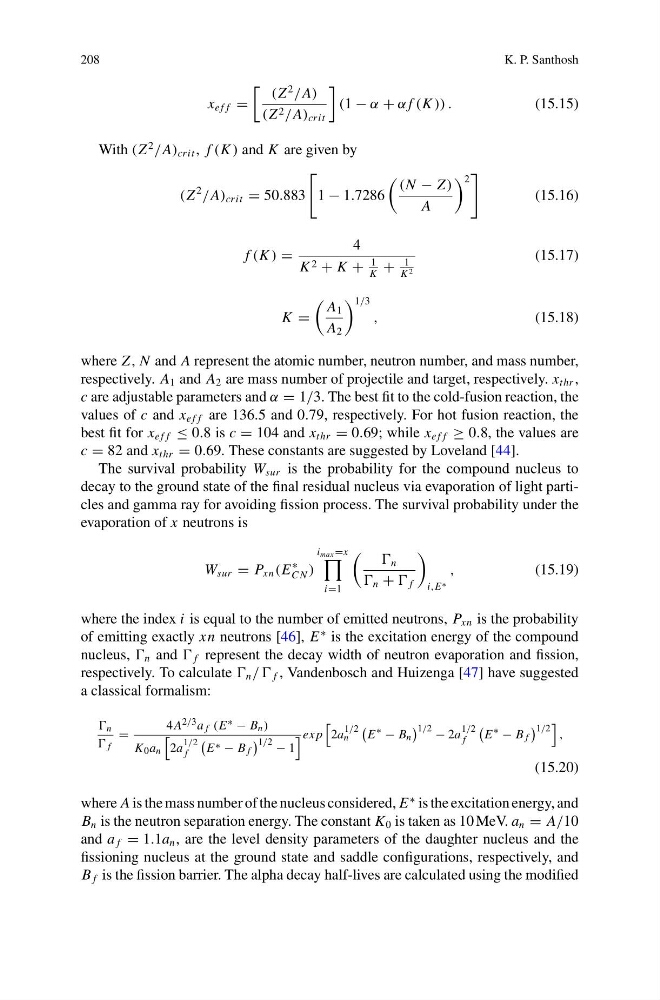
where Z , N and A represent the atomic number, neutron number, and mass number,
respectively. A 1 and A 2 are mass number of projectile and target, respectively. x thr ,
c are adjustable parameters and α = 1/3. The best fit to the cold-fusion reaction, the
values of c and x e f f are 136.5 and 0.79, respectively. For hot fusion reaction, the
best fit for x e f f ≤ 0.8 is c = 104 and x thr = 0.69; while x e f f ≥ 0.8, the values are
c = 82 and x thr = 0.69. These constants are suggested by Loveland [44].
The survival probability W sur is the probability for the compound nucleus to
decay to the ground state of the final residual nucleus via evaporation of light particles and gamma ray for avoiding fission process. The survival probability under the
evaporation of x neutrons is
W sur = P xn (E
∗
C N )
i max =x
i=1
n
n + f
i,E ∗
,
(15.19)
where the index i is equal to the number of emitted neutrons, P xn is the probability
of emitting exactly xn neutrons [46], E
∗ is the excitation energy of the compound
nucleus, n and f represent the decay width of neutron evaporation and fission,
respectively. To calculate n / / f , Vandenbosch and Huizenga [47] have suggested
a classical formalism:
n
f
=
4 A 2/3 a f (E ∗ − B n )
K 0 a n
2a
1/2
f
E ∗ − B f
1/2 − 1
ex p
2a
1/2
n
E
∗ − B n
1/2 − 2a
1/2
f
E
∗ − B f
1/2
,
(15.20)
where A is the mass number of the nucleus considered, E
∗ is the excitation energy, and
B n is the neutron separation energy. The constant K 0 is taken as 10 MeV. a n = A/10
and a f = 1.1a n , are the level density parameters of the daughter nucleus and the
fissioning nucleus at the ground state and saddle configurations, respectively, and
B f is the fission barrier. The alpha decay half-lives are calculated using the modified
K. P. Santhosh
x e f f =
(Z
2
/A)
(Z 2 /A) crit
(1 − α + α f (K )) .
(15.15)
With (Z
2
/A) crit , f (K ) and K are given by
(Z
2
/A) crit = 50.883
1 − 1.7286
(N − Z )
A
2
(15.16)
f (K ) =
4
K 2 + K +
1
K
+
1
K 2
(15.17)
K =
A 1
A 2
1/3
,
(15.18)
where Z , N and A represent the atomic number, neutron number, and mass number,
respectively. A 1 and A 2 are mass number of projectile and target, respectively. x thr ,
c are adjustable parameters and α = 1/3. The best fit to the cold-fusion reaction, the
values of c and x e f f are 136.5 and 0.79, respectively. For hot fusion reaction, the
best fit for x e f f ≤ 0.8 is c = 104 and x thr = 0.69; while x e f f ≥ 0.8, the values are
c = 82 and x thr = 0.69. These constants are suggested by Loveland [44].
The survival probability W sur is the probability for the compound nucleus to
decay to the ground state of the final residual nucleus via evaporation of light particles and gamma ray for avoiding fission process. The survival probability under the
evaporation of x neutrons is
W sur = P xn (E
∗
C N )
i max =x
i=1
n
n + f
i,E ∗
,
(15.19)
where the index i is equal to the number of emitted neutrons, P xn is the probability
of emitting exactly xn neutrons [46], E
∗ is the excitation energy of the compound
nucleus, n and f represent the decay width of neutron evaporation and fission,
respectively. To calculate n / / f , Vandenbosch and Huizenga [47] have suggested
a classical formalism:
n
f
=
4 A 2/3 a f (E ∗ − B n )
K 0 a n
2a
1/2
f
E ∗ − B f
1/2 − 1
ex p
2a
1/2
n
E
∗ − B n
1/2 − 2a
1/2
f
E
∗ − B f
1/2
,
(15.20)
where A is the mass number of the nucleus considered, E
∗ is the excitation energy, and
B n is the neutron separation energy. The constant K 0 is taken as 10 MeV. a n = A/10
and a f = 1.1a n , are the level density parameters of the daughter nucleus and the
fissioning nucleus at the ground state and saddle configurations, respectively, and
B f is the fission barrier. The alpha decay half-lives are calculated using the modified