

15 Studies on Hypernuclei and Superheavy Elements
207
force, and centrifugal force, it also feels the potential generated by the hyperon.
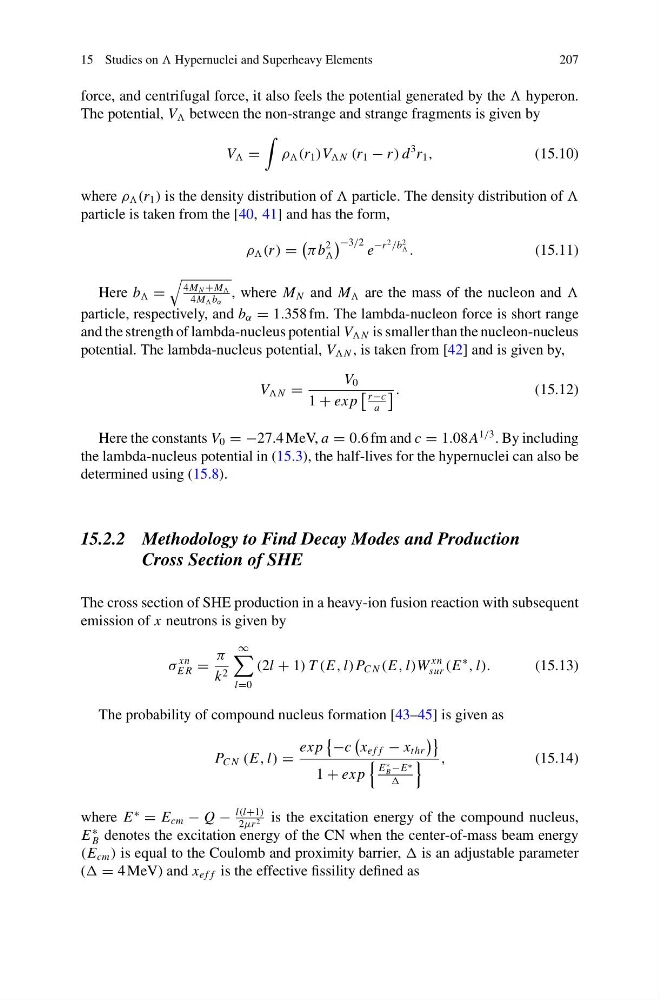
The potential, V between the non-strange and strange fragments is given by
V =
ρ (r 1 )V N (r 1 − r ) d
3 r 1 ,
(15.10)
where ρ (r 1 ) is the density distribution of particle. The density distribution of
particle is taken from the [40, 41] and has the form,
ρ (r ) =
π b
2
−3/2 e
−r
2 /b
2
.
(15.11)
Here b =
4M N +M
4M b α
, where M N and M are the mass of the nucleon and
particle, respectively, and b α = 1.358 fm. The lambda-nucleon force is short range
and the strength of lambda-nucleus potential V N is smaller than the nucleon-nucleus
potential. The lambda-nucleus potential, V N , is taken from [42] and is given by,
V N =
V 0
1 + ex p
r −c
a
.
(15.12)
Here the constants V 0 = −27.4 MeV, a = 0.6 fm and c = 1.08A
1/3 . By including
the lambda-nucleus potential in (15.3), the half-lives for the hypernuclei can also be
determined using (15.8).
15.2.2 Methodology to Find Decay Modes and Production
Cross Section of SHE
The cross section of SHE production in a heavy-ion fusion reaction with subsequent
emission of x neutrons is given by
σ
xn
E R =
π
k 2
∞
l=0
(2l + 1) T (E, l)P C N (E, l)W
xn
sur (E
∗
, l).
(15.13)
The probability of compound nucleus formation [43–45] is given as
P C N (E, l) =
ex p
−c
x e f f − x thr
1 + ex p
E
∗
B −E ∗
,
(15.14)
where E
∗
= E cm − Q −
l(l+1)
2μr 2 is the excitation energy of the compound nucleus,
E
∗
B denotes the excitation energy of the CN when the center-of-mass beam energy
(E cm ) is equal to the Coulomb and proximity barrier, is an adjustable parameter
( = 4 MeV) and x e f f is the effective fissility defined as
207
force, and centrifugal force, it also feels the potential generated by the hyperon.
The potential, V between the non-strange and strange fragments is given by
V =
ρ (r 1 )V N (r 1 − r ) d
3 r 1 ,
(15.10)
where ρ (r 1 ) is the density distribution of particle. The density distribution of
particle is taken from the [40, 41] and has the form,
ρ (r ) =
π b
2
−3/2 e
−r
2 /b
2
.
(15.11)
Here b =
4M N +M
4M b α
, where M N and M are the mass of the nucleon and
particle, respectively, and b α = 1.358 fm. The lambda-nucleon force is short range
and the strength of lambda-nucleus potential V N is smaller than the nucleon-nucleus
potential. The lambda-nucleus potential, V N , is taken from [42] and is given by,
V N =
V 0
1 + ex p
r −c
a
.
(15.12)
Here the constants V 0 = −27.4 MeV, a = 0.6 fm and c = 1.08A
1/3 . By including
the lambda-nucleus potential in (15.3), the half-lives for the hypernuclei can also be
determined using (15.8).
15.2.2 Methodology to Find Decay Modes and Production
Cross Section of SHE
The cross section of SHE production in a heavy-ion fusion reaction with subsequent
emission of x neutrons is given by
σ
xn
E R =
π
k 2
∞
l=0
(2l + 1) T (E, l)P C N (E, l)W
xn
sur (E
∗
, l).
(15.13)
The probability of compound nucleus formation [43–45] is given as
P C N (E, l) =
ex p
−c
x e f f − x thr
1 + ex p
E
∗
B −E ∗
,
(15.14)
where E
∗
= E cm − Q −
l(l+1)
2μr 2 is the excitation energy of the compound nucleus,
E
∗
B denotes the excitation energy of the CN when the center-of-mass beam energy
(E cm ) is equal to the Coulomb and proximity barrier, is an adjustable parameter
( = 4 MeV) and x e f f is the effective fissility defined as