

206
K. P. Santhosh
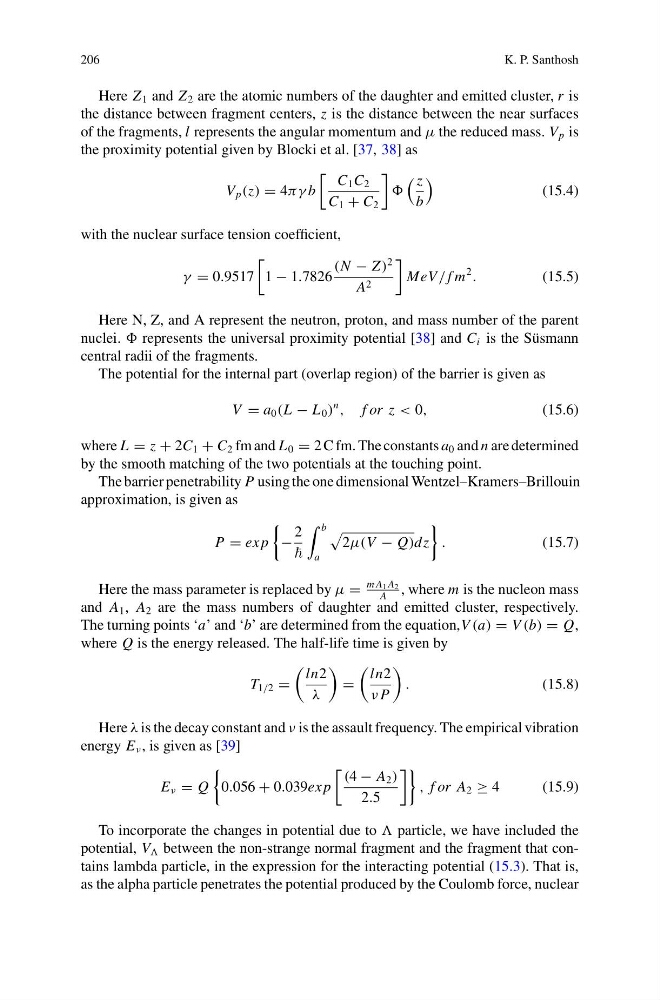
Here Z 1 and Z 2 are the atomic numbers of the daughter and emitted cluster, r is
the distance between fragment centers, z is the distance between the near surfaces
of the fragments, l represents the angular momentum and μ the reduced mass. V p is
the proximity potential given by Blocki et al. [37, 38] as
V p (z) = 4πγ b
C 1 C 2
C 1 + C 2
z
b
(15.4)
with the nuclear surface tension coefficient,
γ = 0.9517
1 − 1.7826
(N − Z )
2
A 2
MeV / f m
2
.
(15.5)
Here N, Z, and A represent the neutron, proton, and mass number of the parent
nuclei. represents the universal proximity potential [38] and C i is the Süsmann
central radii of the fragments.
The potential for the internal part (overlap region) of the barrier is given as
V = a 0 (L − L 0 )
n
, f or z < 0,
(15.6)
where L = z + 2C 1 + C 2 fm and L 0 = 2 C fm. The constants a 0 and n are determined
by the smooth matching of the two potentials at the touching point.
The barrier penetrability P using the one dimensional Wentzel–Kramers–Brillouin
approximation, is given as
P = ex p
−
2
b
a
2μ(V − Q)dz
.
(15.7)
Here the mass parameter is replaced by μ =
m A 1 A 2
A
, where m is the nucleon mass
and A 1 , A 2 are the mass numbers of daughter and emitted cluster, respectively.
The turning points ‘a’ and ‘b’ are determined from the equation,V (a) = V (b) = Q,
where Q is the energy released. The half-life time is given by
T 1/2 =
ln2
λ
=
ln2
ν P
.
(15.8)
Here λ is the decay constant and ν is the assault frequency. The empirical vibration
energy E ν , is given as [39]
E ν = Q
0.056 + 0.039ex p
(4 − A 2 )
2.5
, f or A 2 ≥ 4
(15.9)
To incorporate the changes in potential due to particle, we have included the
potential, V between the non-strange normal fragment and the fragment that contains lambda particle, in the expression for the interacting potential (15.3). That is,
as the alpha particle penetrates the potential produced by the Coulomb force, nuclear
K. P. Santhosh
Here Z 1 and Z 2 are the atomic numbers of the daughter and emitted cluster, r is
the distance between fragment centers, z is the distance between the near surfaces
of the fragments, l represents the angular momentum and μ the reduced mass. V p is
the proximity potential given by Blocki et al. [37, 38] as
V p (z) = 4πγ b
C 1 C 2
C 1 + C 2
z
b
(15.4)
with the nuclear surface tension coefficient,
γ = 0.9517
1 − 1.7826
(N − Z )
2
A 2
MeV / f m
2
.
(15.5)
Here N, Z, and A represent the neutron, proton, and mass number of the parent
nuclei. represents the universal proximity potential [38] and C i is the Süsmann
central radii of the fragments.
The potential for the internal part (overlap region) of the barrier is given as
V = a 0 (L − L 0 )
n
, f or z < 0,
(15.6)
where L = z + 2C 1 + C 2 fm and L 0 = 2 C fm. The constants a 0 and n are determined
by the smooth matching of the two potentials at the touching point.
The barrier penetrability P using the one dimensional Wentzel–Kramers–Brillouin
approximation, is given as
P = ex p
−
2
b
a
2μ(V − Q)dz
.
(15.7)
Here the mass parameter is replaced by μ =
m A 1 A 2
A
, where m is the nucleon mass
and A 1 , A 2 are the mass numbers of daughter and emitted cluster, respectively.
The turning points ‘a’ and ‘b’ are determined from the equation,V (a) = V (b) = Q,
where Q is the energy released. The half-life time is given by
T 1/2 =
ln2
λ
=
ln2
ν P
.
(15.8)
Here λ is the decay constant and ν is the assault frequency. The empirical vibration
energy E ν , is given as [39]
E ν = Q
0.056 + 0.039ex p
(4 − A 2 )
2.5
, f or A 2 ≥ 4
(15.9)
To incorporate the changes in potential due to particle, we have included the
potential, V between the non-strange normal fragment and the fragment that contains lambda particle, in the expression for the interacting potential (15.3). That is,
as the alpha particle penetrates the potential produced by the Coulomb force, nuclear