

15 Studies on Hypernuclei and Superheavy Elements
209
generalized liquid drop model (MGLDM) [48] of our group and spontaneous fission
half-lives are calculated using the formula of Santhosh et al. [49]
log
T 1/2 /yr
= a
Z
2
A
+ b
Z
2
A
2
+ c
N − Z
N + Z
+ d
N − Z
N + Z
2
+ eE shell + f,
(15.21)
where a = −43.25203, b = 0.49192, c = 3674.3927, d = −9360.6, e = 0.8930,
and f = 578.56058. E shell is the shell correction energy.
15.3 Results and Discussion
The BWMF for hypernuclei is an extension of BWMF of normal nuclei to the hypernuclear sector. The formula was developed by studying the variation of binding
energy for all the experimentally identified hypernuclei with A
−2/3 . It was seen that
there exists an asymptotic relation between the binding energy and the hypernuclear
surface term, which is proportional to A
2/3 . The performance of the newly proposed
mass formula (15.1) has been demonstrated by evaluating the binding energies of all
the thirty-five experimentally synthesized hypernuclei from
4
H to
208
Pb [50–55].
The predictive power of the new formula has been revealed by evaluating the standard
deviation. As compared to other theoretical formalisms, the new formula gives the
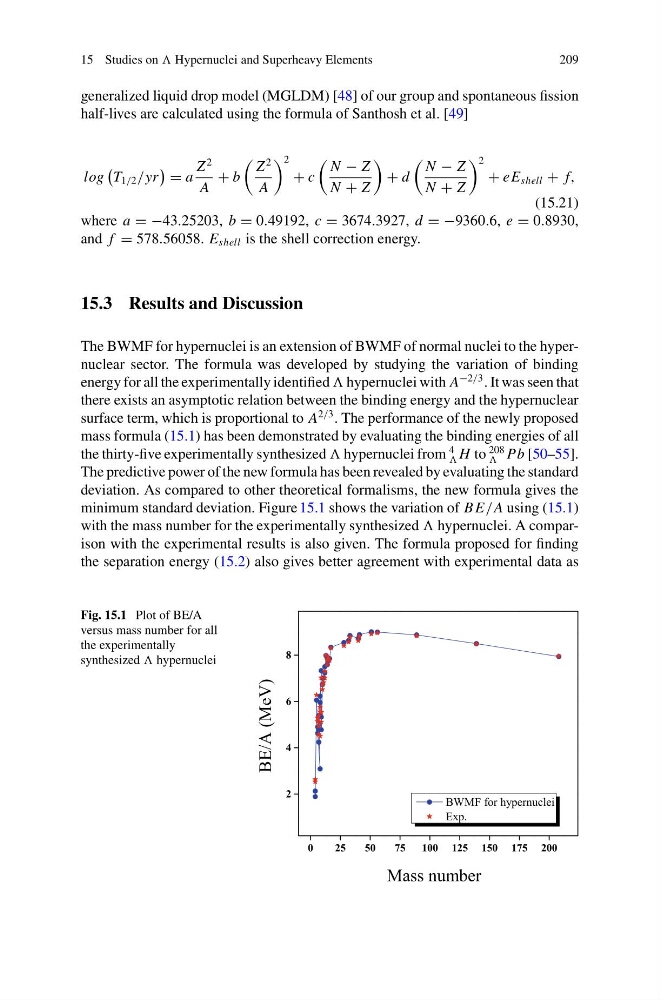
minimum standard deviation. Figure 15.1 shows the variation of B E/A using (15.1)
with the mass number for the experimentally synthesized hypernuclei. A comparison with the experimental results is also given. The formula proposed for finding
the separation energy (15.2) also gives better agreement with experimental data as
Fig. 15.1 Plot of BE/A
versus mass number for all
the experimentally
synthesized hypernuclei
209
generalized liquid drop model (MGLDM) [48] of our group and spontaneous fission
half-lives are calculated using the formula of Santhosh et al. [49]
log
T 1/2 /yr
= a
Z
2
A
+ b
Z
2
A
2
+ c
N − Z
N + Z
+ d
N − Z
N + Z
2
+ eE shell + f,
(15.21)
where a = −43.25203, b = 0.49192, c = 3674.3927, d = −9360.6, e = 0.8930,
and f = 578.56058. E shell is the shell correction energy.
15.3 Results and Discussion
The BWMF for hypernuclei is an extension of BWMF of normal nuclei to the hypernuclear sector. The formula was developed by studying the variation of binding
energy for all the experimentally identified hypernuclei with A
−2/3 . It was seen that
there exists an asymptotic relation between the binding energy and the hypernuclear
surface term, which is proportional to A
2/3 . The performance of the newly proposed
mass formula (15.1) has been demonstrated by evaluating the binding energies of all
the thirty-five experimentally synthesized hypernuclei from
4
H to
208
Pb [50–55].
The predictive power of the new formula has been revealed by evaluating the standard
deviation. As compared to other theoretical formalisms, the new formula gives the
minimum standard deviation. Figure 15.1 shows the variation of B E/A using (15.1)
with the mass number for the experimentally synthesized hypernuclei. A comparison with the experimental results is also given. The formula proposed for finding
the separation energy (15.2) also gives better agreement with experimental data as
Fig. 15.1 Plot of BE/A
versus mass number for all
the experimentally
synthesized hypernuclei