

196
L. Kumar
where φ represents the azimuthal angle of produced particles, n represents the order of
flow harmonic, and n is the reaction plane of order n. The second Fourier coefficient,
v 2 , is known as elliptic flow.
At RHIC energies, the study of anisotropic flow suggested that the system formed
in heavy-ion collisions is a strongly coupled QGP (sQGP) with a small value of the
η/s ratio [1–4]. One of the signatures of the formation of QGP was the scaling of
number of constituent quarks. It was observed that elliptic flow when plotted as a
function of p T shows separation between baryons and mesons at intermediate p T (>
1.5–2.0 GeV/c). The baryons have larger v 2 than the mesons. The baryon-meson
separation at intermediate p T was associated with the difference in their constituent
quarks (n q ), which is 2 for mesons and 3 for baryons. When the v 2 /n q is plotted
as a function of p T /n q the baryons and mesons follow single behavior, i.e., exhibit
same v 2 . This is referred to as the number of constituent quarks scaling and has
been considered as an established signature of QGP formation at high energy heavyion collisions [32, 33]. The basic requirement for this signature to be observed is
the existence of baryon-meson separation at intermediate p T . This information is
exploited in the Beam Energy Scan program at RHIC to look for the signals of phase
boundary. The idea is to vary the collision energy and observe the baryon-meson
separation at each energy. If there is no separation observed at some energy, it would
suggest that no QGP was formed at that energy and hence one could locate the phase
boundary between QGP and hadron gas.
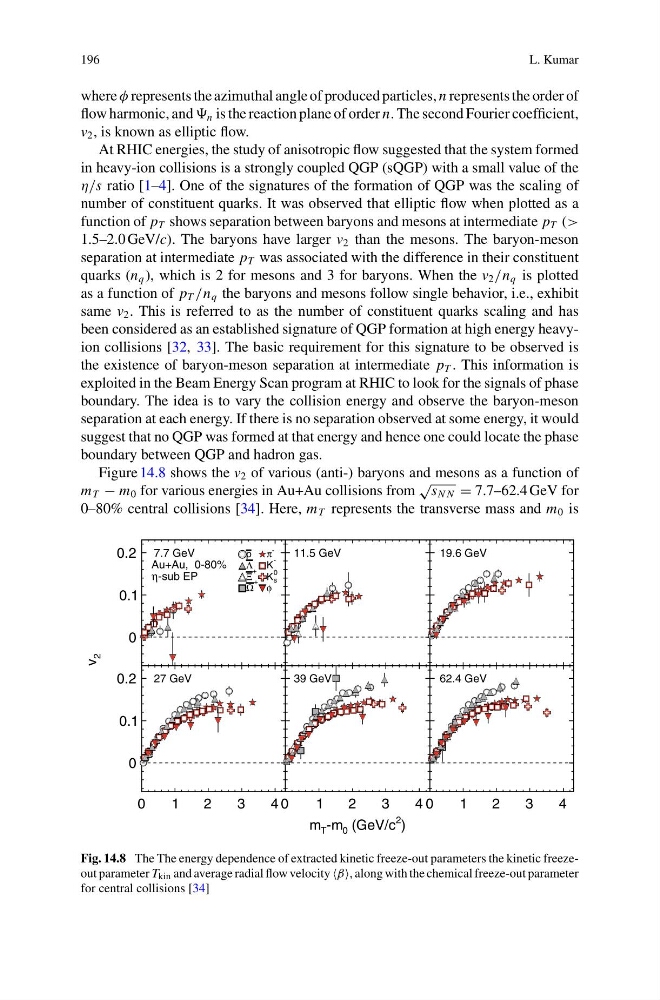
Figure 14.8 shows the v 2 of various (anti-) baryons and mesons as a function of
m T − m 0 for various energies in Au+Au collisions from
√ s N N = 7.7–62.4 GeV for
0–80% central collisions [34]. Here, m T represents the transverse mass and m 0 is
0
0.1
0.2
2
v
7.7 GeV
Au+Au, 0-80%
-sub EP
η
p
Λ +
Ξ +
Ω
-
π
-
K
s
0
K
φ
11.5 GeV
19.6 GeV
0
1
2
3
4
0
0.1
0.2
0
27 GeV
)
2
(GeV/c
0
-m
T
m
1
2
3
40
39 GeV
1
2
3
4
62.4 GeV
Fig. 14.8 The The energy dependence of extracted kinetic freeze-out parameters the kinetic freezeout parameter T kin and average radial flow velocity along with the chemical freeze-out parameter
for central collisions [34]
L. Kumar
where φ represents the azimuthal angle of produced particles, n represents the order of
flow harmonic, and n is the reaction plane of order n. The second Fourier coefficient,
v 2 , is known as elliptic flow.
At RHIC energies, the study of anisotropic flow suggested that the system formed
in heavy-ion collisions is a strongly coupled QGP (sQGP) with a small value of the
η/s ratio [1–4]. One of the signatures of the formation of QGP was the scaling of
number of constituent quarks. It was observed that elliptic flow when plotted as a
function of p T shows separation between baryons and mesons at intermediate p T (>
1.5–2.0 GeV/c). The baryons have larger v 2 than the mesons. The baryon-meson
separation at intermediate p T was associated with the difference in their constituent
quarks (n q ), which is 2 for mesons and 3 for baryons. When the v 2 /n q is plotted
as a function of p T /n q the baryons and mesons follow single behavior, i.e., exhibit
same v 2 . This is referred to as the number of constituent quarks scaling and has
been considered as an established signature of QGP formation at high energy heavyion collisions [32, 33]. The basic requirement for this signature to be observed is
the existence of baryon-meson separation at intermediate p T . This information is
exploited in the Beam Energy Scan program at RHIC to look for the signals of phase
boundary. The idea is to vary the collision energy and observe the baryon-meson
separation at each energy. If there is no separation observed at some energy, it would
suggest that no QGP was formed at that energy and hence one could locate the phase
boundary between QGP and hadron gas.
Figure 14.8 shows the v 2 of various (anti-) baryons and mesons as a function of
m T − m 0 for various energies in Au+Au collisions from
√ s N N = 7.7–62.4 GeV for
0–80% central collisions [34]. Here, m T represents the transverse mass and m 0 is
0
0.1
0.2
2
v
7.7 GeV
Au+Au, 0-80%
-sub EP
η
p
Λ +
Ξ +
Ω
-
π
-
K
s
0
K
φ
11.5 GeV
19.6 GeV
0
1
2
3
4
0
0.1
0.2
0
27 GeV
)
2
(GeV/c
0
-m
T
m
1
2
3
40
39 GeV
1
2
3
4
62.4 GeV
Fig. 14.8 The The energy dependence of extracted kinetic freeze-out parameters the kinetic freezeout parameter T kin and average radial flow velocity along with the chemical freeze-out parameter
for central collisions [34]