

14 Particle Production and Collective Phenomena in Heavy-Ion …
195
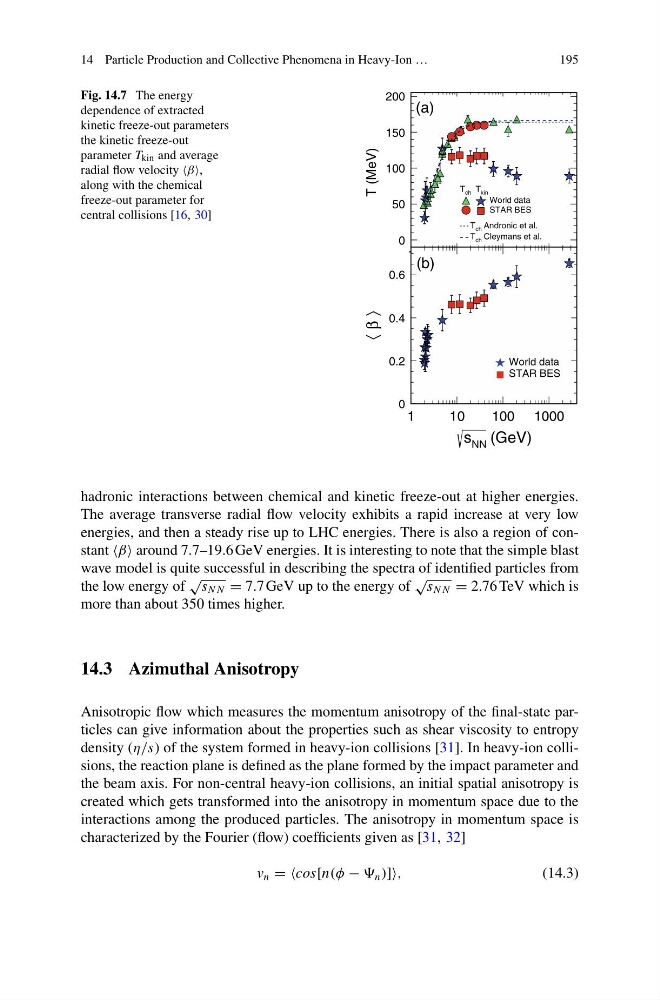
Fig. 14.7 The energy
dependence of extracted
kinetic freeze-out parameters
the kinetic freeze-out
parameter T kin and average
radial flow velocity
along with the chemical
freeze-out parameter for
central collisions [16, 30]
1
10
100
1000
T (MeV)
0
50
100
150
200
World data
STAR BES
Andronic et al.
ch
T
Cleymans et al.
ch
T
kin
T
ch
T
(a)
(GeV)
NN
s
1
10
100 1000
〉
β
〈
0
0.2
0.4
0.6
World data
STAR BES
(b)
hadronic interactions between chemical and kinetic freeze-out at higher energies.
The average transverse radial flow velocity exhibits a rapid increase at very low
energies, and then a steady rise up to LHC energies. There is also a region of constant around 7.7–19.6 GeV energies. It is interesting to note that the simple blast
wave model is quite successful in describing the spectra of identified particles from
the low energy of
√ s N N = 7.7 GeV up to the energy of
√
s N N = 2.76 TeV which is
more than about 350 times higher.
14.3 Azimuthal Anisotropy
Anisotropic flow which measures the momentum anisotropy of the final-state particles can give information about the properties such as shear viscosity to entropy
density (η/s) of the system formed in heavy-ion collisions [31]. In heavy-ion collisions, the reaction plane is defined as the plane formed by the impact parameter and
the beam axis. For non-central heavy-ion collisions, an initial spatial anisotropy is
created which gets transformed into the anisotropy in momentum space due to the
interactions among the produced particles. The anisotropy in momentum space is
characterized by the Fourier (flow) coefficients given as [31, 32]
v n = =cos[n(φ − n )]],
(14.3)
195
Fig. 14.7 The energy
dependence of extracted
kinetic freeze-out parameters
the kinetic freeze-out
parameter T kin and average
radial flow velocity
along with the chemical
freeze-out parameter for
central collisions [16, 30]
1
10
100
1000
T (MeV)
0
50
100
150
200
World data
STAR BES
Andronic et al.
ch
T
Cleymans et al.
ch
T
kin
T
ch
T
(a)
(GeV)
NN
s
1
10
100 1000
〉
β
〈
0
0.2
0.4
0.6
World data
STAR BES
(b)
hadronic interactions between chemical and kinetic freeze-out at higher energies.
The average transverse radial flow velocity exhibits a rapid increase at very low
energies, and then a steady rise up to LHC energies. There is also a region of constant around 7.7–19.6 GeV energies. It is interesting to note that the simple blast
wave model is quite successful in describing the spectra of identified particles from
the low energy of
√ s N N = 7.7 GeV up to the energy of
√
s N N = 2.76 TeV which is
more than about 350 times higher.
14.3 Azimuthal Anisotropy
Anisotropic flow which measures the momentum anisotropy of the final-state particles can give information about the properties such as shear viscosity to entropy
density (η/s) of the system formed in heavy-ion collisions [31]. In heavy-ion collisions, the reaction plane is defined as the plane formed by the impact parameter and
the beam axis. For non-central heavy-ion collisions, an initial spatial anisotropy is
created which gets transformed into the anisotropy in momentum space due to the
interactions among the produced particles. The anisotropy in momentum space is
characterized by the Fourier (flow) coefficients given as [31, 32]
v n = =cos[n(φ − n )]],
(14.3)