

194
L. Kumar
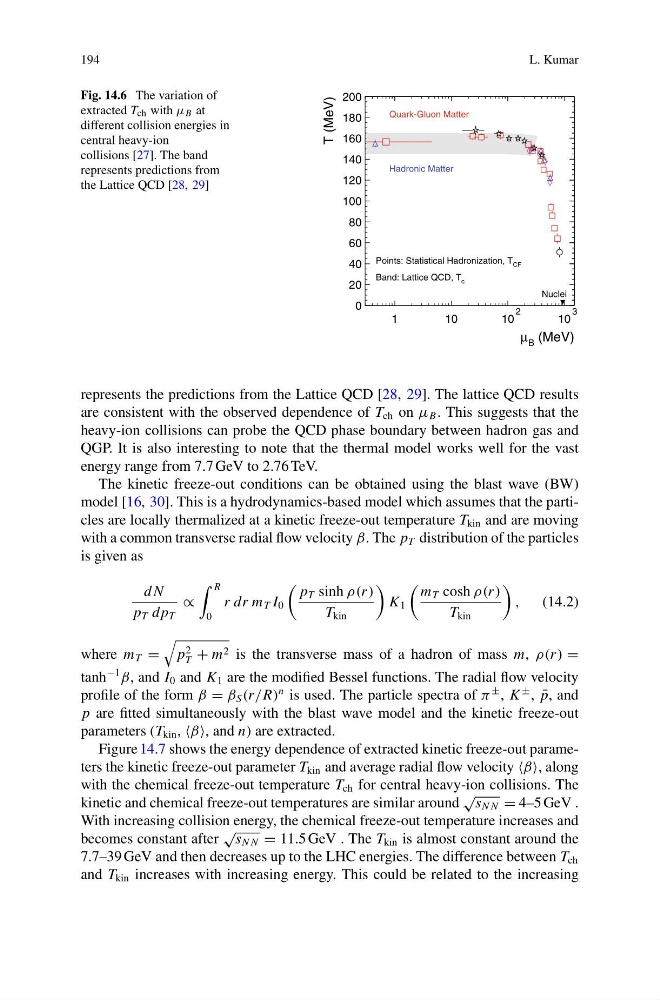
Fig. 14.6 The variation of
extracted T ch with μ B at
different collision energies in
central heavy-ion
collisions [27]. The band
represents predictions from
the Lattice QCD [28, 29]
0
20
40
60
80
100
120
140
160
180
200
1
10
10
2
10
3
μ B (MeV)
T (MeV)
Points: Statistical Hadronization, T CF
Quark-Gluon Matter
Hadronic Matter
Nuclei
Band: Lattice QCD, T c
represents the predictions from the Lattice QCD [28, 29]. The lattice QCD results
are consistent with the observed dependence of T ch on μ B . This suggests that the
heavy-ion collisions can probe the QCD phase boundary between hadron gas and
QGP. It is also interesting to note that the thermal model works well for the vast
energy range from 7.7 GeV to 2.76 TeV.
The kinetic freeze-out conditions can be obtained using the blast wave (BW)
model [16, 30]. This is a hydrodynamics-based model which assumes that the particles are locally thermalized at a kinetic freeze-out temperature T kin and are moving
with a common transverse radial flow velocity β. The p T distribution of the particles
is given as
d N
p T dp T
∝
R
0
r dr m T I 0
p T sinh ρ(r )
T kin
K 1
m T cosh ρ(r )
T kin
, (14.2)
where m T =
p
2
T + m 2 is the transverse mass of a hadron of mass m, ρ(r ) =
tanh
−1
β, and I 0 and K 1 are the modified Bessel functions. The radial flow velocity
profile of the form β = β S (r/R)
n is used. The particle spectra of π
± , K
± , ¯
p, and
p are fitted simultaneously with the blast wave model and the kinetic freeze-out
parameters (T kin , and n) are extracted.
Figure 14.7 shows the energy dependence of extracted kinetic freeze-out parameters the kinetic freeze-out parameter T kin and average radial flow velocity along
with the chemical freeze-out temperature T ch for central heavy-ion collisions. The
kinetic and chemical freeze-out temperatures are similar around
√ s N N = 4–5 GeV .
With increasing collision energy, the chemical freeze-out temperature increases and
becomes constant after
√
s N N = 11.5 GeV . The T kin is almost constant around the
7.7–39 GeV and then decreases up to the LHC energies. The difference between T ch
and T kin increases with increasing energy. This could be related to the increasing
L. Kumar
Fig. 14.6 The variation of
extracted T ch with μ B at
different collision energies in
central heavy-ion
collisions [27]. The band
represents predictions from
the Lattice QCD [28, 29]
0
20
40
60
80
100
120
140
160
180
200
1
10
10
2
10
3
μ B (MeV)
T (MeV)
Points: Statistical Hadronization, T CF
Quark-Gluon Matter
Hadronic Matter
Nuclei
Band: Lattice QCD, T c
represents the predictions from the Lattice QCD [28, 29]. The lattice QCD results
are consistent with the observed dependence of T ch on μ B . This suggests that the
heavy-ion collisions can probe the QCD phase boundary between hadron gas and
QGP. It is also interesting to note that the thermal model works well for the vast
energy range from 7.7 GeV to 2.76 TeV.
The kinetic freeze-out conditions can be obtained using the blast wave (BW)
model [16, 30]. This is a hydrodynamics-based model which assumes that the particles are locally thermalized at a kinetic freeze-out temperature T kin and are moving
with a common transverse radial flow velocity β. The p T distribution of the particles
is given as
d N
p T dp T
∝
R
0
r dr m T I 0
p T sinh ρ(r )
T kin
K 1
m T cosh ρ(r )
T kin
, (14.2)
where m T =
p
2
T + m 2 is the transverse mass of a hadron of mass m, ρ(r ) =
tanh
−1
β, and I 0 and K 1 are the modified Bessel functions. The radial flow velocity
profile of the form β = β S (r/R)
n is used. The particle spectra of π
± , K
± , ¯
p, and
p are fitted simultaneously with the blast wave model and the kinetic freeze-out
parameters (T kin , and n) are extracted.
Figure 14.7 shows the energy dependence of extracted kinetic freeze-out parameters the kinetic freeze-out parameter T kin and average radial flow velocity along
with the chemical freeze-out temperature T ch for central heavy-ion collisions. The
kinetic and chemical freeze-out temperatures are similar around
√ s N N = 4–5 GeV .
With increasing collision energy, the chemical freeze-out temperature increases and
becomes constant after
√
s N N = 11.5 GeV . The T kin is almost constant around the
7.7–39 GeV and then decreases up to the LHC energies. The difference between T ch
and T kin increases with increasing energy. This could be related to the increasing