

14 Particle Production and Collective Phenomena in Heavy-Ion …
193
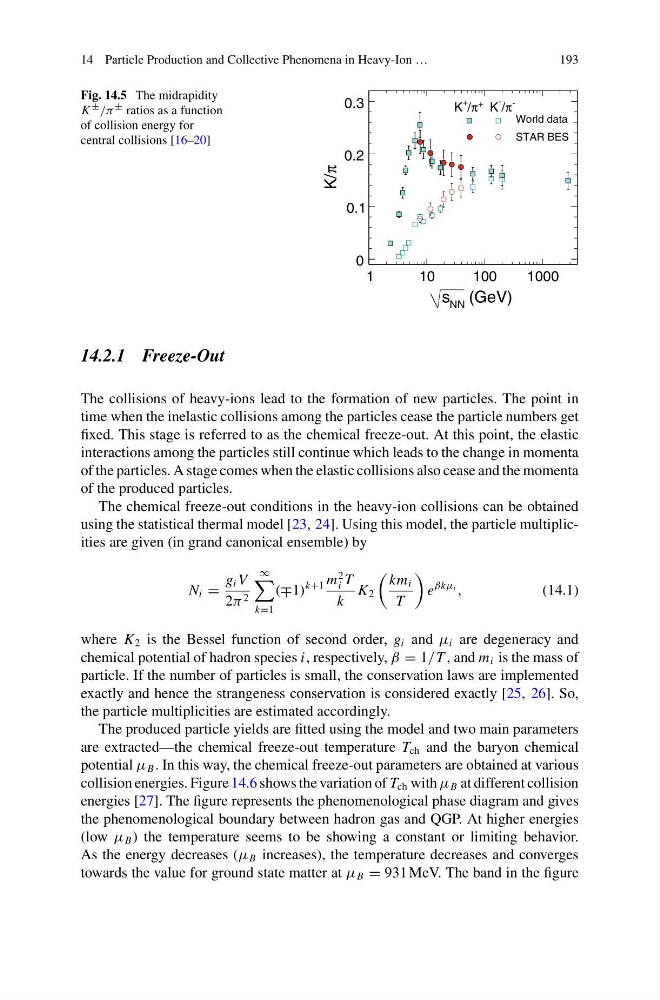
Fig. 14.5 The midrapidity
K ± /π ± ratios as a function
of collision energy for
central collisions [16–20]
(GeV)
NN
s
1
10
100
1000
π
K/
0
0.1
0.2
0.3
-
π
/
-
K
+
π
/
+
K
World data
STAR BES
14.2.1 Freeze-Out
The collisions of heavy-ions lead to the formation of new particles. The point in
time when the inelastic collisions among the particles cease the particle numbers get
fixed. This stage is referred to as the chemical freeze-out. At this point, the elastic
interactions among the particles still continue which leads to the change in momenta
of the particles. A stage comes when the elastic collisions also cease and the momenta
of the produced particles.
The chemical freeze-out conditions in the heavy-ion collisions can be obtained
using the statistical thermal model [23, 24]. Using this model, the particle multiplicities are given (in grand canonical ensemble) by
N i =
g i V
2π 2
∞
k=1
(∓1)
k+1 m
2
i T
k
K 2
km i
T
e
βkμ i ,
(14.1)
where K 2 is the Bessel function of second order, g i and μ i are degeneracy and
chemical potential of hadron species i, respectively, β = 1/T , and m i is the mass of
particle. If the number of particles is small, the conservation laws are implemented
exactly and hence the strangeness conservation is considered exactly [25, 26]. So,
the particle multiplicities are estimated accordingly.
The produced particle yields are fitted using the model and two main parameters
are extracted—the chemical freeze-out temperature T ch and the baryon chemical
potential μ B . In this way, the chemical freeze-out parameters are obtained at various
collision energies. Figure 14.6 shows the variation of T ch with μ B at different collision
energies [27]. The figure represents the phenomenological phase diagram and gives
the phenomenological boundary between hadron gas and QGP. At higher energies
(low μ B ) the temperature seems to be showing a constant or limiting behavior.
As the energy decreases (μ B increases), the temperature decreases and converges
towards the value for ground state matter at μ B = 931 MeV. The band in the figure
193
Fig. 14.5 The midrapidity
K ± /π ± ratios as a function
of collision energy for
central collisions [16–20]
(GeV)
NN
s
1
10
100
1000
π
K/
0
0.1
0.2
0.3
-
π
/
-
K
+
π
/
+
K
World data
STAR BES
14.2.1 Freeze-Out
The collisions of heavy-ions lead to the formation of new particles. The point in
time when the inelastic collisions among the particles cease the particle numbers get
fixed. This stage is referred to as the chemical freeze-out. At this point, the elastic
interactions among the particles still continue which leads to the change in momenta
of the particles. A stage comes when the elastic collisions also cease and the momenta
of the produced particles.
The chemical freeze-out conditions in the heavy-ion collisions can be obtained
using the statistical thermal model [23, 24]. Using this model, the particle multiplicities are given (in grand canonical ensemble) by
N i =
g i V
2π 2
∞
k=1
(∓1)
k+1 m
2
i T
k
K 2
km i
T
e
βkμ i ,
(14.1)
where K 2 is the Bessel function of second order, g i and μ i are degeneracy and
chemical potential of hadron species i, respectively, β = 1/T , and m i is the mass of
particle. If the number of particles is small, the conservation laws are implemented
exactly and hence the strangeness conservation is considered exactly [25, 26]. So,
the particle multiplicities are estimated accordingly.
The produced particle yields are fitted using the model and two main parameters
are extracted—the chemical freeze-out temperature T ch and the baryon chemical
potential μ B . In this way, the chemical freeze-out parameters are obtained at various
collision energies. Figure 14.6 shows the variation of T ch with μ B at different collision
energies [27]. The figure represents the phenomenological phase diagram and gives
the phenomenological boundary between hadron gas and QGP. At higher energies
(low μ B ) the temperature seems to be showing a constant or limiting behavior.
As the energy decreases (μ B increases), the temperature decreases and converges
towards the value for ground state matter at μ B = 931 MeV. The band in the figure