

192
L. Kumar
1
10
100 1000
Particle Ratio
0
0.2
0.4
0.6
0.8
1
1.2
1.4
1.6
World data
STAR BES
+
π
-
π
Ratio:
(a)
(GeV)
NN
s
1
10
100
1000
0
0.2
0.4
0.6
0.8
1
1.2
+
K
-
K
Ratio:
(b)
5 10 20
100 200
-3
10
-2
10
-1
10
1
p
p
Ratio:
(c)
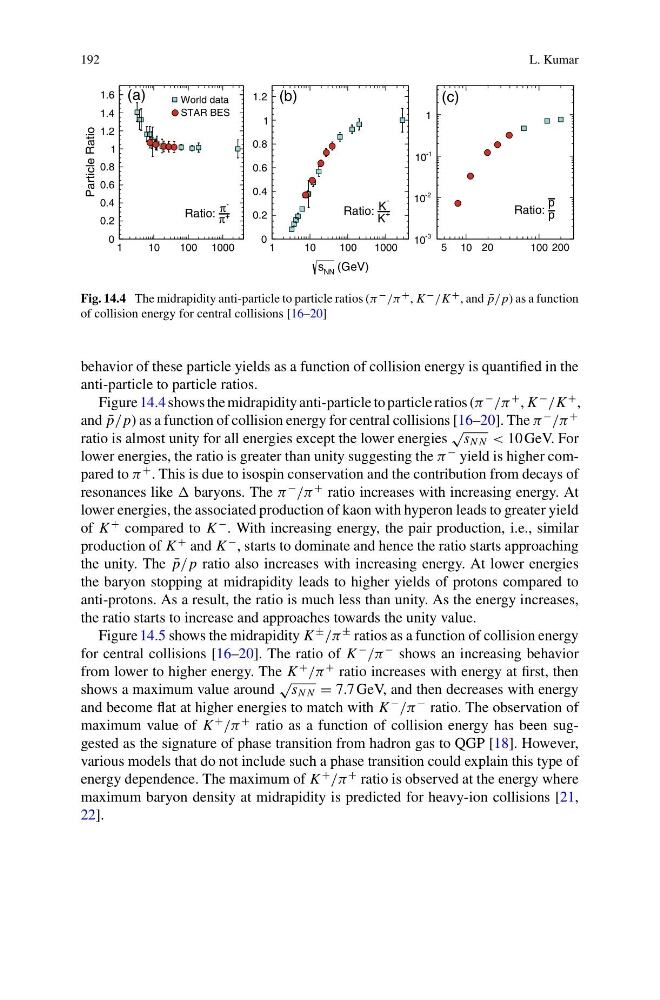
Fig. 14.4 The midrapidity anti-particle to particle ratios (π − /π + , K − /K + , and ¯
p/ p) as a function
of collision energy for central collisions [16–20]
behavior of these particle yields as a function of collision energy is quantified in the
anti-particle to particle ratios.
Figure 14.4 shows the midrapidity anti-particle to particle ratios (π
−
/π
+ , K
−
/K
+ ,
and ¯
p/ p) as a function of collision energy for central collisions [16–20]. The π
−
/π
+
ratio is almost unity for all energies except the lower energies
√
s N N < 10 GeV. For
lower energies, the ratio is greater than unity suggesting the π
− yield is higher compared to π
+ . This is due to isospin conservation and the contribution from decays of
resonances like baryons. The π
−
/π
+ ratio increases with increasing energy. At
lower energies, the associated production of kaon with hyperon leads to greater yield
of K
+ compared to K
− . With increasing energy, the pair production, i.e., similar
production of K
+ and K
− , starts to dominate and hence the ratio starts approaching
the unity. The ¯
p/ p ratio also increases with increasing energy. At lower energies
the baryon stopping at midrapidity leads to higher yields of protons compared to
anti-protons. As a result, the ratio is much less than unity. As the energy increases,
the ratio starts to increase and approaches towards the unity value.
Figure 14.5 shows the midrapidity K
±
/π
± ratios as a function of collision energy
for central collisions [16–20]. The ratio of K
−
/π
− shows an increasing behavior
from lower to higher energy. The K
+
/π
+ ratio increases with energy at first, then
shows a maximum value around
√ s N N = 7.7 GeV, and then decreases with energy
and become flat at higher energies to match with K
−
/π
− ratio. The observation of
maximum value of K
+
/π
+ ratio as a function of collision energy has been suggested as the signature of phase transition from hadron gas to QGP [18]. However,
various models that do not include such a phase transition could explain this type of
energy dependence. The maximum of K
+
/π
+ ratio is observed at the energy where
maximum baryon density at midrapidity is predicted for heavy-ion collisions [21,
22].
L. Kumar
1
10
100 1000
Particle Ratio
0
0.2
0.4
0.6
0.8
1
1.2
1.4
1.6
World data
STAR BES
+
π
-
π
Ratio:
(a)
(GeV)
NN
s
1
10
100
1000
0
0.2
0.4
0.6
0.8
1
1.2
+
K
-
K
Ratio:
(b)
5 10 20
100 200
-3
10
-2
10
-1
10
1
p
p
Ratio:
(c)
Fig. 14.4 The midrapidity anti-particle to particle ratios (π − /π + , K − /K + , and ¯
p/ p) as a function
of collision energy for central collisions [16–20]
behavior of these particle yields as a function of collision energy is quantified in the
anti-particle to particle ratios.
Figure 14.4 shows the midrapidity anti-particle to particle ratios (π
−
/π
+ , K
−
/K
+ ,
and ¯
p/ p) as a function of collision energy for central collisions [16–20]. The π
−
/π
+
ratio is almost unity for all energies except the lower energies
√
s N N < 10 GeV. For
lower energies, the ratio is greater than unity suggesting the π
− yield is higher compared to π
+ . This is due to isospin conservation and the contribution from decays of
resonances like baryons. The π
−
/π
+ ratio increases with increasing energy. At
lower energies, the associated production of kaon with hyperon leads to greater yield
of K
+ compared to K
− . With increasing energy, the pair production, i.e., similar
production of K
+ and K
− , starts to dominate and hence the ratio starts approaching
the unity. The ¯
p/ p ratio also increases with increasing energy. At lower energies
the baryon stopping at midrapidity leads to higher yields of protons compared to
anti-protons. As a result, the ratio is much less than unity. As the energy increases,
the ratio starts to increase and approaches towards the unity value.
Figure 14.5 shows the midrapidity K
±
/π
± ratios as a function of collision energy
for central collisions [16–20]. The ratio of K
−
/π
− shows an increasing behavior
from lower to higher energy. The K
+
/π
+ ratio increases with energy at first, then
shows a maximum value around
√ s N N = 7.7 GeV, and then decreases with energy
and become flat at higher energies to match with K
−
/π
− ratio. The observation of
maximum value of K
+
/π
+ ratio as a function of collision energy has been suggested as the signature of phase transition from hadron gas to QGP [18]. However,
various models that do not include such a phase transition could explain this type of
energy dependence. The maximum of K
+
/π
+ ratio is observed at the energy where
maximum baryon density at midrapidity is predicted for heavy-ion collisions [21,
22].