

14 Particle Production and Collective Phenomena in Heavy-Ion …
191
0
0.5
1
1.5
2
-4
10
-3
10
-2
10
-1
10
1
10
2
10
Au+Au 7.7 GeV +
π
(a)
0
0.5
1
1.5
2
-4
10
-3
10
-2
10
-1
10
1
10
0-5%
5-10% / 2
10-20% / 4
20-30% / 6
+
K
(c)
-4
10
-3
10
-2
10
-1
10
1
10
p
30-40% / 8
40-50% / 10
50-60% / 12
60-70% / 14
70-80% / 16
(e)
0
0.5
1
1.5
2
-4
10
-3
10
-2
10
-1
10
1
10
2
10
-
π
(b)
(GeV/c)
T
p
0
0 . 5
1
1 . 5
2
-4
10
-3
10
-2
10
-1
10
1
10
-
K
(d)
0
0 . 5
1
1 . 5
2
-4
10
-3
10
-2
10
-1
10
p
(f)
]
-2
[(GeV/c)
dy
T
dp
T
p
N
2
d
π
2
1
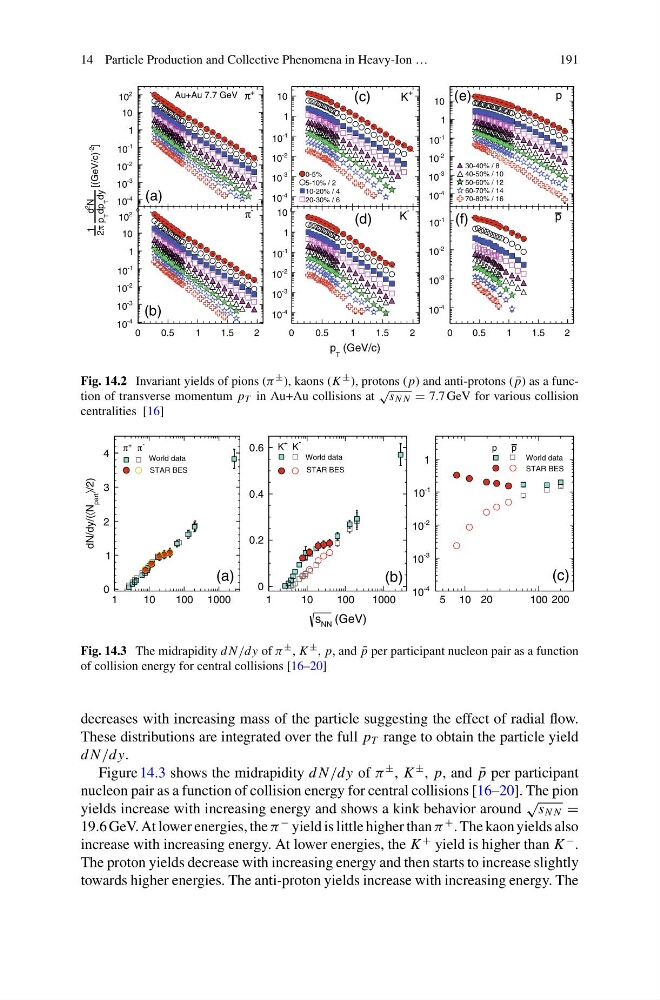
Fig. 14.2 Invariant yields of pions (π ± ), kaons (K ± ), protons ( p) and anti-protons ( ¯
p) as a function of transverse momentum p T in Au+Au collisions at
√
s N N = 7.7 GeV for various collision
centralities [16]
1
10
100 1000
/2)
〉
part
N
〈
dN/dy/(
0
1
2
3
4
World data
STAR BES
-
π
+
π
(a)
(GeV)
NN
s
1
10
100
1000
0
0.2
0.4
0.6
World data
STAR BES
-
K
+
K
(b)
5 10 20
100 200
-4
10
-3
10
-2
10
-1
10
1
World data
STAR BES
p
p
(c)
Fig. 14.3 The midrapidity d N/dy of π ± , K ± , p, and ¯
p per participant nucleon pair as a function
of collision energy for central collisions [16–20]
decreases with increasing mass of the particle suggesting the effect of radial flow.
These distributions are integrated over the full p T range to obtain the particle yield
d N/dy.
Figure 14.3 shows the midrapidity d N/dy of π
± , K
± , p, and ¯
p per participant
nucleon pair as a function of collision energy for central collisions [16–20]. The pion
yields increase with increasing energy and shows a kink behavior around
√
s N N =
19.6 GeV. At lower energies, the π
− yield is little higher than π
+ . The kaon yields also
increase with increasing energy. At lower energies, the K
+ yield is higher than K
− .
The proton yields decrease with increasing energy and then starts to increase slightly
towards higher energies. The anti-proton yields increase with increasing energy. The
191
0
0.5
1
1.5
2
-4
10
-3
10
-2
10
-1
10
1
10
2
10
Au+Au 7.7 GeV +
π
(a)
0
0.5
1
1.5
2
-4
10
-3
10
-2
10
-1
10
1
10
0-5%
5-10% / 2
10-20% / 4
20-30% / 6
+
K
(c)
-4
10
-3
10
-2
10
-1
10
1
10
p
30-40% / 8
40-50% / 10
50-60% / 12
60-70% / 14
70-80% / 16
(e)
0
0.5
1
1.5
2
-4
10
-3
10
-2
10
-1
10
1
10
2
10
-
π
(b)
(GeV/c)
T
p
0
0 . 5
1
1 . 5
2
-4
10
-3
10
-2
10
-1
10
1
10
-
K
(d)
0
0 . 5
1
1 . 5
2
-4
10
-3
10
-2
10
-1
10
p
(f)
]
-2
[(GeV/c)
dy
T
dp
T
p
N
2
d
π
2
1
Fig. 14.2 Invariant yields of pions (π ± ), kaons (K ± ), protons ( p) and anti-protons ( ¯
p) as a function of transverse momentum p T in Au+Au collisions at
√
s N N = 7.7 GeV for various collision
centralities [16]
1
10
100 1000
/2)
〉
part
N
〈
dN/dy/(
0
1
2
3
4
World data
STAR BES
-
π
+
π
(a)
(GeV)
NN
s
1
10
100
1000
0
0.2
0.4
0.6
World data
STAR BES
-
K
+
K
(b)
5 10 20
100 200
-4
10
-3
10
-2
10
-1
10
1
World data
STAR BES
p
p
(c)
Fig. 14.3 The midrapidity d N/dy of π ± , K ± , p, and ¯
p per participant nucleon pair as a function
of collision energy for central collisions [16–20]
decreases with increasing mass of the particle suggesting the effect of radial flow.
These distributions are integrated over the full p T range to obtain the particle yield
d N/dy.
Figure 14.3 shows the midrapidity d N/dy of π
± , K
± , p, and ¯
p per participant
nucleon pair as a function of collision energy for central collisions [16–20]. The pion
yields increase with increasing energy and shows a kink behavior around
√
s N N =
19.6 GeV. At lower energies, the π
− yield is little higher than π
+ . The kaon yields also
increase with increasing energy. At lower energies, the K
+ yield is higher than K
− .
The proton yields decrease with increasing energy and then starts to increase slightly
towards higher energies. The anti-proton yields increase with increasing energy. The